Poster

A poster is a large piece of printed paper that has a picture of something. Posters are made to be shown on a wall or other flat surface. Posters may be used for advertising, education, propaganda, and decoration.[1][2] They may also be copies of famous works of art.
Contents
Chromolithography and the poster[change | change source]
Chromolithography (colour lithography) was invented by Engelmann and son, who were granted a patent in 1837.[3] After that, it was a matter of time before it reached full commercial development.
Because of its low production costs, over the 50 years after the American Civil War, millions of chromolithographs were printed and were sold for under $10. Louis Prang, a Bostonian, produced fine-art subjects, such as still lifes, landscapes, and classical subjects.[4] Nevertheless, it was only after the Jules Chéret posters, in 1847, that the potential of this technical process for creation of artistic posters was realized.[5]
Examples[change | change source]
Jules Chéret[change | change source]
-

Chéret's posters elevated advertisement to an art form. In 1858 he printed his first color poster in France. He ultimately became known as "the father of modern lithography", as well as the "Father of the Poster". Chéret used design as the dominant features while reducing text to a minor role.[6]
-

Chéret's style gradually evolved from the complex Victorian decorative graphics into a simpler compositional design in which large central figures were prominent in the motif with simplified backgrounds, and large surfaces of vivid colour. Hand-lettered titles were used in harmony with the design.[7]
-
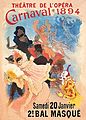
His large posters displayed free-spirited women which earned him the title of "father of the women's liberation". The women of Chéret's posters, playful, elegant and lively were very different from previously depicted prostitutes or puritans.
-

Alfred Choubrac minimized the role of the text in a poster. In this poster all of the relevant information is summarized in one short sentence.
.jpg)


19th century posters in the US[change | change source]
Louis John Rhead[change | change source]
-

Louis John Rhead was from a family of English artists. He was sent to Paris at the age of thirteen to study under Boulanger, and returned to England several years later. Rhead continued his studies under Edward Pointer and Alphonse Legros. By the time he arrived in America in 1888, he was one of the leaders in the Art Nouveau movement. He created posters for Scribner's and Century magazines.[8]
-

In the 1890s Rhead designed nearly one hundred posters. In England and the U.S. he did posters for magazines: Cassell's Magazine, the Weekly Dispatch, The Century, St. Nicholas, Harper's, The Bookman and Scribners'. He produced large posters for the New York Sun and the New York Journal, and commercial posters for products such as Lundborg perfumes, Pearline washing powders, and Packer's soap.[9]
-

In 1895 he won a Gold Medal for Best American Poster Design at the first International Poster Show in Boston. By the late 1890s, the popularity of poster art declined and Rhead turned his skills to book illustration.[10] Between 1902 and his death in 1926, Rhead illustrated numerous children books published by Harpers and others.
-

Rhead is noted as a great graphic designer. Many consider his use of colors startling, and his compositions sophisticated. He created art work that in his time looked modern and vanguard.


Edward Penfield[change | change source]
-

Edward Penfield, has been called the “originator of the poster in America. He was born 2 June 1866 in Brooklyn, New York. Edward enrolled at the Art Students' League in New York City. He also studied painting under the impressionist George de Forest Brush around 1890. He is mostly known for his advertising ‘placards’ for Harper's New Monthly Magazine.
-

Penfield’s first published work appeared in Harper's Weekly in 1891. In his early works, Penfield executed ink and watercolor wash illustrations in a similar style to the older generation of graphic artists, such as W.T. Smedley, W.A. Rogers, Thor de Thulstrep, Rufus Zogbaum and E.A. Abbey.[11]
-

His trademark linework and use of broad tonal areas developed after his return from Europe. His well-thought design was as important as his illustration. There were a number of influences, including Japanese prints, the Arts and Crafts movement, the impressionistic approach of Parisian poster-making, and British poise and directness.[12]
-

The graphic art of Penfield demonstrates a keen sense of design and composition. His work was described by Publisher's Weekly: "The advertising poster has within recent years actually soared into the regions of art". Penfield is also credited with bringing abstraction to commercial art through his boldly simplified shapes.[13]


.jpg)
Toulouse-Lautrec and Post-impressionism[change | change source]
-

Henri Raymond de Toulouse-Lautrec (1864-1901) was born as the son of an aristocratic family in the South of France. He got painting and drawing lessons from Rene Princeteau. He went to Paris in 1882 to study painting, where he met Émile Bernard and Vincent van Gogh. He became attracted to the post-impressionist style and joined the movement. Lautrec became a part of the bohemian community of Montmartre with its nightlife of cabarets, cafes, restaurants, sleazy dance halls and brothels. 1892/3.[14]
-

Toulouse Lautrec, was deeply influenced by Japanese woodblock printing. From the 1850s onwards, Japanese art work flowed into the west and attracted the attention of both artists and collectors. The term "japonisme" was coined in 1872 by Philippe Burty, a French art critic. Lautrec lived during the height of what have been called "the banquet years" of Paris. Although his handicap and his alcohol abuse kept him from enjoying some of life's pleasures, it was the nightlife of Montmartre which inspired his work. 1892.[15]
-

The elegant and joyful women of Chéret were replaced in Lautrec by prostitutes, madams and denizens of the demi-monde (twilight zone) who accepted him as a fellow outcast. They let him to wander about, sketching and painting freely. He grew close to his models, brought them presents, and took them to his studio, restaurants, circuses, or theatres during their time off. He neither vilified nor glamorized these women, but presented an objective, almost documentary view of the everyday life they shared with him; 1892.[16]
-

Lautrec wove the text into the graphics, but here there is almost no text. Still, this poster probably has all the necessary information. People would know who Cadieux was, and where the theatre was. Shows a terrific sense of movement. 1893.[17]

_1892.jpg)
_1892.jpg)
_1893.jpg)
Art nouveau posters and the impact of graphics on painting[change | change source]
-

The English graphic artist Aubrey Beardsley mostly did illustrations for periodicals. Clearly art nouveau, based on elegant and flowing lines; and splendid elongated figures. Beardsley specialised in suggesting vice and moral corruption, where Lautrec simply showed people.[18]
-

Alphonse Mucha was another influential Art Nouveau designer. The subjects of his posters are often beautiful, with joyous young women, flowing lines and decorative flowers. He used an innovative soft pastel coloring scheme in his posters.[19]
-

Henri Privat-Livement's typical use of organic forms in this poster for a seaside casino.
-
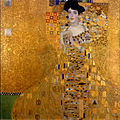
The works of Gustav Klimt an Austrian painter is a clear example of the influence of graphic design on painting.[20] This portrait of Adele Bloch-Bauer exhibits many of the influences of graphic design.[21]


Posters in the first half of the 20th century[change | change source]
Posters were used for war propaganda, to encourage young people to enlist in the army, and to sell government war bonds. From a strictly artistic view the posters were unimaginative and far from the masterpieces of the late 19th century posters. The posters almost all came with a caption to bang the message home.
-

This is virtually a copy of the famous British poster featuring Lord Kitchener 'Your country needs YOU!' (1914).
-

No sign of art nouveau here; simplicity itself in a British poster designed for use in the USA. 1917.[22]
-
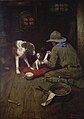
Among the propaganda war posters, this stands out, with its distinct blend of sympathy and help. Norman Rockwell, 1918.[23][24]
-
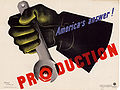
The French graphic artist Jean Carlu, who was influenced by cubism, had style. This 1942 war poster is tinged with Art Deco and streamlining.[25]


References[change | change source]
- ↑ Hillier, Bevis 1969. Posters. London: Weidenfeld & Nicolson.
- ↑ Barnicoat, John 1979. Posters: a concise history. London: Thames & Hudson. ISBN 0-500-20118-8
- ↑ Twyman, Michael 1970. Lithography 1800–1850. Oxford University Press. p160
- ↑ Gallo, Max, The poster in History, (2002) W.W.
- ↑ Thornton R.S. 1989. Japanese posters: the first 100 years. Design Issues, 6, #1, Design in Asia and Australia. 4-14
- ↑ David Raizman 2003. History of modern design: graphics and products since the Industrial Revolution. Laurence King. ISBN 9781856693486
- ↑ Bradford R. Collins, 1985. The poster as art: Jules Cheret and the struggle for the equality of the arts in late nineteenth-century France. MIT Press.
- ↑ Stanley Appelbaum 1990. The Complete «Masters of the Poster»: all 256 color plates from «les Maîtres de L'affiche». Courier Dover ISBN 9780486263090
- ↑ Smithsonian Institution
- ↑ "Louis Rhead Obituary", New York Times (July 30, 1926)
- ↑ Wilczak, Susan A. The posters of Edward Penfield for Harper's New Monthly Magazine: a reflection of American society in the 1890s [Thesis]. Ann Arbor, MI: Department of Art, Michigan State University, 1996.
- ↑ Bauwens, Maurice; Hayashi, T.; La Forgue, Jules; Meier-Graefe, J.; Pennell, Joseph; and Boudét, G., editors. Les affiches étrangères illustrées. Paris: G. Boudet, 1897.
- ↑ Exman, Eugene. The House of Harper: One hundred and fifty years of publishing. New York: Harper and Row, 1967.Johnson, Diane Chalmers. American art nouveau. New York: Harry N. Abrams, 1979. Jones, Sydney R. Posters and their designers. London: The Studio, Ltd, 1924. Keay, Carolyn. American posters of the turn of the century. New York: St Martin's, 1975. Les maitres de l'affiche. 5 vols. Paris: Imprimerie Chaix, 1896, 1897, 1898, 1899, 1900. King, Julia. The flowering of Art Nouveau graphics. Salt Lake City, UT: Peregrine Smith Books, 1990. Maginnis, Charles. D. Pen drawing: an illustrated treatise, 1899. Malhotra, Ruth; Spielmann, Heinz; and Thon, Christina. Das frühe plakat in Europa und den USA: ein bestandskatalog. Band 1, Großbritannien vereinigte von Nordamerika. Berlin: Gebr. Mann Verlag, 1973. 43-173.
- ↑ ACKROYD, Christopher. Toulouse-Lautrec. Chartwell Books, 1989. The History and techniques of the great masters. DESLOGE, Nora. Toulouse-Lautrec: the Baldwin M. Baldwin Collection, San Diego Museum of Art. San Diego Museum of Art, 1988. D'ESPARBES, Georges et al. Les Demi-cabots, le café concert, le cirque, les forains. Paris, 1896. FEINBLATT, Ebria & Bruce Davis. Toulouse-Lautrec and his contemporaries: posters of the belle époque from the Wagner Collection. Los Angeles County Museum of Art, 1985. GAUZI, Françoise. Lautrec et son temps. Paris, 1954. ZELDIN, Theodore. France 1848-1945. Oxford and New York, 1977. Oxford history of modern Europe.
- ↑ SAN DIEGO MUSEUM OF ART. The Baldwin M. Baldwin Collection of Toulouse-Lautrec. San Diego, 1972. SAN DIEGO MUSEUM OF ART. The Baldwin M. Baldwin Foundation Collection: graphics and other works by Henri de Toulouse-Lautrec. San Diego, 1980. SCHIMMEL, Herbert D. & Phillip Dennis Cate. The Henri de Toulouse-Lautrec and W.H.B. Sands correspondence. New York, 1983. STUCKEY, Charles F. Toulouse-Lautrec paintings. Art Institute of Chicago, 1979. SUGANA, G.M. The complete paintings of Toulouse-Lautrec. New York, 1969.
- ↑ ADHEMAR, Jean. Toulouse-Lautrec: his complete lithographs and drypoints. New York, 1965. ADRIANI, Götz. Toulouse-Lautrec. London, 1987. Trans. Sebastian Wormell; first published Cologne, 1986. ADRIANI, Götz. Toulouse-Lautrec: the complete graphic works; a catalogue raisonné, the Gerstenberg collection. Royal Academy of Arts, London, 1988. CASTLEMAN, Riva & Wolfgang Wittrock. Henri de Toulouse-Lautrec, images of the 1890s. Museum of Modern Art, New York, 1985. CATE, Phillip Dennis & Patricia Eckert Boyer. The Circle of Toulouse-Lautrec. The Jane Voorhees Zimmerli Art Museum, Rutgers, 1985. COOPER, Douglas. Henri de Toulouse-Lautrec. New York, 1966. DELTEIL, Loys. Le Peintre-graveur illustré; vols. IX, X. Paris, 1920. DORTU, M.G. Toulouse-Lautrec et son oeuvre; six vols. New York, 1971.
- ↑ JOYANT, Maurice. Henri de Toulouse-Lautrec; two vols. Paris, 1926-7. MONTORGUEIL, Georges. Preface to Le Café-concert. 1893. WEISBERG, Gabriel P. et al. Japonisme: the Japanese influence on French art, 1854-1910. Cleveland Museum of Art, 1975. WITTROCK, Wolfgang. Toulouse-Lautrec, the complete prints. London, 1985. Two vols.
- ↑ Calloway, Stephen. 1998. Aubrey Beardsley. New York, N.Y.: Harry N. Abrams. ISBN 0810940094.
- ↑ Anna Dvorak. “Illustrations for Books and Periodicals.” in Alphonse Mucha: the complete graphic works. Anne Bridges (ed). NY: Harmony, 1980.
- ↑ see :GUSTAV KLIMT: Art Nouveau Visionary, By Eva di Stefano, Sterling, 2008, ISBN 9781402759208
- ↑ Gustav Klimt: 1862-1918, by Gilles Neret, Taschen (August 1, 1999), ISBN 978-3822859803
- ↑ Harper P. War, Revolution and Peace, propaganda posters from the Hoover Institution Archives 1914-1945 [Stanford Art Department, Stanford Museum] [1969], Marshall Cavendish Collection, 'Selling the War' in Images of War No.64 (Marshall Cavendish, London) 1996. [1]. Archived 2009-10-31.
- ↑ Norman Rockwell is considered the "quintessential middlebrow American artist".Kelly, Michael (1992-07-12). "The Candidates as Culture Vultures". The New York Times. The New York Times Company. Retrieved 2008-04-08.
- ↑ Some critics view his sentimental and nostalgic vision out of step with the harsh realities of American life, such as The Great Depression.Wright, Tricia (2007). "The Depression and World War II". American Art and Artists. HarperCollins Publishers. pp. 122–123. ISBN 978-0-06-089124-4.
- ↑ Art Deco Graphics, by Patricia Kery,Thames and Hudson; New edition (May 2, 2002), 0500283532, 978-0500283530. The birth of the modern poster, Mark Henshaw, the National Gallery of Australia, [2]

