Economy Base Level
from Peter Radford
We are, no doubt, about to be barraged by a torrent of alternative facts concerning the economy and economic growth under our new leader. So let’s get a few facts on the table in order to set a base level for future reference. Let’s start with growth during the past six presidencies:

So, no, Obama was not the disaster Trump and the Republicans are trying to paint him as. The economy during Obama’s term outperformed that of his predecessor. This includes the enormous difficulty of digging out of the Great Recession without much help from Congress. Average growth through all that last six presidencies is around 2.8% a year, so boosting it to, and then maintaining it at, the 4.0% promised by Trump will take some extraordinary efforts, not to mention a defiance of history and is thus unlikely to occur. Read more…
Beyond Trump and free trade
from David Ruccio
Now that President Trump has begun carrying out his campaign pledges to undo America’s trade ties, formally withdrawing the United States from the Trans-Pacific Partnership and announcing he will start to renegotiate the North American Free Trade Agreement, it’s time to analyze what this means.
As it turns out, I’d already started to do this before the election, with a series of posts (e.g., here, here, here, and here) on Trump and the mounting criticism of the trade agreements the United States had signed (such as NAFTA) or was in the process of negotiating (the TPP).
It’s clear Trump’s decisions—which he claims are a “Great thing for the American worker”—challenge the view of economic and political elites, as well as those of mainstream economists (such as Brad DeLong), in the United States and around the world that everyone benefits from free trade.*
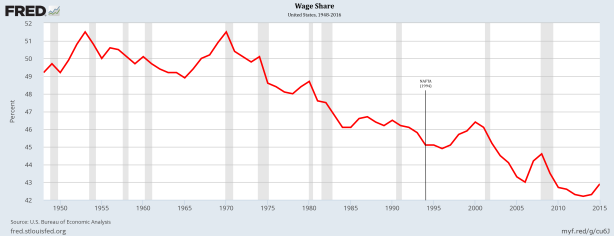
But, we now know, there has also been a growing counter-narrative, that not everyone has gained from growing international trade and trade agreements, which have generated unequal benefits and costs. What’s interesting about this alternative story, at least when it comes to NAFTA, is that critics on each side argue the other side is the one that has benefited: U.S. critics that Mexico has gained, and just the opposite in Mexico, that the United States has captured the lion’s share of the benefits from NAFTA.
Here’s the problem: workers on both sides of the border have lost out, and their losses are mostly not due to NAFTA. Read more…
The Trump cabinet: strangest show on Earth
from Dean Baker
As we start the Trump presidency, events just keep getting more bizarre. At his first and last press conference as president-elect, Donald Trump boasted about his divestment plan in which he was “sort of, kind of” turning over the management of his business enterprises to his two adult sons. He displayed a table full of documents that were supposed to indicate the extent of his divestment, but the documents were not made available for the press to examine.
Furthermore, in spite of claiming that he was stepping away from his business enterprises, Trump was still boasting being offered a $2 billion deal from a Dubai businessman. While Trump assured us that he turned the deal down, the obvious question is why he was discussing it in the first place.
Insofar as Trump is actually stepping away from his business, this is very far from the sort of blind trust arrangements made by presidents of both parties for the last half century. The public can never be sure that his actions as president are not motivated by a desire to fatten the profits of Trump enterprises. Nor can we be assured that actions by foreign governments won’t be affected by their country’s dealings with the president’s business empire.
The ethical lapses from the top carry through to his cabinet appointments, which seem destined to replace Ringling Bros. Circus as the strangest show on Earth. Andy Puzder, Trump’s pick for secretary of labor, runs two chains of fast-food restaurants that have repeatedly violated wage and hour laws and has been legally forced to make payments to workers. These are the laws that Mr. Puzder will be responsible for enforcing if he gets approved for the job.
Read more…
The Fed and the Crisis on the Eurozone
Yes, he said it. One of the gems found by Erwan Mahé in the minutes of the FOMC meetings. Ben Bernanke: “Here we potentially have a comparison to Keynes’ The Economic Consequences of the Peace and the Versailles treaty, where he pointed out that forcing Germany into extreme austerity, although it might satisfy certain moral, ethical, or political urges, had macroeconomic consequences that might force Germany eventually to rebel. By the same token, if there’s not growth for the South, eventually they’re going to decide that default and leaving the euro are better options than what they have.”
From: Erwan Mahé 27 January 2017
Good morning! I would like to take this opportunity to wish everyone best wishes for 2017. Let us hope it will be less complicated than the one that just ended.
Unfortunately, I fear that we will remain at the mercy of political events for some time to come. I have come to fear like the plague alternative facts analysis of politics relating to financial markets, with the real economy seemingly more and more directive than before, at least for the time being. But I also use this time of the year to plunge into the reading of the full, declassified minutes of FOMC meetings of the last five years, this time, from 2011. Read more…
Why Minsky matters
from Lars Syll
In an often cynical world, standard financial and macroeconomic quantitative models give people the benefi t of the doubt. Fundamental economic theory assumes the best of us, supposing that human beings are perfectly rational, know all the facts of a given situation, understand the risks, and optimize our behavior and portfolios accordingly. Reality, of course, is quite different. While a significant portion of individual and market behavior can be modeled reasonably well, the human emotions that drive cycles of fear and greed are not predictable and can often defy historical precedent. As a result, quantitative models sometimes fail to anticipate major macroeconomic turning points. The ongoing debt crisis in Europe is the most recent example of an extreme event shattering historical norms.
Once an extreme event occurs, standard models offer limited insight as to how the ensuing crisis could play out and how it should be managed, which is why policy responses can seem disjointed. The latest policy responses to the European crisis have been no exception. To understand and respond to a crisis like the one in Europe, perhaps we need to consider some new models that include the “human factor.” Economic historian Charles Kindleberger can offer some insight. In his book Manias, Panics, and Crashes, Kindleberger explores the anatomy of a typical financial crisis and provides a framework that considers the impact of the powerful human dynamics of fear and greed. Kindleberger’s descriptive process of the boom and bust liquidity cycle can help shed light on the current European sovereign debt saga, and perhaps illuminate whether we have in fact turned the corner on this financial crisis.

A $500 bn pot of gold: How Boston Consulting and Google pushed Modi to end the era of cash
from Norbert Häring
Boston Consulting Group (BCG), the omnipresent US-consulting company, and Google, the global data miner, issued a joint report in July 2016 on the “$500 bn Pot of Gold”, which is the Indian digital payment market. Even though the authors deny it, the report gives much reason to suspect that the authors knew that something radical was imminent from the Indian government. The report is remarkably honest about the aims of the whole exercise.
There is no statement in the BCG-Google-report “Digital Payments 2020” to the effect that it is related to the joint initiative of USAID and the Indian ministry of finance, formally established in 2015, to push back the use of cash and promote digital payments. Rather it is presented as a freestanding initiative of BCG and Google. I reached out to one of the authors, BCG’s senior partner Alpesh Shah, to ask about this and he insisted: “This was a joint BCG-Google report, with no connection / relation to USAID/Indian Ministry of Finance.” However, there is much to suggest that there was a connection. First of all, the subject so perfectly fits with the program of that partnership. The subtitle of the report is “The Making of a $500 bn ecosystem in India”. The steering committee for the report included a representative of Visa, member of the Better Than Cash Alliance together with USAID and affiliate of the partnership of USAID and Indian finance ministry to advance digital payments. It also included PayTM and Vodafone, which are also part of the CATALYST coalition, a project, which according to USAID, is a “next step” in said partnership of USAID and the Indian finance ministry.
The report is a call to arms for all payment service providers. They are alerted that things are going to be shaken up in India. On page three it says: Read more…
Economism—or vulgar economics
from David Ruccio

In discussing the textbook treatment of the minimum wage, James Kwak provides a perfect example of how contemporary mainstream economics “can be more misleading than it is helpful.”
Kwak refers to the problem as “economism.”* For me, borrowing from a different tradition, it is a case of “vulgar economics.” Read more…
The Beginning
from Peter Radford
Already the Trump regime is taking shape. Or, rather, I ought say the agenda is taking shape since the cabinet that is supposed to be overseeing things is well behind schedule in arriving on station.
First things first.
Trump raised to cost of applying for a mortgage for low income people. He undid a recent reduction in the fees charged by the FHA. That reduction had been put in place because the FHA has a large surplus and wanted to pass along that prosperity to homeowners. Apparently Trump thinks that FHA mortgages should be more expensive. This is an attack on low income voters that is pure Republican thinking and not at all populist. Republicans hate the FHA. They always have. They don’t believe in any help for low income people other than charity.
Next: Trump signed an order calling for the abolition of Obamacare. This is meaningless since undoing Obamacare will take a long time. What the order could do, however, is to throw the insurance market into a bit of a mess and thus drive up premiums for everyone as insurance companies scramble to figure out how to ditch 20 million customers.
Third: Trump begins his attack on free trade by getting the US out of the Trans Pacific Partnership [TPP] and calling for the renegotiation of NAFTA. He also has made dark comments about imposing tariffs on imports. None of this will have a great deal of impact because the exchange rate ought offset most of it. TPP was a rotten deal because it was mainly, from the US point of view, a pro-big business boondoggle. It was first proposed during the Bush administration, and was opposed by many leaders on the left. Good riddance. Re-negotiating NAFTA will be much more tricky and probably will have little effect. Most of the shifts in employment, which seems to be Trump’s motivation, will not change because automation is making them anachronisms. Read more…
A case for low Eurozone interest rates
As far as I’m concerned, the ECB does not yet have to increase interest rates – as households still have to be able to refinance many billions high rate loans. As mister Draghi has shown, using sectoral balances, households have, unlike companies and governments not yet profited from low rates and QE! Individual EU countries have to reign in the housing market, though. Below, I’ll share some thoughts about this (as I’m a member of the ECB shadow council who gives advice on this, and I am reconsidering my point of view).
Graph 1: Net interest ‘income’ of banks, the government, non-financial companies and households.

Source: ECB
The golden rule of public debt
from Lars Syll
Nation states borrow to provide public capital: For example, rail networks, road systems, airports and bridges. These are examples of large expenditure items that are more efficiently provided by government than by private companies.
The benefits of public capital expenditures are enjoyed not only by the current generation of people, who must sacrifice consumption to pay for them, but also by future generations who will travel on the rail networks, drive on the roads, fly to and from the airports and drive over the bridges that were built by previous generations. Interest on the government debt is a payment from current taxpayers, who enjoy the fruits of public capital, to past generations, who sacrificed consumption to provide that capital.
To maintain the roads, railways, airports and bridges, the government must continue to invest in public infrastructure. And public investment should be financed by borrowing, not from current tax revenues …
The debt raised by a private sector company should be strictly less than the value of assets, broadly defined. That principle does not apply to a nation state. Even if government provided no capital services, the value of its assets or liabilities should not be zero except by chance.
National treasuries have the power to transfer resources from one generation to another. By buying and selling assets in the private markets, government creates opportunities for those of us alive today to transfer resources to or from those who are yet to be born. If government issues less debt than the value of public capital, there will be an implicit transfer from current to future generations. If it owns more debt, the implicit transfer is in the other direction.
The optimal value of debt, relative to public capital, is a political decision. Public economics suggests that the welfare of the average citizen will be greatest when the growth rate is equal to the interest rate. Economists call that principle the golden rule. Democratic societies may, or may not, choose to follow the golden rule. Whatever principle the government does choose to fund its expenditure, the optimal value of public sector borrowing will not be zero, except by chance.
Today there seems to be a rather widespread consensus of public debt being acceptable as long as it doesn’t increase too much and too fast. If the public debt-GDP ratio becomes higher than X % the likelihood of debt crisis and/or lower growth increases.
College and the American Dream (3 charts)
from David Ruccio

The American Dream has all but collapsed under the weight of growing inequality. It’s becoming increasingly difficult for the American working-class to sustain a decent standard of living, and their children are increasingly unlikely to be better off than they are.
But those who hang on to the American Dream—or at least the selling of that dream to others—believe that sending young people to the nation’s colleges and universities is the solution. Read more…
Are negative interest rates dangerous? A debate between Thomas Palley and Adam Posen
Thomas Palley
A negative interest rate policy (NIRP) appears revolutionary, but its justification rests on failed, pre-Keynesian “classical” economics. This claims that lower interest rates can always solve aggregate demand shortages and lead to full employment. Keynes discredited classical economics by showing that saving and investment might not respond, as assumed, to lower interest rates. Once all profitable investment opportunities have been undertaken, negative interest rates may encourage firms to buy back shares or raise credit for takeover activity. This creates financial fragility via debt-laden balance sheets, and reduces firms’ financial capacity for future investment. Negative interest rates may also in fact increase savings if households try to compensate for lost interest income. NIRP may generate financial disruption, too, which can reduce the supply of bank credit and increase its cost. Somebody must bear the cost of negative rates. If banks absorb it, that will reduce their profitability and they may reduce lending via raised credit standards. Alternatively, if banks decide they do not want to lose deposits — a valuable source of cheap, stable long-term finance — by introducing negative interest rates, they may instead pass the cost on to borrowers. NIRP also undermines insurance companies and pension funds, which may then engage in risky yield-chasing. This makes them financially fragile and leads to asset bubbles. Internationally, NIRP encourages competitive devaluation “currency wars” that cause disruption to manufacturing. And it creates exchange rate uncertainty, which can lower global investment. Lastly, there is the danger of a major contradiction. NIRP aims to increase house prices and equity prices, and so generate wealth effects that stimulate the economy. But if the policy is successful, future interest rates will rise. And this risks triggering a financial crisis as bubbles burst, house prices fall, and we see debt defaults. In normal times, lower interest rates stimulate the economy, but one can have too much of a good thing. NIRP is pushing monetary policy into an area where it is likely to start doing harm. Read more…
The Group of Thirty might finally end its scandalous existence
from Norbert Häring
The European Ombudswoman has announced that she will investigate the membership of the President of the European Central Bank (ECB), Mario Draghi, in the Group of Thirty. this is a shadowy forum of the most senior executives from large commercial banks and the most important central banks.The Group of Thirty meets behind closed doors without the press and without minutes taken. Some of the institutions are being supervised by the ECB. This group could come to an end, in its current form, if the EU-Ombudswoman finds fault with Draghi’s membership.
Some Background on the Group of Thirty: It was founded in 1978 upon an Initiative of the Rockefeller-Foundation. It has a little more than 30 (usually all-male) members, mostly active or former top manages of large international financial institutions and active or former central bankers. Often they are both at the same time. Almost a third of members are representing US-institutions. Its main purpose is the mingling of commercial bankers and central bankers. The central bankers have their groups in Basel, there they regularly meet. The big international banks have groups like the Institute of International Finance there they discuss current topics and issue reports. The Group of Thirty is the only mixed group and the central bankers that go there, do not apply any of the usual transparency and anti-corruption rules that otherwise govern their relationships with commercial bankers. Read more…
The inequality gap — five sickening facts
from Lars Syll
1
Just eight men own the same wealth as the 3.6 billion people who make up the poorest half of humanity. Although some of them have earned their fortune through talent or hard work, over half the world’s billionaires either inherited their wealth or accumulated it through industries prone to corruption and cronyism.
2 Seven out of 10 people live in a country that has seen a rise in inequality in the last 30 years.
3 The richest are accumulating wealth at such an astonishing rate that the world could see its first trillionaire in just 25 years. So, you would need to spend $1 million every day for 2738 years to spend $1 trillion.
4 Extreme inequality across the globe is having a tremendous impact on women’s lives. Employed women, who face high levels of discrimination in the work place, and take on a disproportionate amount of unpaid care work often find themselves at the bottom of the pile. On current trends, it will take 170 years for women to be paid the same as men.
5 Corporate tax dodging costs poor countries at least $100 billion every year. This is enough money to provide an education for the 124 million children who aren’t in school and prevent the deaths of at least six million children thanks to health care services.
Current concerns about the zero bound on interest rates
from Maria Alejandra Madi
Much of the comments on the global financial and economic crisis have focused on the proximate causes and governance issues related to risk management, monetary policy and weak regulation. New political alignments allowed a process of global financial deregulations in the early 1970s. The political ascendancy of financial capital and extensive capital market liberalization, employment goals were abandoned in the economic policy agenda. Indeed, price stabilization and “fiscal prudence” turned out to be the primary objectives of the economic policy. As a result, prior to the 2008 global crisis, inflation was low and close to official inflation target rates in the advanced economies. However, credit bubbles threaten the macroeconomic stability.
After the Global Crisis, academic economists and policy makers have actively participated in the debate on monetary policy in the United States and European Union. In the face of the outcomes of the crisis, central banks have dealt with a triple challenge
- how to contain the crisis
- how to prevent a recessionary downturn
- how to avoid enhancing financial instability in the form of inflationary pressures or asset and credit bubbles.
The Federal Reserve (Fed) and the European Central Bank (ECB) have faced major global financial challenges together. However, within their respective zones, they coped with their institutional set-up and governance guidelines.
After the bail-outs, their main concern is whether nominal interest rates really have a lower bound around zero per cent. After the crisis, central banks responded to the large fall in aggregate demand and the under- utilized productive resources by adjusting the policy interest rates to, or very close to, zero. Indeed, these central banks have focused on lender-of-last-resort program extensions. The main question is: to what extent central banks can deal with huge levels of leverage, structural flaws of financial innovations (securitization, structured finance, and derivatives above all) and lack of transparency in terms of risk management?. read more
Economics as science and ideology
from Peter Söderbaum
Book review of Offer, Avner and Gabriel Söderberg, The Nobel Factor: The Prize in Economics, Social Democracy and the Market Turn, Princeton University Press, Princeton 2016.
Since 1969 there has been a so called Nobel Economics Prize. It is not a normal Nobel Prize established by Alfred Nobel but rather a prize reminding us of the 300 year existence of the Central Bank in Sweden. The correct name is “The Bank of Sweden Prize in Economic Sciences in Memory of Alfred Nobel”. The history of this prize, how it came about and its development over the years with Laureates and their achievements is now presented by two scholars in Economic History, Avner Offer and Gabriel Söderberg.
Offer and Söderberg appear to be well acquainted with developments in mainstream economics and the different achievements by the winners of the prize. However, their study is of interest mainly because they depart from neoclassical economists in their approach. Mainstream economists believe in value-neutrality (or at least behave as if they believed in value-neutrality). For Offer and Söderberg, value issues are instead at the heart of analysis. They are interested in the ideological and political role of “the Nobel Factor” over the years.
Beliefs in value-neutrality suggest that the values or ideological orientations of economists are of little interest. The scholar is just looking for the truth about economic agents (households and firms), the functioning of markets and the economy as a whole. In fact this value-neutrality idea functions as a “limited responsibility” doctrine for the neoclassical economist as scholar. read more
Healthcare Chaos
from Peter Radford
Here we are one day before the ascension of Trump to the White House and already the policy chaos has begun. To be fair to Trump this particular chaos is not necessarily of his own doing entirely. The Republicans in Congress are also responsible. So hell bent are they in expunging all things Obama from the record that they have charged into the valley of death known as health care reform. Or, in this case, un-reform.
Having spent vast amounts of hours and taxpayer money in pointless votes to eliminate the Affordable Health Care act, and its eradication having become a totem of party loyalty, the Republicans jumped for joy when they finally gained enough control of Congress to make this wish come true. This is the moment their extremists have been waiting for.
And it’s terrifying the entire party except for those so clueless that they imagine getting rid of Obamacare is easy.
The source of this terror is the realization that they are now responsible for the consequences of their quixotic crusade. They will be accountable. It was all well and good to tilt at windmills when everyone knew that their efforts would be foiled, but now the public is looking at them as the legislative power. What happens over the next few years in our health care marketplace is entirely the doing of the Republican party. Read more…
Uncovering where the econometric skeletons are buried
from Lars Syll
A rigorous application of econometric methods in economics presupposes that the phenomena of our real world economies are ruled by stable causal relations between variables. Parameter-values estimated in specific spatio-temporal contexts are presupposed to be exportable to totally different contexts. To warrant this assumption one, however, has to convincingly establish that the targeted acting causes are stable and invariant so that they maintain their parametric status after the bridging. The endemic lack of predictive success of the econometric project indicates that this hope of finding fixed parameters is a hope for which there really is no other ground than hope itself.
Invariance assumptions need to be made in order to draw causal conclusions from non-experimental data: parameters are invariant to interventions, and so are errors or their distributions. Exogeneity is another concern. In a real example, as opposed to a hypothetical, real questions would have to be asked about these assumptions. Why are the equations ‘structural,’ in the sense that the required invariance assumptions hold true? Applied papers seldom address such assumptions, or the narrower statistical assumptions: for instance, why are errors IID?
The tension here is worth considering. We want to use regression to draw causal inferences from non-experimental data. To do that, we need to know that certain parameters and certain distributions would remain invariant if we were to intervene. Invariance can seldom be demonstrated experimentally. If it could, we probably wouldn’t be discussing invariance assumptions. What then is the source of the knowledge?
‘Economic theory’ seems like a natural answer, but an incomplete one. Theory has to be anchored in reality. Sooner or later, invariance needs empirical demonstration, which is easier said than done.
David Freedman: Statistical Models – Theory and Practice (CUP 2009:187)
Since econometrics aspires to explain things in terms of causes and effects it needs loads of assumptions. Invariance is not the only limiting assumption that has to be made. Equally important are the ‘atomistic’ assumptions of additivity and linearity. read more
Theory of Employment
from Asad Zaman
 This is the 9th Post in a sequence about Re-Reading Keynes. In chapter 2 of General Theory, Keynes wishes to develop a theory of employment. He claims that classical economics does not have a theory of employment, because it assumes that all resources will be fully employed. But the theory that unemployment will always be 0% – except for frictional – is not a theory which can explain observations of high and persistent unemployment. Taking this post-Depression observation for granted, the question arises how we can create a theory in which the labor resources can be utilized at different levels. In order show that classical theory cannot explain the observed fluctuations in the level of employment, Keynes lists the four possibilities under classical theory which could create a change in the quantity of labor being employed:
- A more efficiently organized labor market, which find faster matches between the unemployed and job opportunities, would lower frictional unemployment and increase employment.
- A decrease in the disutility of labor would mean that laborers would be willing to accept lower wage offers, which would lead to expansion of the employment.
- An increase in the productivity of labor would bring greater rewards to the employers and induce them to hire more labor at a given wage.
- An exogenous decline in price of consumer goods purchased by laborers would increase the real wage and thereby employment. Exogenous means that demand for these goods by non-laborers decreases, causing the price decline. read more
Mind the growing gap
from David Ruccio
 Oxfam’s headline-grabbing numbers are bad enough: “Eight men are as rich as half the world.” But the international organization has presented an even more serious and severe indictment of current economic arrangements—which can’t be glossed over by merely encouraging those at the top to pay more taxes.
In the background paper, “An Economy for the 99 Percent” (a follow-up to last year’s “An Economy for the 1%“), Oxfam researchers both document the existence of grotesque levels of economic inequality in the world today and analyze the main causes of that inequality.
Regular readers of this blog will recognize the numbers indicating the obscene levels of contemporary inequality: Read more…


Recent Comments