Feeds:
Posts
Comments

Buds

1-lilac

I’ve spent many winters watching the buds of trees and bushes, especially those right around my house like the lilac (Syringa vulgaris) in the above photo. I check it regularly starting in February for signs of swelling. In winter buds are my connection to spring and I love watching the bud scales finally open to reveal tiny leaves or flowers. Bud scales are modified leaves that cover and protect the bud through winter. Some buds can have several, some have two, some have just one scale called a cap, and some buds are naked, with none at all. Buds that have several scales are called imbricate with scales that overlap like shingles. A gummy resin fills the spaces between the scales and makes the bud waterproof. This is especially important in cold climates because water freezing inside the bud scales would destroy the bud. The lilac bud above is a good example of an imbricate bud.

2-rhody

For those who can’t see or don’t want to look at small buds like lilacs fortunately there are big buds on plants like rhododendron. It also has imbricate buds. This one was half the length of my thumb.

3-cornelian-cherry

Buds with just two (sometimes three) scales are called valvate. The scales meet but do not overlap. This Cornelian cherry bud is a great example of a valvate bud. In the spring when the plant begins to take up water through its roots the buds swell and the scales part to let the bud grow. Some bud scales are hairy and some are covered with sticky resin that further protects the bud. I was surprised to see the bud scales on this example opening already. We can still get below zero cold.

Cornelian cherry (Cornus mas) is an ornamental flowering shrub related to dogwoods. It blooms in early spring (in March) with clusters of blossoms that have small, bright yellow bracts.

4-nannyberry

Native nannyberry buds (Viburnum lentago) are also examples of valvate buds. These buds always remind me of great blue herons or cranes. The bottom bud scale was broken on this one. Nannyberry is another of our native viburnums but unlike many of them this shrub produces edible fruit. Native Americans ate them fresh or dried and used the bark and leaves medicinally.

5-staghorn-sumac

Staghorn sumacs (Rhus typhina) have no bud scales so their naked buds are hairy and the hairs protect the bud. Another name for staghorn sumac is velvet tree, and that’s exactly what its branches feel like. Native Americans made a drink from this tree’s berries that tasted just like lemonade, and grinding the berries produces a purple colored, lemon flavored spice.

6-hobblebush

Hobblebush (Viburnum lantanoides) is another native shrub with naked buds. This photo shows that the flower bud in the center and the two leaf buds on either side are clothed more in wool than hair, but there are no scales for protection. Still, they come through the coldest winters and still bloom beautifully each spring.

7-magnolia

Magnolia flower buds in botanical terms are “densely pubescent, single-scaled, terminal flower buds,” which means that instead of using scales or hairs they use both. The hairy single scale is called a cap and it will fall off only when the bud inside has swollen to the point of blossoming. Meanwhile, the bud stays wrapped protectively in a fur coat.

8-red-oak

Red oak (Quercus rubra) buds usually appear in a cluster and are conical and reddish brown. I like the chevron like pattern that the bud scales make. Red oak is one of our most common trees in New England but in the past many thousands were lost to gypsy moth infestations. It is an important source of lumber, flooring and fire wood. The USDA says that red oaks can live to be 500 years old.

9-sugar-maple

Terminal buds appear on the end or terminus of a branch and nothing illustrates that better than the sugar maple (Acer saccharum.) The large, pointed, very scaly bud is flanked by smaller lateral buds on either side. The lateral buds are usually smaller than the terminal bud. Sugar maple twigs and buds are brown rather than red like silver or red maples. In 2016 New Hampshire produced 169,000 gallons of maple syrup but the season only lasted through the month of March due to the warm weather. The average cost per gallon in 2015 was $59.40. I’m guessing it went up in 2016.

10-striped-maple

Striped maples (Acer pensylvanicum) have colorful twigs and buds and are among the easiest trees to identify no matter what time of year because of the green and white vertical stripes on their bark. Their terminal buds have two scales and are valvate like the nannyberry buds. Striped maple is very fussy about where it grows and will not stand pollution, heat, or drought. It likes cool, shady places with sandy soil that stays moist. They bloom in June and have very pretty green bell shaped blossoms.

11-striped-maple-bark

Striped maple bark makes the trees very easy to identify when they’re young, but as trees age the bark becomes uniformly gray.

12-beech

The bud I’m probably most looking forward to seeing open in spring is the beech (Fagus grandifolia.) There are beautiful silvery downy edges on the new laves that only last for a day or two, so I watch beech trees closely starting in May. Botanically beech buds are described as “narrow conical, highly imbricate, and sharply pointed.”

13-gray-birch

It was about 15 degrees and snowing when this photo was taken and you can see the frozen gummy resin that glues some bud scales together on this gray birch (Betula populifolia) bud and male catkin on the right. Ruffed grouse will eat the buds and catkins and. pine siskins and black-capped chickadees eat the seeds. Yellow-bellied sapsuckers feed on the sap and I’ve seen beavers take an entire clump of gray birch overnight, so they must be really tasty. Deer also browse on the twigs in winter.

14-sweet-birch

Black birch buds (Betula lenta) don’t have as many bud scales as gray birch buds and the bark doesn’t look at all like other birches, so it can be hard to identify. Another name for the tree is cherry birch and that’s because its bark looks like cherry bark. It is also called sweet birch because it smells like wintergreen, and I always identify it by chewing a twig. If it tastes like wintergreen then I know it’s a black birch. Trees were once harvested, shredded and distilled to make oil of wintergreen. So many were taken that they became hard to find, but they seem to be making a good comeback.

15-catalpa

Everything about the northern catalpa (Catalpa speciosa) tree is big. It grows to 70-100 feet and has huge heart shaped leaves. Great trusses of large white orchid like flowers blossom appear on them in late spring, and even the seedpods look like giant string beans. But then there are its buds, which are tiny. In this photo the brown leaf bud appears just above the suction cup like leaf scar, which is where last year’s leaf was. Each tiny bud has about six small pointed scales. Catalpa wood is very rot resistant and railroads once grew large plantations of them to use as rail ties. It has also been used for telephone poles. The word catalpa comes from the Native American Cherokee tribe.

16-catalpa-leaf

Catalpa trees have the biggest leaves of any tree I know of. This shot of my camera sitting on one is from a couple of years ago. It’s amazing that such a big thing can grow from such a tiny bud.

17-white-pine

Clusters of small, sticky buds appear at the ends of white pine branches (Pinus strobus.) They are sticky because they’re coated with pine sap, which we call pine pitch. They aren’t sticky when it’s cold though; the white platy material is frozen pine pitch. Once the weather warms it will go back to being a thick, amber, sticky fluid that doesn’t easily wash off.

I have to apologize for the quality of some of these photos. With it dark before and after work these days photography can only happen on weekends and if it’s dark and cloudy on those days then I have to assume that nature is giving me a lesson in great patience and I just have to do what I can with the camera.

Despite the poor photos I hope this post has shown how interesting and beautiful buds can be, and I hope you’ll have a look at the buds in your own yard or neighborhood. You might be very surprised by what you find.

Leaves wither because winter begins; but they also wither because spring is already beginning, because new buds are being made. ~Karel Capek

Thanks for coming by.

1-trail-closed-sign

When I was a boy growing up in Keene, New Hampshire I spent a lot of time following the railroad tracks that ran just a few yards behind my house. These tracks crossed a lot of roads if you followed them long enough but the hardest one to get across was always route 101, a main artery which runs the width of the state, east to west from Keene to the seacoast. A lot has changed since then; the railroad tracks are now a rail trail and the highway has become so busy that you can hardly get across it.

2-trail

This view of the rail trail looks north toward the house I grew up in, but also toward Keene State College. Off to the right, unseen in this photo, is the college athletic complex. The students use the rail trail as a convenient way to reach the athletic fields without having to drive to them, so this trail can get very busy in warmer months. Of course all those students have to cross the very busy route 101 to get here and that can be dangerous, so the town came up with a solution: build a bridge over the highway, and this section of rail trail has been closed while that project is completed.

3-side-trail

A side trail leads from the rail trail to the athletic complex, but most enter by way of a gate a little further down the trail.

4-wires

Long before the college built their athletic complex the electric utility ran their high voltage wires through here. I used to spend hours playing under and around these power lines when I was a boy and never gave them a thought, but in April of 2014 one of the wires fell to the ground and tragically, a college employee was electrocuted. For me, who once spent so much time here, the news was a real blow and woke me up to the dangers I faced as a boy without even realizing they existed. I told myself then that I’d never walk under these power lines again and I haven’t but many, especially dog walkers, still do.

5-hazel-catkins

Hazel catkins danced in the sunlight. They are the male flowers of the hazelnut shrub, in this case American hazelnut (Corylus americana.) The tiny crimson threads of the female flowers won’t appear until late March and by then the male catkins will be showing signs of shedding pollen.

6-hazel-catkin

One of the catkins was deformed and looked like a cartoon animal paw.

7-virgins-bower

The seed heads of the native clematis that we call virgin’s bower (Clematis virginiana) decorated a fallen tree. Chances are it once grew to the top of the tree and fell with it. This vine is toxic enough to cause internal bleeding but it was used it as a pepper substitute and called was called “pepper vine” by early pioneers. Native Americans used it to treat migraine headaches and nervous disorders, and for skin infections. Herbalists still use it to treat the same illnesses today.

8-bittersweet-in-dead-elms

There are many elms along this trail that have died of Dutch elm disease and invasive Oriental bittersweet (Celastrus orbiculatus) vines grow into their tops and slowly pull them down. The bittersweet wants full sunshine and it climbs to the tops of trees to get it; it doesn’t care if the tree is living or not. There are several broken limbs hanging from vines in this view and many downed trees buried in vines along the trail.

9-bridge

In what would have been a short while if I hadn’t kept stopping to look at things I reached the bridge, which is still closed while the freshly poured concrete deck cures. The deck is wrapped in plastic and gets heat pumped up to it from truck sized heaters on the ground below.

10-bridge

I had to wait a while before I could get a shot of the bridge without cars under it. I drive this way each morning on the way to work and I can vouch for the busy-ness of this road. Traffic is almost nonstop at any time of day and I can imagine it being very hard to walk across. It was hard enough when I was ten. I didn’t know it until I saw this photo but the center of the bridge is far to right of the center of the road from this vantage point. It was built in I think 4 pieces and lifted into place by crane.

11-burning-bush-fruit

An invasive burning bush (Euonymus alatus) still had plenty of fruit on it. I was happy to see that the birds weren’t eating it and helping it spread. Studies have shown that 170- 700 seedlings per acre can grow from a single fruiting shrub. If you have hundreds of them fruiting then you have a real problem, and we do. The shrubs get large and shade out native plants and since deer won’t eat them they have virtually no competition or control, so they’re free to form large monocultures where nothing else grows. That’s why planting and / or selling them is banned in New Hampshire.

12-mealy-firedot-lichen-caloplaca-citrina-on-cherry

The bark of this black cherry tree had large areas covered with mealy firedot lichen (Caloplaca citrina.) This yellow to yellow-orange crustose lichen grows on wood or stone and the book Lichens of North America says it is very common lichen that rarely produces spores. The mealy part of its common name comes from the numerous granular soralia, which are used as a vegetative means of reproduction. They are meant to break off and start new lichens.

13-mealy-firedot-lichen-caloplaca-citrina-on-cherry

As you can probably imagine if you brushed against this lichen tiny pieces of it would easily fall from the tree and might even stick to your clothing for a while so you could transport them to another place. Many lichens use this method of reproduction and it appears to be very successful.

14-hillside

This view across a cornfield faces west toward Brattleboro, Vermont and I had forgotten how the wind comes howling over that hill. I used to walk south from my house to a friend’s house on the road that is in front of the hill but can’t be seen, and my right ear would feel just about frozen by the time I got there. When I went back home it was my left ear. Of course it wasn’t cool to wear a hat in those days, but I was wearing one when this photo was taken.

15-milkweed

The wind had torn the seeds out of this milkweed pod. It’s not too late; milkweed seeds need at least 3-6 weeks of cold to grow to their best.

16-corn

There were a few cobs left on the corn plants and they were at just the right height for Canada geese, which land here in quite large numbers in the fall.

17-drainage-ditches

Keene sits in a bowl with hills as the rim on land that was once swampy ground, so farmers dug drainage ditches to dry out the fields. They were a ten year old boy’s dream come true and I still walk along them occasionally even today. There are some beautiful wildflowers that grow on their banks, including some of the darkest purple New England asters I’ve seen.

18-nest

I saw one of the tiniest bird nests I’ve ever seen. It could have just about hidden behind a hen’s egg and I have no idea what bird might have built it. A hummingbird maybe?

19-frosted-comma-lichen-arthonia-caesia

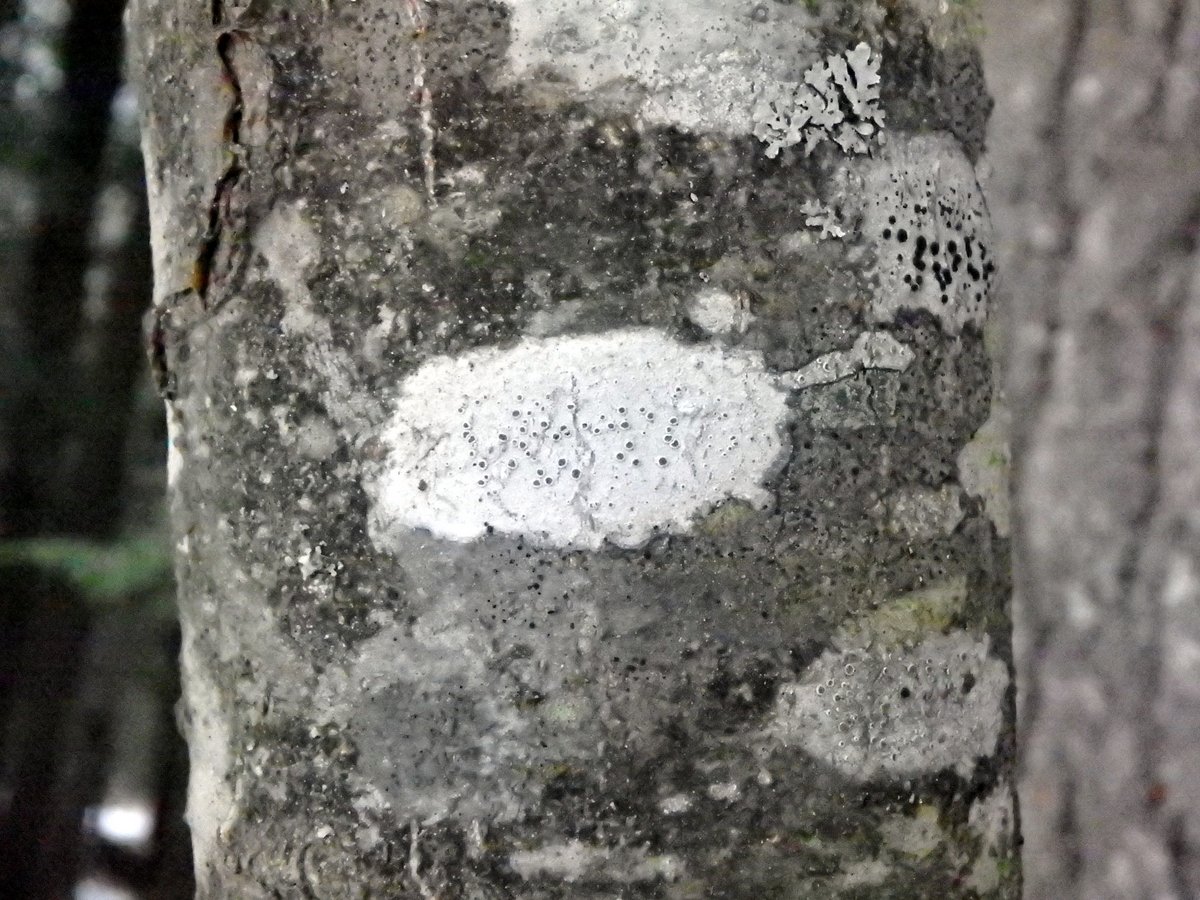
A dime size (.70 in) spot of white on a tree caught my eye and when I moved closer I saw that it was covered with blue dots. It was a beautiful sight and I didn’t know it at the time but its name is (I think) the frosted comma lichen (Arthonia caesia.) The unusual spherical blue dots are its Ascomata.

20-frosted-comma-lichen-arthonia-caesia-close

Ascomata are the fruit bodies of lichens and contain the spores, which can number in the millions.They are most commonly bowl-shaped (apothecia) but may take a spherical (cleistothecia) or flask-like (perithecia) form. This lichen has spherical ascocarps so they must be cleistothecia. They’re also very beautiful, and are the only truly blue fruit bodies I’ve seen on a lichen. Some, like those on the smoky eye boulder lichen, can be blue due to the slant of the light falling on them and I found a completely blue lichen recently but it had turned blue because of the cold. This one is naturally blue and I loved seeing it.

I have noticed even people who claim everything is predestined, and that we can do nothing to change it, look before they cross the road. ~Stephen Hawking

Thanks for stopping in.

1-snowy-road

This is the road I drove down early one morning after a 5 inch snowfall the night before. The pre-dawn light was really too dim to take photos, but I didn’t let that stop me. It was too pretty, I thought, to pass by without recording it. As Scottish author William Sharp noted: “It is the still ecstasy of nature, wherein every spray, every blade of grass, every spire of reed, every intricacy of twig, is clad with radiance.”

2-winter-brook

A small brook wound its way through the woods. I loved its polished black surface against the snow.

3-beech-leaves

Beech leaves provided a touch of color.

4-monadnock

Mount Monadnock loomed dramatically over the surrounding countryside in a view of it that I’ve never shown here before. In another half hour when the sun kissed its flanks it would probably have made an amazingly beautiful scene but I was on my way to work and I didn’t have time to dilly dally. There was snow to move.

5-ice-shelf

Ice shelves have begun forming along the Ashuelot River. This one was clearly visible as a shelf but when they’re completely attached to the river bank and are covered by snow they can create a very dangerous situation, because there are times when you can’t tell if you’re walking on land or on an ice shelf. I’ve caught myself standing on them before and that’s why I now stay well away from rivers in winter unless I know the shoreline well.

6-snow-melt

The dark trunks of trees absorb heat from the sun and reflect it back at the snow, which melts in a ring around it. These melted rings seem to be a magnet for smaller birds and animals like chipmunks and squirrels.

7-black-eye-lichen-tephromela-atra

If I see whitish or grayish spots on tree bark I always like to take a look because it could be a script lichen or some other lichen that I’ve never seen. In this case it was what I think is a black-eye lichen (Tephromela atra.) According to the book Lichens of North America this lichen grows on stone, bark or wood from the tropics to the arctic.

8-black-eye-lichen-tephromela-atra-close

As you can imagine the raised rimmed, black spore bearing apothecia of the black eyed lichen are extremely small, so it’s always a good idea to carry a loupe or a camera with macro capabilities. Many features on this and many other lichens are simply too small to be seen with the eyes alone.

9-mealy-rim-lichen-lecanora-strobilina

Another small lichen on a different tree showed some unusual color in its apothecia but I couldn’t see any definite shape without the camera.

10-mealy-rim-lichen-lecanora-strobilina-close

The book Lichens of North America says the apothecia on the mealy rim-lichen (Lecanora strobilina) are flat to convex and a waxy yellowish color. They grow on bark and wood of many kinds in full sunlight and the apothecia are very small at about .03 inches. Though the color here looks more orangey pink I think the light might have had something to do with that.

11-pixie-cup-lichens

Pixie cup lichens (Cladonia pyxidata) look like tiny golf tees or trumpets, and they are also called trumpet lichens. They are common and I almost always find them growing on the sides of rotting tree stumps. Pixie cups are squamulose lichens, which means they are scaly, but they are also foliose, or leafy. A squamule is a lobe of the body of the lichen (Thallus,) and squamulose lichens are made up of small, leafy lobes. As can be seen in the center of this photo the stalk like cups (podetia) grow out of the leaf like squamules. This is the first time I’ve ever caught it happening in a photo. Pixie Cups were used by certain Eskimo tribes as wicks in their whale blubber lamps. The lichens would be floated in the oil and then lit. The oil would burn off of the lichen but the flame wouldn’t harm it.

12-red-maple-buds

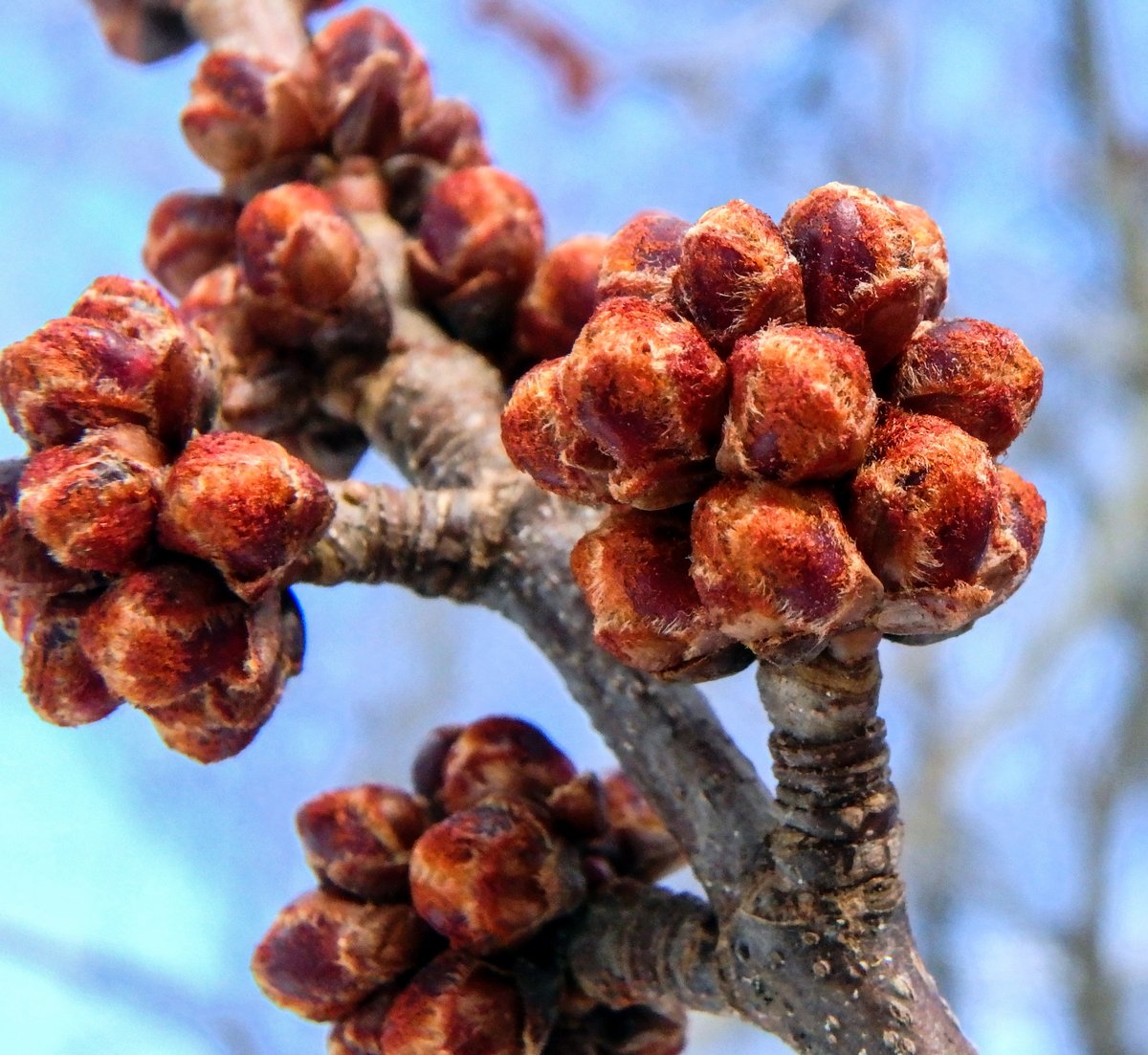
Red maple flower buds (Acer rubrum) are just waiting for the signal from spring. These are one of my favorite early spring flowers and I’m looking forward to seeing them again. The flowers, twigs, leaf stems, seeds, and autumn foliage of this tree all come in varying shades of red. These buds are tomato red, according to my color finding software.

13-hawthorn-bud

Hawthorn buds (Crataegus) are also tomato red but they’re very small; each one no bigger than a single flower bud in the clusters of red maple buds in the previous photo. I had to try several times to get a photo of this one. I think an overcast day might have made things easier. There are over 220 species of hawthorn in North America, with at least one variety native to every state and Canadian province. In New Hampshire we have 17 species, so the chances of my identifying this example are slim to none. Since I see it regularly I know that it has white blossoms.

14-hawthorn-thorn

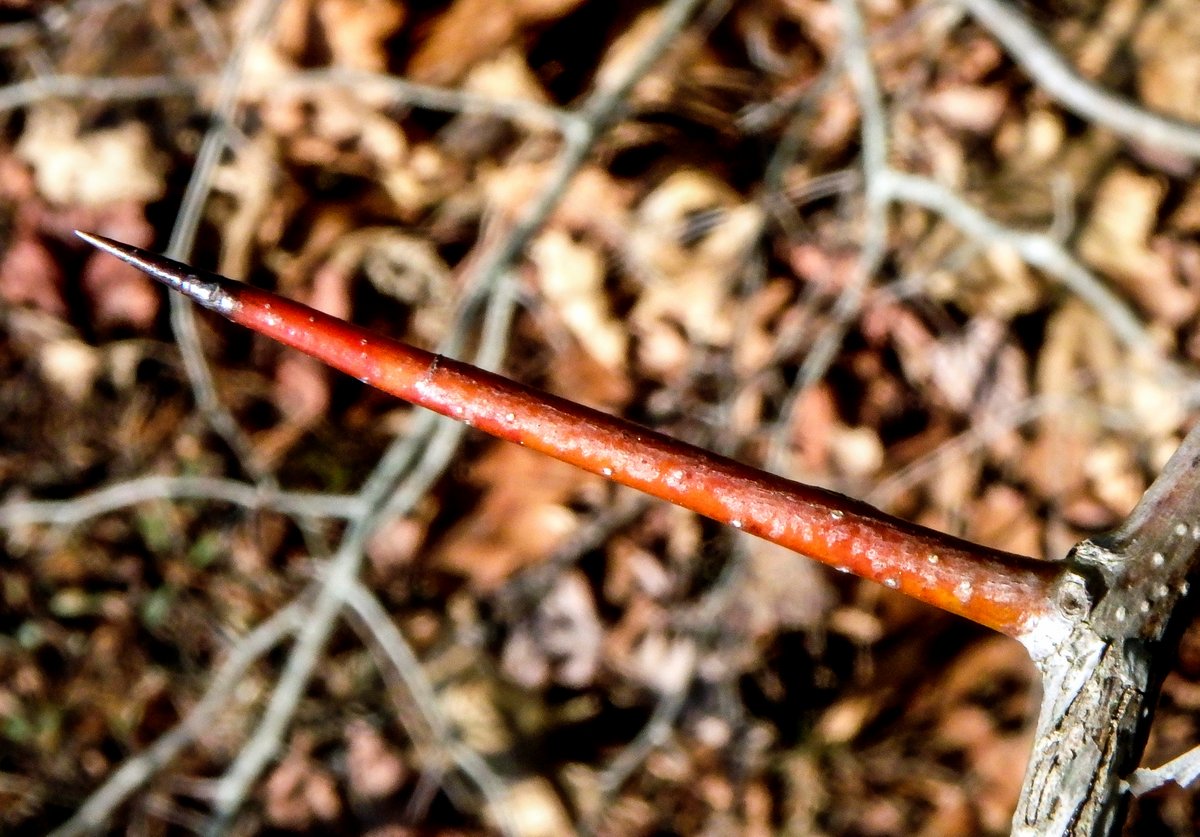
The hawthorn also has red thorns; as red as its buds and sharp as a pin. This one was about 2 inches long. Hawthorn berries and bark were used medicinally by Native Americans to treat poor blood circulation and other ailments.

15-box-buds

I was surprised to see the flower buds of this boxwood shrub (Buxus) showing color on one recent warm day. I hope it was telling me we’ll have an early spring! Boxwood is called “man’s oldest garden ornamental.” The early settlers must have thought very highly of it because they brought it over in the mid-1600s. The first plants to land on these shores were brought from Amsterdam and were planted in about 1653 on Long Island in New York. There are about 90 species of boxwood and many make excellent hedges.

16-winter-fungi

Jelly creps (Crepidotus mollis) are small, quarter sized “winter mushrooms” that like to grow on hardwood logs. They are also called soft slipper mushrooms and feel kind of spongy and flabby, much like your ear lobe. They grow with an overlapping shelving habit like that seen in the photo.

17-bee-balm-seedhead

The flowers of native scarlet bee balm (Monarda didyma) are tubular and grow out of leafy bracts, and these bracts were all that was left of this bee balm plant. This is the first time I’ve noticed that they had stripes. The Native American Oswego tribe in New York taught the early settlers how to make tea from bee balm. The settlers used it when highly taxed regular tea became hard to find and it has had the name Oswego tea ever since. The plant was also used by Native Americans as a seasoning for game and as a medicine.

The breeze at dawn has secrets to tell you. Don’t go back to sleep. ~Rumi

Thanks for coming by.


1-ice-drop

The first time I did one of these looking back posts was last year and I thought I remembered it being fun, but I found this one a little harder than fun. Picking one photo from 80-100 of them for each of the 12 months isn’t easy, but in the end I decided on the ones that best spoke about the month they were from. Last winter we didn’t have a lot of snow but we always have cold in winter, and that’s why I chose this photo of a tear shaped icicle for the month of January. It is said that January is our coldest month but I’ve seen February earn that title a few times in recent years.

2-maple-dust-lichen-on-beech

Along with cold February can sometimes bring enough snow to cover nearly everything, and this is when tree trunks gain a certain appeal. There are almost always lichens and mosses found on them and last February this maple dust lichen answered a question that I had been asking for some time, which was “Do maple dust lichens only grow on maple trees?” This one growing on a beech tree put the question to rest, and I have since seen them on poplars and young oaks as well. This pretty little lichen averages about an inch in diameter I’d guess, and can be identified by the white fringe around its perimeter. Proof that even when there’s six feet of snow on the ground there is still plenty of beauty to be found.

3-skunk-cabbage

March is when things really begin to stir and one of the first plants I see coming up is skunk cabbage (Symplocarpus foetidus.) As this photo shows, we didn’t have much snow last March but even if we had the skunk cabbages would have simply melted their way up through it. Through a process called thermogenesis, skunk cabbages raise their internal temperature so it’s above the surrounding air temperature, and this melts any ice or snow that might hinder its progress. The dark color of their blotchy spathes attracts sunlight and that means they are also heated by the sun. This makes a nice cozy warming room inside the spathe where early insects can come and hang out and warm up. While they’re inside if they happen to bump into the spadix full of flowers and get pollen all over themselves, so much the better.

4-spring-beauties

April is when flowers begin to appear in great numbers. Spring bulbs bloom, trees bloom, and the first of our wildflowers bloom, including wild ginger, purple trillium, trout lily and the beautiful spring beauties (Claytonia virginica) shown in this photo.  I’m always so excited when I see their first blooms I drop down to my knees and start taking photos, forgetting that there are often leafless poison ivy vines crawling under last year’s fallen leaves. But itchy knees are worth it when beautiful things like these can be seen. There are few sights as breathtaking as a woodland floor carpeted by thousands of them and I’m very anxious to see them again.

5-new-beech-leaves

In May the leaf buds on many of our trees start breaking and king among them is the beech, in my opinion. American beech (Fagus grandifolia) bud break begins when the normally straight buds start to curl. The curling is caused by the cells on the sunny side of the bud growing faster than those on the shaded side. This creates a tension that curls the bud and eventually causes the bud scales to pull apart so the leaves can emerge. Once the downy angel wing like leaves begin to show they unfurl quickly, so you have to watch carefully. I check them each day, and it’s always worth the effort to see something so beautiful. It’s too bad that so many people miss such a captivating event.

6-ladys-slippers

In June there are many beautiful wildflowers blooming and I had a very hard time choosing which one to include here. In the end I chose the pink lady’s slipper (Cypripedium acaule,) which is New Hampshire’s state wildflower. The wild part of the word is significant, because our official state flower is the lilac, which isn’t native to New Hampshire. In any case the lady’s slipper is a beautiful native orchid and we’re lucky enough to have several different examples of them. Pink are the most common in this area but I’ve heard that there are yellow ones tucked away here and there and I’m always looking out for them.

7-swamp-milkweed

July is when I finally get to see the swamp milkweeds again. In my opinion they are easily one of our most beautiful wildflowers, and one that I’ve lost myself in more than once. If only there were more of them. I know of only two or three smallish clumps and last year one of those was too sick and insect ridden to even blossom, so they’re something I have to search for here, but their rarity and beauty make them worth every minute of searching.

8-cedar-waxwing

August is when the silky dogwood berries ripen and the cedar waxwings appear out of nowhere to eat them up, and isn’t it amazing how nature will teach you such things if you just pay a little closer attention? I love seeing the beautiful blue and white berries that always remind me of Chinese porcelain, and I also love seeing the sleek beautiful birds that feast on them.

9-moldy-mushroom

The fungi and slime molds didn’t do too well this year because of our drought but I saw a few in September, including this bolete with a mycoparasite called Syzygites megalocarpus growing on its cap. A mycoparasite is essentially a fungus that feeds on other fungi. This one has been found on over 65 species of mushroom. It can appear overnight if heat and humidity levels are just right, and that’s exactly what this one did.

10-reflections

No matter how you slice it October has to be about the fall foliage colors because that’s usually when they’re at their peak in this area and that’s when people from all over the world come to see them. This spot at Howe Reservoir in Dublin is always worth a look because it’s a forest of mostly deciduous trees and it is always colorful in the fall. I love the muted, pastel shades that happened on this cloudy day.

11-frozen-pool

We don’t usually get much snow in November but it does get cold enough for ice to form on puddles and small brooks and streams. I found this frozen pool in the woods on a cool walk one November day and I liked the many colors in and around it. The ice was thin enough so one step would have probably shattered it.

12-split-gill-fungus

There are people who seem to think that once the leaves fall there is nothing left to see outside until spring, but nothing could be further from the truth. I chose this photo of a split gill mushroom (Schizophyllum commune) that I took in December to show that there is still a lot of beauty and interest out there. You just have to look a little more carefully, that’s all.  The “gills” on the split gill fungus are actually folds on its underside that split lengthwise when it dries out. The splits close over the fertile surfaces as the mushroom shrivels in dry weather. When rehydrated by rain the splits reopen, the spore-producing surfaces are exposed to the air, and spores are released.

13-purple-fringed-orchid-from-july

I thought I’d make the photo count in this post an even baker’s dozen so I could squeeze in what I thought was an amazing find in July. I walked down an unknown trail through a swamp and found a two foot tall orchid growing right beside it on a mossy hummock. It’s either a purple fringed orchid (Platanthera psycodes) or a greater purple fringed orchid (Platanthera grandiflora.) I’m not sure which but it is definitely one of the most beautiful wildflowers that I’ve seen. The chance of finding something like this is what keeps me wandering through these woods. There are beautiful things around every turn in the trail.

To be able to look back upon one’s life in satisfaction is to live twice. ~Khalil Gibran

Thanks for stopping in. I hope everyone has a safe, happy, nature filled New Year!

1-road-start

When it snows enough to make hiking a little more work I like to follow Beaver Brook in Keene. It’s a popular spot with both nature lovers and dog walkers and it’s rare that someone hasn’t made a path for you to follow. Since the old road that is now a trail essentially ends at a waterfall it’s easy to guess where the trodden snow path will lead.

2-ledges

One of the other reasons I like to come here in winter is because of the easy access to the ledges that are close beside the old road. There are many mosses and lichens that grow on thede ledges and I hoped to see the beautiful smoky eye boulder lichens (Porpidia albocaerulescens) that grow here, but unfortunately on this day snow covered them all.

3-blue-lichen

Though I didn’t see any smoky eye boulder lichens I did see one of the lichens that taught me that lichens can change color. This lichen is normally an ashy gray color in summer but as it gets colder it becomes darker and darker blue. This is the darkest I’ve ever seen it and I wonder if that’s because of the below zero nights we’ve had. I haven’t been able to identify it but it’s very granular and scattered, with no definite shape.

4-stairstep-moss

The stair-step moss (Hylocomium splendens) that I only find in this place is very delicate looking but it can take a lot of winter ice and snow and grows as far north as the arctic tundra. It is also called glittering wood moss and sparkles when the light is right. It grows on stone here and seems to like places when it can hang over an edge.

5-beaver-brook

Another reason I like coming here in winter is to see the often spectacular ice formations that grow along the brook, but this year it has frozen from bank to bank early and the only ice seen was flat and shapeless. Beaver Brook itself had been all but silenced except for a giggle heard here and there where there were small openings in the ice. It’s very strange to walk in a place where you know there is always the sound of running water and then suddenly not hear it. Only ice can silence a stream or river.

6-ice

There wasn’t even that much ice on the ledges, and I finally realized that the ice that grows here must grow from snow melt rather than seeping ground water. If it’s too cold for the snow to melt as it has been recently, ice doesn’t grow. If the ice came from seeping groundwater it would keep growing no matter how cold it got.

7-ice-on-stone

The dribbles of ice on this stone looked ancient, as if they had been here forever.

8-patterns-in-stone

Even without ice on them the stones here are fascinating and speak of the countless eons of tremendous pressure that stretched and folded these hills into what we see today. The stones here were once a mineral stew and today many blood red garnets can be found.

9-fern

Evergreen ferns grow under the ledge overhangs and wait patiently for spring, when this year’s green fronds will finally turn brown and new shoots will appear. It is thought that staying green through the winter lets evergreen plants begin photosynthesizing earlier in the spring, which gives them a head start over the competition.

10-large-boulder

Off in the woods across the brook stands a huge glacial erratic boulder. If it could be hollowed out two people could easily fit inside it with plenty of room to spare. One day an old timer I met here told me that there are people who cross the brook to climb it, but I’ve never seen them do so. He’s the same old timer who told me that he had seen the brook flood and cross the road, which is a very scary thing to think about because not too far from here is downtown Keene.

11-lichens-and-liverworts

There are about 800 species of frullania liverworts and many grow as epiphytes on the bark of trees and shrubs where the humidity is high. Epiphytic plants take nothing from the host plants they grow on, so this liverwort does no harm to trees. As it gets colder these liverwort turn color until they become a dark purple; almost black, so they are much more noticeable in winter than in summer when they’re green. Some can get fairly large but this example was smaller than a tennis ball.

12-frullania-liverwort

The tiny leaves of frullania liverworts are strung together like beads. Some frullania liverworts are said to be very fragrant but though I finally membered to smell a few they didn’t seem to have any scent at all. This liverwort can cause something called woodcutter’s eczema. This eczema, called phytodermatitis (basically an itchy rash,) has been seen in loggers and others who regularly handle logs or cord wood with it on them. It doesn’t sound like anything serious and usually disappears in two or three weeks once the person stops handling logs with liverworts on them.

13-script-lichens

Script lichens (Graphis) grow on tree bark all along this old road. The dark “script” characters are the lichen’s fruiting bodies (Apothecia.) There are many script lichen species and each seems to prefer a certain species of tree. This photo shows the clear separation between three species. Though the dark fruiting bodies are all horizontal in these examples, their size and spacing is quite different. Script lichens are another lichen that seems to produce spores only in cold weather. In summer they appear as whitish or grayish splotches on tree bark.

14-script-lichens

I got excited when I saw this script lichen because I thought I had found the rare and beautiful asterisk lichen (Arthonia radiata) that I’ve been searching for, but I think the two fruiting bodies that look like asterisks were just an anomaly in what is a common script lichen (Graphis scripta.)  In a true asterisk lichen all of the fruiting bodies would be star shaped.

15-golden-birch

Many of the trees looked like they wore capes of ermine. Speaking of ermines, I searched for the otter slides that I’ve seen here in the past, but didn’t see any. The old road has steep hillsides along its length and otters come here to slide down them in winter.

16-guard-post

This road was laid out in the 1700s and was abandoned in the early 70s when a new highway was built-literally right across the existing road. Since then nature has slowly been reclaiming the area. Some of the old guard rails still stand but many have been swallowed up by the brook, which over time has eaten away the edge of the road.

17-big-snowball

From a distance I thought that a boulder had rolled down off the hillside and landed in the road but it turned out to be a huge snowball that someone had rolled. It was chest high and must have taken considerable effort to move.

18-fungus

Fall oyster mushrooms (Pleurotus ostreatus) grew on the trunk of a maple but were now frozen solid. These fungi cause white rot and are not a good thing to see on living trees. Oyster mushrooms are also carnivorous. Scientists discovered in 1986 that they “exude extracellular toxins that stun {nematode] worms, whereupon the mycelium invades its body through its orifices.” They also consume bacteria (Pseudomonas and Agrobacterium) in order to get nitrogen and protein.

19-moss-on-tree

We’ve all seen the deep channels in tree bark but what I didn’t know until I started researching mosses and lichens for this blog is how rainwater runs in these channels. They’re like small vertical streams and a frozen one can be seen over on the left in this shot. Mosses and lichens and even some fungi take advantage of these streams and grow beside them on the tree’s bark. By doing so they probably get a little extra water when it rains.

20-oak-leaf

An oak leaf had fallen on the snow. Its dark color will attract sunlight and that will heat it enough to melt the snow, and it will gradually sink in until it eventually disappears under it. Oak leaves are among the most water resistant leaves but being under the snow all winter is enough to waterlog even them.

21-approaching-falls

I made it to the falls which are over on the right out of the photo but I didn’t bother climbing down the embankment to take photos of them because they were frozen and hardly making a sound. It would have been a slippery climb for a shot of a big lump of ice and once I get down in there I’m never sure if I’ll get back out because it’s very steep.

The stripped and shapely maple grieves
The ghosts of her departed leaves.
The ground is hard, as hard as stone.
The year is old, the birds are flown.
~John Updike

Thanks for coming by.

christmas-tree

MERRY CHRISTMAS EVERYONE

May you walk gently through the world and know its beauty all the days of your life. ~Apache Blessing

1-trail

We’ve had two good snowstorms recently about six days apart. The first dropped about six inches and the second about seven inches, so unless we get some rain or warm weather I think it’s safe to say that we’ll have a white Christmas. This view shows a trail around a pond that I follow quite regularly. I wasn’t the first one here on this day.

2-pondside

The pond is frozen but isn’t safe for skating yet. This is a very popular skating place and once the ice is thick enough the City of Keene will plow it so it can be used. Hopefully the ice will be thick enough to plow; the plow truck has ended up on the pond bottom several times over the years. Luckily it isn’t that deep.

3-cattails

Cattails tell you where the solid ground ends and the pond begins. This is a good thing because often unless you know the place well you can’t tell where the land meets water when it’s all covered in snow. That’s especially true along rivers; one year I realized that I was standing on an ice shelf quite a few feet out over a river. Once I stopped shaking I was able to get back on land without getting wet. I’ve made sure never to make that mistake again; people drown by doing such foolish things.

4-pondside

Because it was so cold when it fell the snow was light and fluffy and easy to shovel. Since all it takes is a light breeze to blow such powdery snow around I didn’t think my chances of seeing snowy trees was very good, but thankfully there was no breeze and the trees stayed frosted. In the woods every single thing was covered by a coating of snow.

5-otter

But wait a minute; what is that dark object out there on the ice?  I know this pond well enough to know that there shouldn’t be anything sticking up out of the water in that spot.

6-otter

It was the otter, and this makes the second terrible photo that I’ve taken of it. My camera simply isn’t made for such long shots but I keep trying anyway. Odd that this animal would live here all alone. At least, I’ve never seen more than a single one at a time. I thought they were very social animals and I’m surprised that it hasn’t gone off in search of a mate. It stayed just long enough for a single photo before slipping through a hole. I wondered how it was able to make a hole. Maybe the ice is thin there. The snow plow driver might want to take note.

7-shadows

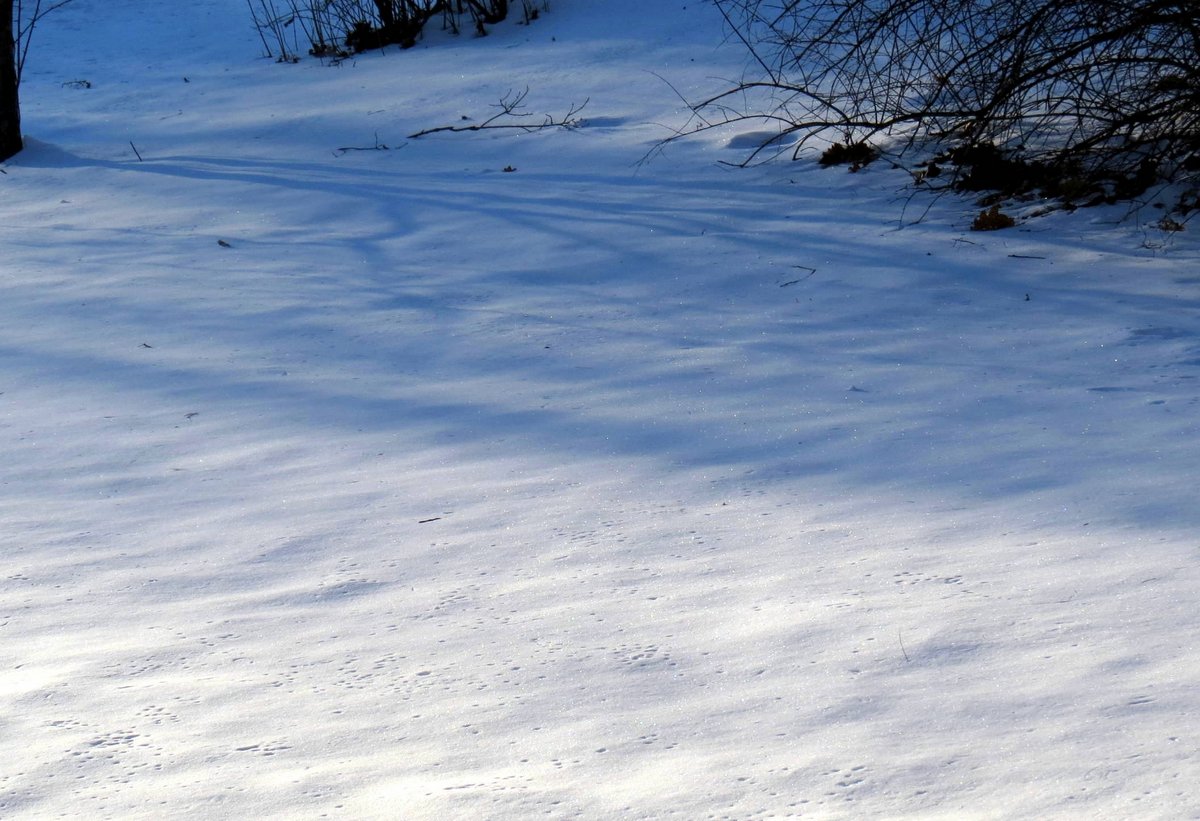
This view of some blue shadows was taken the day before the latest storm, when the sun was shining.

8-rail-trail

There were snowmobile tracks on this rail trail but snowmobiles must be getting lighter because the snow wasn’t packed down and each step was more of a slide, because there was ice under the snow.

9-snowmobiles

But the snowmobiles weren’t having any trouble. I’m  grateful for snowmobile clubs because if it wasn’t for them many of these trails would have grown over with brush and trees years ago.

10-oak-leaves

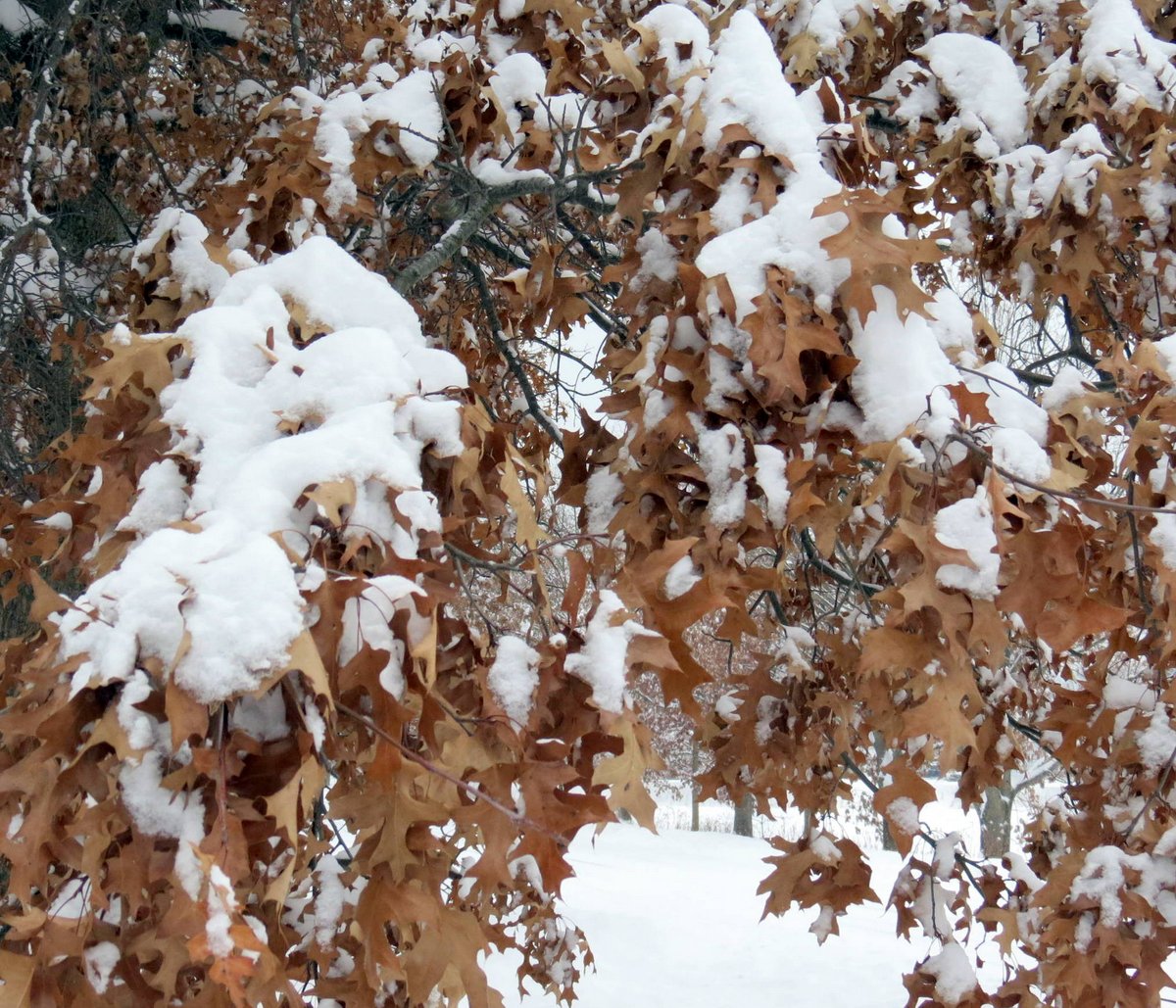
I always see pink in certain winter oak leaves and orange in others. My color finding software sees salmon pink in some of these leaves and tan in others.

11-ashuelot-river

I can’t say that I often feel aghast but I felt just that when I saw the Ashuelot River frozen from bank to bank in this spot, because in all the years I’ve been doing this blog it has never frozen here this early. In fact it’s rare for it to freeze here at all, mostly because of the fast current, I think. Apparently below zero temperatures work quickly; we’ve only had one night where they dropped that low.

12-ashuelot-on-12-11-16

This photo was taken just five days before the previous one. Hard to believe I know, but true. As Mark Twain once said: “If you don’t like the weather in New England now, just wait a few minutes.”

13-snowy-branches

The snow on these oak branches told me that there hadn’t been a puff of wind along the river either.

14-asters

What was left of the asters bent under the weight.

15-river-stones

I like how water turns so dark in the winter. I don’t know if the white of the snow makes it seem darker or if it’s a play of the light.

16-swamp

Sharp eyed longtime readers might notice something missing in this shot. There used to be an old dead white pine in this swamp that I called the heron tree.

17-blue-heron-tree

This was what the heron tree looked like on Thanksgiving Day in 2014.  Later, one day I looked for it and it was gone without a trace, as if someone had plucked it like a flower.

18-gb-heron

And this view of the first snow in December of 2013 shows why I called it the heron tree. Herons sat in it regularly and I wonder if they miss it as much as I do.

19-sunlight

No matter how dark the sky is the sun always shines again and the clouds broke on this day to let it shine for all of about 5 seconds while I was out.

There is nothing in the world more beautiful than the forest clothed to its very hollows in snow. It is the still ecstasy of nature, wherein every spray, every blade of grass, every spire of reed, every intricacy of twig, is clad with radiance. ~William Sharp

Thanks for coming by. Happy winter solstice!