Hocus pocus! Adopt a magician’s stance, if you want to reveal statistical sleights of hand

images-3

.

Here’s the follow-up post to the one I reblogged on Feb 3. When they sought to subject Uri Geller to the scrutiny of scientists, magicians had to be brought in because only they were sufficiently trained to spot the subtle sleight of hand shifts by which the magician tricks by misdirection. We, too, have to be magicians to discern the subtle misdirections and shifts of meaning in the discussions of statistical significance tests (and other methods)—even by the same statistical guide. We needn’t suppose anything deliberately devious is going on at all! Often, the statistical guidebook reflects shifts of meaning that grow out of one or another critical argument. These days, they trickle down quickly to statistical guidebooks, thanks to popular articles on the “statistics crisis in science”. The danger is that their own guidebooks contain inconsistencies. To adopt the magician’s stance is to be on the lookout for standard sleights of hand. There aren’t that many.[0]

I don’t know Jim Frost, but he gives statistical guidance at the minitab blog. The purpose of my previous post is to point out that Frost uses the probability of a Type I error in two incompatible ways in his posts on significance tests. I assumed he’d want to clear this up, but so far he has not. His response to a comment I made on his blog is this:

Based on Fisher’s measure of evidence approach, the correct way to interpret a p-value of exactly 0.03 is like this:

Assuming the null hypothesis is true, you’d obtain the observed effect or more in 3% of studies due to random sampling error.

We know that the p-value is not the error rate because:

1) The math behind the p-values is not designed to calculate the probability that the null hypothesis is true (which is actually incalculable based solely on sample statistics). …

But this is also true for a test’s significance level α, so on these grounds α couldn’t be an “error rate” or error probability either. Yet Frost defines α to be a Type I error probability (“An α of 0.05 indicates that you are willing to accept a 5% chance that you are wrong when you reject the null hypothesis“.) [1]

Let’s use the philosopher’s slightly obnoxious but highly clarifying move of subscripts. There is error probability1—the usual frequentist (sampling theory) notion—and error probability2—the posterior probability that the null hypothesis is true conditional on the data, as in Frost’s remark.  (It may also be stated as conditional on the p-value, or on rejecting the null.) Whether a p-value is predesignated or attained (observed), error probabilitity1 ≠ error probability2.[2] Frost, inadvertently I assume, uses the probability of a Type I error in these two incompatible ways in his posts on significance tests.[3]

Interestingly, the simulations to which Frost refers to “show that the actual probability that the null hypothesis is true [i.e., error probability2] tends to be greater than the p-value by a large margin” work with a fixed p-value, or α level, of say .05. So it’s not a matter of predesignated or attained p-values [4]. Their computations also employ predesignated probabilities of type II errors and corresponding power values. The null is rejected based on a single finding that attains .05 p-value. Moreover, the point null (of “no effect”) is give a spiked prior of .5. (The idea comes from a context of diagnostic testing; the prior is often based on an assumed “prevalence” of true nulls from which the current null is a member. Please see my previous post.)

Their simulations are the basis of criticisms of error probability1 because what really matters, or so these critics presuppose, is error probability2 .

Whether this assumption is correct, and whether these simulations are the slightest bit relevant to appraising the warrant for a given hypothesis, are completely distinct issues. I’m just saying that Frost’s own links mix these notions. If you approach statistical guidebooks with the magician’s suspicious eye, however, you can pull back the curtain on these sleights of hand.

Oh, and don’t lose your nerve just because the statistical guides themselves don’t see it or don’t relent. Send it on to me at [email protected].

******************************************************************************

[0] They are the focus of a book I am completing: “Statistical Inference As Severe Testing: How to Get Beyond the Statistics Wars (CUP, 2017)

[1]  I admit we need a more careful delineation of the meaning of ‘error probability’.  One doesn’t have an error probability without there being something that could be “in error”. That something is generally understood as an inference or an interpretation of data. A method of statistical inference moves from data to some inference about the source of the data as modeled; some may wish to see the inference as a kind of “act” (using Neyman’s language) or “decision to assert” but nothing turns on this.
Associated error probabilities refer to the probability a method outputs an erroneous interpretation of the data, where the particular error is pinned down. For example, it might be, the test infers μ > 0 when in fact the data have been generated by a process where μ = 0.  The test is defined in terms of a test statistic d(X), and  the error probabilitiesrefer to the probability distribution of d(X), the sampling distribution, under various assumptions about the data generating process. Error probabilities in tests, whether of the Fisherian or N-P varieties, refer to hypothetical relative frequencies of error in applying a method.

[2] Notice that error probability2 involves conditioning on the particular outcome. Say you have observed a 1.96 standard deviation difference, and that’s your fixed cut-off. There’s no consideration of the sampling distribution of d(X), if you’ve conditioned on the actual outcome. Yet probabilities of Type I and Type II errors, as well as p-values, are defined exclusively in terms of the sampling distribution of d(X), under a statistical hypothesis of interest. But all that’s error probability1.

[3] Doubtless, part of the problem is that testers fail to clarify when and why a small significance level (or p-value) provides a warrant for inferring a discrepancy from the null. Firstly, for a p-value to be actual (and not merely nominal):

Pr(P < pobs; H0) = pobs .

Cherry picking and significance seeking can yield a small nominal p-value, while the actual probability of attaining even smaller p-values under the null is high. So this identity fails. Second, A small p- value warrants inferring a discrepancy from the null because, and to the extent that, a larger p-value would very probably have occurred, were the null hypothesis correct. This links error probabilities of a method to an inference in the case at hand.

….Hence pobs is the probability that we would mistakenly declare there to be evidence against H0, were we to regard the data under analysis as being just decisive against H0.” (Cox and Hinkley 1974, p. 66).

[4] The myth that significance levels lose their error probability status once the attained p-value is reported is just that, a myth. I’ve discussed it a lot elsewhere; but the the current point doesn’t turn on this. Still, it’s worth listening to statistician Stephen Senn (2002, p. 2438) on this point.

 I disagree with [Steve Goodman] on two grounds here: (i) it is not necessary to separate p-values from their hypothesis test interpretation; (ii) the replication probability has no direct bearing on inferential meaning. Second he claims that, ‘the replication probability can be used as a frequentist counterpart of Bayesian and likelihood models to show that p-values overstate the evidence against the null-hypothesis’ (p. 875, my italics). I disagree that there is such an overstatement.  In my opinion, whatever philosophical differences there are between significance tests and hypothesis test, they have little to do with the use or otherwise of p-values. For example, Lehmann in Testing Statistical Hypotheses, regarded by many as the most perfect and complete expression of the Neyman–Pearson approach, says

‘In applications, there is usually available a nested family of rejection regions corresponding to different significance levels. It is then good practice to determine not only whether the hypothesis is accepted or rejected at the given significance level, but also to determine the smallest significance level … the significance probability or p-value, at which the hypothesis would be rejected for the given observation’. (Lehmann, Testing Statistical hypotheses (1994, p. 70, original italics). 

Note to subscribers: Please check back to find follow-ups and corrected versions of blogposts, indicated with (ii), (iii) etc.

Some Relevant Posts:

Categories: frequentist/Bayesian, P-values, reforming the reformers, S. Senn, Statistics | Leave a comment

High error rates in discussions of error rates: no end in sight

27D0BB5300000578-3168627-image-a-27_1437433320306

waiting for the other shoe to drop…

“Guides for the Perplexed” in statistics become “Guides to Become Perplexed” when “error probabilities” (in relation to statistical hypotheses tests) are confused with posterior probabilities of hypotheses. Moreover, these posteriors are neither frequentist, subjectivist, nor default. Since this doublespeak is becoming more common in some circles, it seems apt to reblog a post from one year ago (you may wish to check the comments).

Do you ever find yourself holding your breath when reading an exposition of significance tests that’s going swimmingly so far? If you’re a frequentist in exile, you know what I mean. I’m sure others feel this way too. When I came across Jim Frost’s posts on The Minitab Blog, I thought I might actually have located a success story. He does a good job explaining P-values (with charts), the duality between P-values and confidence levels, and even rebuts the latest “test ban” (the “Don’t Ask, Don’t Tell” policy). Mere descriptive reports of observed differences that the editors recommend, Frost shows, are uninterpretable without a corresponding P-value or the equivalent. So far, so good. I have only small quibbles, such as the use of “likelihood” when meaning probability, and various and sundry nitpicky things. But watch how in some places significance levels are defined as the usual error probabilities —indeed in the glossary for the site—while in others it is denied they provide error probabilities. In those other places, error probabilities and error rates shift their meaning to posterior probabilities, based on priors representing the “prevalence” of true null hypotheses.

Begin with one of his kosher posts “Understanding Hypothesis Tests: Significance Levels (Alpha) and P values in Statistics” (blue is Frost):

(1) The Significance level is the Type I error probability (3/15)

The significance level, also denoted as alpha or α, is the probability of rejecting the null hypothesis when it is true. For example, a significance level of 0.05 indicates a 5% risk of concluding that a difference exists when there is no actual difference….

Keep in mind that there is no magic significance level that distinguishes between the studies that have a true effect and those that don’t with 100% accuracy. The common alpha values of 0.05 and 0.01 are simply based on tradition. For a significance level of 0.05, expect to obtain sample means in the critical region 5% of the time when the null hypothesis is true. In these cases, you won’t know that the null hypothesis is true but you’ll reject it because the sample mean falls in the critical region. That’s why the significance level is also referred to as an error rate! (My emphasis.)

Note: Frost is using the term “error rate” here, which is why I use it in my title. Error probability would be preferable.

This type of error doesn’t imply that the experimenter did anything wrong or require any other unusual explanation. The graphs show that when the null hypothesis is true, it is possible to obtain these unusual sample means for no reason other than random sampling error. It’s just luck of the draw.

(2) Definition Link: Now we go to the blog’s definition link for this “type of error”

No hypothesis test is 100% certain. Because the test is based on probabilities, there is always a chance of drawing an incorrect conclusion.

Type I error

When the null hypothesis is true and you reject it, you make a type I error. The probability of making a type I error is α, which is the level of significance you set for your hypothesis test. An α of 0.05 indicates that you are willing to accept a 5% chance that you are wrong when you reject the null hypothesis. (My emphasis)

  Null Hypothesis
Decision True False
Fail to reject Correct Decision (probability = 1 – α) Type II Error – fail to reject the null when it is false (probability = β)
Reject Type I Error – rejecting the null when it is true (probability = α) Correct Decision (probability = 1 – β)


He gives very useful graphs showing quite clearly that the probability of a Type I error comes from the sampling distribution of the statistic (in the illustrated case, it’s the distribution of sample means).

So it is odd that elsewhere Frost tells us that a significance level (attained or fixed) is not the probability of a Type I error. Note: the issue here isn’t whether the significance level is fixed or attained, the difference to which I’m calling your attention is between an ordinary frequentist error probability and a posterior probability in a null hypothesis, given it is rejected—based on a prior probability for the null vs a probability for a single alternative, which he writes as P(real). We may call it the false finding rate (FFR), and it arises in typical diagnostic screening contexts. I elsewhere take up the allegation, by some, that a significance level is an error probability but a P-value is not (Are P-values error probabilities?). A post is here. Also see note [a] below.]
Here are some examples from Frost’s posts on 4/14 & 5/14:

 (3)  In a different post Frost alleges: A significance level is not the Type I error probability

Incorrect interpretations of P values are very common. The most common mistake is to interpret a P value as the probability of making a mistake by rejecting a true null hypothesis (a Type I error).

Now “making a mistake” may be vague, (and his statement here is a bit wonky) but the parenthetical link makes it clear he intends the Type I error probability. Guess what? The link is to the exact same definition of Type I error as before: the ordinary error probability computed from the sampling distribution. Yet in the blogpost itself, the Type I error probability now refers to a posterior probability of the null, based on an assumed prior probability of .5!

If a P value is not the error rate, what the heck is the error rate?

Sellke et al.* have estimated the error rates associated with different P values. While the precise error rate depends on various assumptions (which I discuss here), the table summarizes them for middle-of-the-road assumptions.

P value Probability of incorrectly rejecting a true null hypothesis
0.05 At least 23% (and typically close to 50%)
0.01 At least 7% (and typically close to 15%)

*Thomas SELLKE, M. J. BAYARRI, and James O. BERGER, Calibration of p Values for Testing Precise Null Hypotheses, The American Statistician, February 2001, Vol. 55, No. 1

We’ve discussed how J. Berger and Sellke (1987) compute these posterior probabilities using spiked priors, generally representing undefined “reference” or conventional priors. (Please see my previous post.) J. Berger claims, at times, that these posterior probabilities (which he computes in lots of different ways) are the error probabilities, and Frost does too, at least in some posts. The allegation that therefore P-values exaggerate the evidence can’t be far behind–or so a reader of this blog surmises–and there it is, right below:

Do the higher error rates in this table surprise you? Unfortunately, the common misinterpretation of P values as the error rate creates the illusion of substantially more evidence against the null hypothesis than is justified. As you can see, if you base a decision on a single study with a P value near 0.05, the difference observed in the sample may not exist at the population level. (Frost 5/14)

Admittedly, Frost is led to his equivocation by the sleights of hands of others, encouraged after around 2003 (in my experience).

(4) J. Berger’s Sleight of Hand: These sleights of hand are familiar to readers of this blog; I wouldn’t have expected them in a set of instructional blogposts about misinterpreting significance levels (at least without a great big warning). But Frost didn’t dream them up, he’s following a practice, traceable to J. Berger, of claiming that a posterior (usually based on conventional priors) gives the real error rate (or the conditional error rate). [The computations come from Edwards, Lindmann, and Savage 1963.) Whether it’s the ‘right’ default prior to use or not, my point is simply that the meaning is changed, and Frost ought to issue a trigger alert! Instead, he includes numerous links to related posts on significance tests, making it appear that blithely assigning a .5 spiked prior to the null is not only kosher, but is part of ordinary significance testing. It’s scarcely a justified move. As Casella and R.Berger (1987) show, this is a highly biased prior to use. See this post, and others by Stephen Senn (3/16/15, 5/9/15). Moreover, many people regard point nulls as always false.

In my comment on J. Berger (2003), I noted my surprise at his redefinition of error probability. (See pp. 19-24 in this paper). In response to me, Berger asks,

“Why should the frequentist school have exclusive right to the term ‘error probability’? It is not difficult to simply add the designation ‘frequentist’ (or Type I or Type II) or ‘Bayesian’ to the term to differentiate between the schools” (J. Berger 2003, p. 30).

That would work splendidly, I’m all in favor of differentiating between the schools. Note that he allows “Type I ” to go with the ordinary frequentist variant. If Berger had emphasized this distinction in his paper, Frost would have been warned of the slipperly slide he’s about to take a trip on. Instead, Berger has increasingly grown accustomed to claiming these are the real frequentist(!) error probabilities. (Others have followed.)

(5) Is Hypothesis testing like Diagnostic Screening? Now Frost (following David Colquhoun) appears to favor (not Berger’s conventionalist prior) a type of frequentist or “prevalence” prior:

It is the proportion of hypothesis tests in which the alternative hypothesis is true at the outset. It can be thought of as the long-term probability, or track record, of similar types of studies. It’s the plausibility of the alternative hypothesis.

Do we know these prevalences? What reference class should a given hypothesis be regarded as having been selected? There would be many different urns to which a particular hypothesis belongs. Such frequentist-Bayesian computations may be appropriate in contexts of high throughput screening, where a hypothesis is viewed as a generic, random selection from an urn of hypotheses. Here, a (behavioristic) concern to control the rates of following up false leads is primary. But that’s very different from evaluating how well tested or corroborated a particular H is. And why should fields with “high crud factors” (as Meehl called them) get the benefit? (having a low prior prevalence of “no effect”).

I’ve discussed all these points elsewhere, and they are beside my current complaint which is simply this: In some places, Frost construes the probability of a Type I error as an ordinary error probability based on the sampling distribution alone; and other places as a Bayesian posterior probability of a hypothesis, conditional on a set of data.

Frost goes further in the post to suggest that “hypotheses tests are journeys from the prior probability to posterior probability”.

Hypothesis tests begin with differing probabilities that the null hypothesis is true depending on the specific hypotheses being tested. [Mayo: They do?] This prior probability influences the probability that the null is true at the conclusion of the test, the posterior probability.


Initial Probability of
true null (1 – P(real))
P value obtained Final Minimum Probability
of true null
0.5 0.05 0.289
0.5 0.01 0.110
0.5 0.001 0.018
0.33 0.05 0.12
0.9 0.05 0.76

The table is based on calculations by Colquhoun and Sellke et al. It shows that the decrease from the initial probability to the final probability of a true null depends on the P value. Power is also a factor but not shown in the table.

It is assumed that there is just a crude dichotomy: the null is true vs the effect is real (never mind magnitudes of discrepancy which I and others insist upon), and further, that you reject on the basis of a single, just statistically significant result. But these moves go against the healthy recommendations for good testing in the other posts on the Minitab blog. I recommend Frost go back and label the places where he has conflated the probability of a Type I error with a posterior probability based on a prior: use Berger’s suggestion of reserving “Type I error probability” for the ordinary frequentist error probability based on a sampling distribution alone, calling the posterior error probability Bayesian. Else contradictory claims will ensue…But I’m not holding my breath.

I may continue this in (ii)….

***********************************************************************

January 21, 2016 Update:

Jim Frost from Minitab responded, not to my post, but to a comment I made on his blog prior to writing the post. Since he hasn’t commented here, let me paste the relevant portion of his reply. I want to separate the issue of predesignating alpha and the observed P-value, because my point now is quite independent of it. Let’s even just talk of a fixed alpha or fixed P-value for rejecting the null. My point’s very simple: Frost sometimes considers the type I error probability to be alpha (in the 2015 posts) based solely on the sampling distribution which he ably depicts– whereas in other places he regards it as the posterior probability of the null hypothesis based on a prior probability (the 2014 posts). He does the same in his reply to me (which I can’t seem to link, but it’s in the discussion here):

From Frost’s reply to me:

Yes, if your study obtains a p-value of 0.03, you can say that 3% of all studies that obtain a p-value less than or equal to 0.03 will have a Type I error. That’s more of a N-P error rate interpretation (except that N-P focused on critical test values rather than p-values). …..

Based on Fisher’s measure of evidence approach, the correct way to interpret a p-value of exactly 0.03 is like this:

Assuming the null hypothesis is true, you’d obtain the observed effect or more in 3% of studies due to random sampling error.

We know that the p-value is not the error rate because:

1) The math behind the p-values is not designed to calculate the probability that the null hypothesis is true (which is actually incalculable based solely on sample statistics). See a graphical representation of the math behind p-values and a post dedicated to how to correctly interpret p-values.

2) We also know this because there have been a number of simulation studies that look at the relationship between p-values and the probability that the null is true. These studies show that the actual probability that the null hypothesis is true tends to be greater than the p-value by a large margin.

3) Empirical studies that look at the replication of significant results also suggest that the actual probability that the null is true is greater than the p-value.

Frost’s points (1)-(3) above would also oust alpha as the type I error probability, for it’s also not designed to give a posterior. Never mind the question of the irrelevance or bias associated with the hefty spiked prior to the null involved in the simulations, all I’m saying is that Frost should make the distinction that even J. Berger agrees to, if he doesn’t want to confuse his readers.

—————————————————————————

[a] A distinct issue as to whether significance levels, but not P-values (the attained significance level) are error probabilities, is discussed here. Here are some of the assertions from Fisherian, Neyman-Pearsonian and Bayesian camps cited in that post. (I make no attempt at uniformity in writing the “P-value”, but retain the quotes as written.

From the Fisherian camp (Cox and Hinkley):

For given observations y we calculate t = tobs = t(y), say, and the level of significance pobs by

pobs = Pr(T > tobs; H0).

….Hence pobs is the probability that we would mistakenly declare there to be evidence against H0, were we to regard the data under analysis as being just decisive against H0.” (Cox and Hinkley 1974, 66).

Thus pobs would be the Type I error probability associated with the test.

From the Neyman-Pearson N-P camp (Lehmann and Romano):

“[I]t is good practice to determine not only whether the hypothesis is accepted or rejected at the given significance level, but also to determine the smallest significance level…at which the hypothesis would be rejected for the given observation. This number, the so-called p-value gives an idea of how strongly the data contradict the hypothesis. It also enables others to reach a verdict based on the significance level of their choice.” (Lehmann and Romano 2005, 63-4) 

Very similar quotations are easily found, and are regarded as uncontroversial—even by Bayesians whose contributions stood at the foot of Berger and Sellke’s argument that P values exaggerate the evidence against the null.

Gibbons and Pratt:

“The P-value can then be interpreted as the smallest level of significance, that is, the ‘borderline level’, since the outcome observed would be judged significant at all levels greater than or equal to the P-value[i] but not significant at any smaller levels. Thus it is sometimes called the ‘level attained’ by the sample….Reporting a P-value, whether exact or within an interval, in effect permits each individual to choose his own level of significance as the maximum tolerable probability of a Type I error.” (Gibbons and Pratt 1975, 21).


REFERENCES:

Berger, J. O. and Sellke, T.  (1987). “Testing a point null hypothesis: The irreconcilability of p values and evidence,” (with discussion). J. Amer. Statist. Assoc. 82: 112–139.

Casella G. and Berger, R. (1987). “Reconciling Bayesian and Frequentist Evidence in the One-sided Testing Problem,” (with discussion). J. Amer. Statist. Assoc. 82 106–111, 123–139.

Edwards, A. ., Lindman, H. and Savage, L. 1963. ‘Bayesian Statistical Inference for Psychological Research’, Psychological Review 70(3): 193–242.

Sellke, T., Bayarri, M. J. and Berger, J. O. 2001. Calibration of p Values for Testing Precise Null Hypotheses. The American Statistician, 55(1): 62-71.

  1. Frost blog posts:
  • 4/17/14: How to Correctly Interpret P Values
  • 5/1/14: Not All P Values are Created Equal
  • 3/19/15: Understanding Hypothesis Tests: Significance Levels (Alpha) and P values in Statistics

Some Relevant Errorstatistics Posts:

  •  4/28/12: Comedy Hour at the Bayesian Retreat: P-values versus Posteriors.
  • 9/29/13: Highly probable vs highly probed: Bayesian/ error statistical differences.
  • 7/14/14: “P-values overstate the evidence against the null”: legit or fallacious? (revised)
  • 8/17/14: Are P Values Error Probabilities? or, “It’s the methods, stupid!” (2nd install)
  • 3/5/15: A puzzle about the latest test ban (or ‘don’t ask, don’t tell’)
  • 3/16/15: Stephen Senn: The pathetic P-value (Guest Post)
  • 5/9/15: Stephen Senn: Double Jeopardy?: Judge Jeffreys Upholds the Law (sequel to the pathetic P-value)
Categories: highly probable vs highly probed, J. Berger, reforming the reformers, Statistics | 1 Comment

3 YEARS AGO (JANUARY 2014): MEMORY LANE

3 years ago...

3 years ago…

MONTHLY MEMORY LANE: 3 years ago: January 2014. I mark in red three posts from each month that seem most apt for general background on key issues in this blog, excluding those reblogged recently[1], and in green up to 3 others I’d recommend[2].  Posts that are part of a “unit” or a group count as one. This month, I’m grouping the 3 posts from my seminar with A. Spanos, counting them as 1.

January 2014

  • (1/2) Winner of the December 2013 Palindrome Book Contest (Rejected Post)
  • (1/3) Error Statistics Philosophy: 2013
  • (1/4) Your 2014 wishing well. …
  • (1/7) “Philosophy of Statistical Inference and Modeling” New Course: Spring 2014: Mayo and Spanos: (Virginia Tech)
  • (1/11) Two Severities? (PhilSci and PhilStat)
  • (1/14) Statistical Science meets Philosophy of Science: blog beginnings
  • (1/16) Objective/subjective, dirty hands and all that: Gelman/Wasserman blogolog (ii)
  • (1/18) Sir Harold Jeffreys’ (tail area) one-liner: Sat night comedy [draft ii]
  • (1/22) Phil6334: “Philosophy of Statistical Inference and Modeling” New Course: Spring 2014: Mayo and Spanos (Virginia Tech) UPDATE: JAN 21
  • (1/24) Phil 6334: Slides from Day #1: Four Waves in Philosophy of Statistics
  • (1/25) U-Phil (Phil 6334) How should “prior information” enter in statistical inference?
  • (1/27) Winner of the January 2014 palindrome contest (rejected post)
  • (1/29) BOSTON COLLOQUIUM FOR PHILOSOPHY OF SCIENCE: Revisiting the Foundations of Statistics

    .

  • (1/31) Phil 6334: Day #2 Slides


[1] Monthly memory lanes began at the blog’s 3-year anniversary in Sept, 2014.

[2] New Rule, July 30, 2016-very convenient.


Save

Save

Save

Save

Save

Categories: 3-year memory lane, Bayesian/frequentist, Statistics | 1 Comment

The “P-values overstate the evidence against the null” fallacy

3077175-lg

.

The allegation that P-values overstate the evidence against the null hypothesis continues to be taken as gospel in discussions of significance tests. All such discussions, however, assume a notion of “evidence” that’s at odds with significance tests–generally Bayesian probabilities of the sort used in Jeffrey’s-Lindley disagreement (default or “I’m selecting from an urn of nulls” variety). Szucs and Ioannidis (in a draft of a 2016 paper) claim “it can be shown formally that the definition of the p value does exaggerate the evidence against H0” (p. 15) and they reference the paper I discuss below: Berger and Sellke (1987). It’s not that a single small P-value provides good evidence of a discrepancy (even assuming the model, and no biasing selection effects); Fisher and others warned against over-interpreting an “isolated” small P-value long ago.  But the formulation of the “P-values overstate the evidence” meme introduces brand new misinterpretations into an already confused literature! The following are snippets from some earlier posts–mostly this one–and also includes some additions from my new book (forthcoming). 

Categories: Bayesian/frequentist, fallacy of rejection, highly probable vs highly probed, P-values, Statistics | 46 Comments

Winners of December Palindrome: Kyle Griffiths & Eileen Flanagan

Winners of the December 2016 Palindrome contest

Since both November and December had the contest word verifies/reverifies, the judges decided to give two prizes this month. Thank you both for participating!


kyle

.

Kyle Griffiths

Palindrome: Sleep, raw Elba, ere verified ire; Sir, rise, ride! If I revere able war peels.

The requirement: A palindrome using “verifies” (reverifies) or “verified” (reverified) and Elba, of course.

Statement: Here’s my December submission, hope you like it, it has a kind of revolutionary war theme. I have no particular history of palindrome-writing or contest-entering.  Instead, I found Mayo’s work via the recommendation of Jeremy Fox of Dynamic Ecology.  I am interested in her take on modern statistical practices in ecology, and generally in understanding what makes scientific methods robust and reliable.  I’m an outsider to philosophy and stats (I have an MS in Biology), so I appreciate the less-formal tone of the blog. I’m really looking forward to Mayo’s next book.

Book choice (out of 12 or more):  Principles of Applied Statistics (D. R. Cox and C. A. Donnelly 2011, Cambridge: Cambridge University Press)

Bio: Part-time Biology Instructor, Scientific Aide for California Dept. of Fish & Wildlife. Interested in aquatic ecology, fish population dynamics.

*******************************************************************************************


.

Eileen Flanagan

Palindrome: Elba man, error reels inanities. I verified art I trade, if I revise it in an isle. Error renamable.

The requirement: A palindrome using “verifies” (reverifies) or “verified” (reverified) and Elba, of course.

Bio: Retired civil servant with a philosophy Ph.D; a bit camera shy so used a stand-in for my photo. 🙂

Statement: I found your blog searching for information on fraud in science a few years ago, and now that I am retired, I am enjoying twisting my mind around palindromes and other word games that I find on-line. 🙂

Book choice (out of 12 or more):  For my book, I would like a copy of Error and the Growth of Experimental Knowledge (D. G. Mayo, 1996, Chicago: Chicago University Press).


*******************************************************************************************

Some of Mayo’s attempts, posted through Nov-Dec:

Elba felt busy, reverifies use. I fire very subtle fable.

To I: disabled racecar ties. I verified or erode, if I revise it. Race card: Elba’s idiot.

Elba, I rave to men: “I felt busy!” Reverified, I hide, I fire very subtle fine mote variable.

I deified able deities. I verified a rap parade. If I revise, I tied. Elba deified I.

Categories: Announcement, Palindrome | Leave a comment

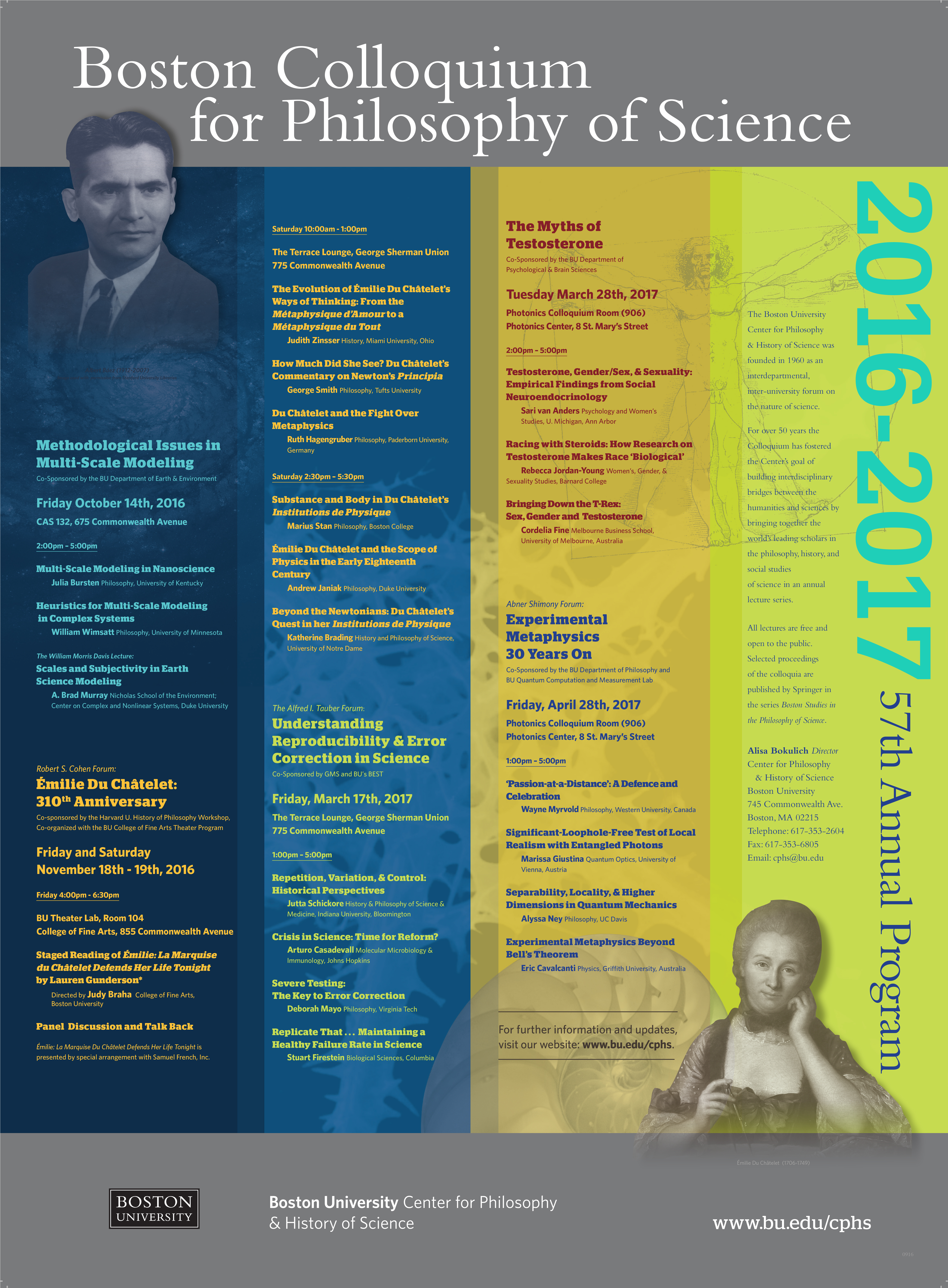
BOSTON COLLOQUIUM FOR PHILOSOPHY OF SCIENCE: Understanding Reproducibility & Error Correction in Science

BOSTON COLLOQUIUM FOR PHILOSOPHY OF SCIENCE

2016–2017
57th Annual Program

Download the 57th Annual Program

The Alfred I. Taub forum:

UNDERSTANDING REPRODUCIBILITY & ERROR CORRECTION IN SCIENCE

Cosponsored by GMS and BU’s BEST at Boston University.
Friday, March 17, 2017
1:00 p.m. – 5:00 p.m.
The Terrace Lounge, George Sherman Union
775 Commonwealth Avenue

  • Reputation, Variation, &, Control: Historical Perspectives
    Jutta Schickore History and Philosophy of Science & Medicine, Indiana University, Bloomington.
  • Crisis in Science: Time for Reform?
    Arturo Casadevall Molecular Microbiology & Immunology, Johns Hopkins
  • Severe Testing: The Key to Error Correction
    Deborah Mayo Philosophy, Virginia Tech
  • Replicate That…. Maintaining a Healthy Failure Rate in Science
    Stuart Firestein Biological Sciences, Columbia


boston-mayo-2017

Categories: Announcement, philosophy of science, Philosophy of Statistics, Statistical fraudbusting, Statistics | Leave a comment

Midnight With Birnbaum (Happy New Year 2016)

 Just as in the past 5 years since I’ve been blogging, I revisit that spot in the road at 11p.m., just outside the Elbar Room, get into a strange-looking taxi, and head to “Midnight With Birnbaum”. (The pic on the left is the only blurry image I have of the club I’m taken to.) I wonder if the car will come for me this year, given that my Birnbaum article has been out since 2014… The (Strong) Likelihood Principle–whether or not it is named–remains at the heart of many of the criticisms of Neyman-Pearson (N-P) statistics (and cognate methods). Yet as Birnbaum insisted, the “confidence concept” is the “one rock in a shifting scene” of statistical foundations, insofar as there’s interest in controlling the frequency of erroneous interpretations of data. (See my rejoinder.) Birnbaum bemoaned the lack of an explicit evidential interpretation of N-P methods. Maybe in 2017? Anyway, it’s 6 hrs later here, so I’m about to leave for that spot in the road… If I’m picked up, I’ll add an update at the end.

You know how in that (not-so) recent Woody Allen movie, “Midnight in Paris,” the main character (I forget who plays it, I saw it on a plane) is a writer finishing a novel, and he steps into a cab that mysteriously picks him up at midnight and transports him back in time where he gets to run his work by such famous authors as Hemingway and Virginia Wolf?  He is impressed when his work earns their approval and he comes back each night in the same mysterious cab…Well, imagine an error statistical philosopher is picked up in a mysterious taxi at midnight (New Year’s Eve 2011 2012, 2013, 2014, 2015, 2016) and is taken back fifty years and, lo and behold, finds herself in the company of Allan Birnbaum.[i] There are a couple of brief (12/31/14 & 15) updates at the end.  

.

.

ERROR STATISTICIAN: It’s wonderful to meet you Professor Birnbaum; I’ve always been extremely impressed with the important impact your work has had on philosophical foundations of statistics.  I happen to be writing on your famous argument about the likelihood principle (LP).  (whispers: I can’t believe this!)

BIRNBAUM: Ultimately you know I rejected the LP as failing to control the error probabilities needed for my Confidence concept. Continue reading

Categories: Birnbaum Brakes, Statistics, strong likelihood principle | Tags: , , , | 21 Comments

Szucs & Ioannidis Revive the Limb-Sawing Fallacy


images-2

.

When logical fallacies of statistics go uncorrected, they are repeated again and again…and again. And so it is with the limb-sawing fallacy I first posted in one of my “Overheard at the Comedy Hour” posts.* It now resides as a comic criticism of significance tests in a paper by Szucs and Ioannidis (posted this week),  Here’s their version:

“[P]aradoxically, when we achieve our goal and successfully reject Hwe will actually be left in complete existential vacuum because during the rejection of HNHST ‘saws off its own limb’ (Jaynes, 2003; p. 524): If we manage to reject H0then it follows that pr(data or more extreme data|H0) is useless because H0 is not true” (p.15).

Here’s Jaynes (p. 524):

“Suppose we decide that the effect exists; that is, we reject [null hypothesis] H0. Surely, we must also reject probabilities conditional on H0, but then what was the logical justification for the decision? Orthodox logic saws off its own limb.’ 

Ha! Ha! By this reasoning, no hypothetical testing or falsification could ever occur. As soon as H is falsified, the grounds for falsifying disappear! If H: all swans are white, then if I see a black swan, H is falsified. But according to this criticism, we can no longer assume the deduced prediction from H! What? Continue reading

Categories: Error Statistics, P-values, reforming the reformers, Statistics | 14 Comments

3 YEARS AGO (DECEMBER 2013): MEMORY LANE

3 years ago...

3 years ago…

MONTHLY MEMORY LANE: 3 years ago: December 2013. I mark in red three posts from each month that seem most apt for general background on key issues in this blog, excluding those reblogged recently[1], and in green up to 3 others I’d recommend[2].  Posts that are part of a “unit” or a group count as one. In this post, that makes 12/27-12/28 count as one.

December 2013

  • (12/3) Stephen Senn: Dawid’s Selection Paradox (guest post)
  • (12/7) FDA’s New Pharmacovigilance
  • (12/9) Why ecologists might want to read more philosophy of science (UPDATED)
  • (12/11) Blog Contents for Oct and Nov 2013
  • (12/14) The error statistician has a complex, messy, subtle, ingenious piece-meal approach
  • (12/15) Surprising Facts about Surprising Facts
  • (12/19) A. Spanos lecture on “Frequentist Hypothesis Testing
  • (12/24) U-Phil: Deconstructions [of J. Berger]: Irony & Bad Faith 3
  • (12/25) “Bad Arguments” (a book by Ali Almossawi)
  • (12/26) Mascots of Bayesneon statistics (rejected post)
  • (12/27) Deconstructing Larry Wasserman
  • (12/28) More on deconstructing Larry Wasserman (Aris Spanos)
  • (12/28) Wasserman on Wasserman: Update! December 28, 2013
  • (12/31) Midnight With Birnbaum (Happy New Year)

[1] Monthly memory lanes began at the blog’s 3-year anniversary in Sept, 2014.

[2] New Rule, July 30, 2016-very convenient.


Save

Save

Save

Save

Save

Categories: 3-year memory lane, Bayesian/frequentist, Error Statistics, Statistics | 1 Comment

S. Senn: “Placebos: it’s not only the patients that are fooled” (Guest Post)

Stephen Senn

Stephen Senn

Placebos: it’s not only the patients that are fooled

Stephen Senn
Head of  Competence Center for Methodology and Statistics (CCMS)
Luxembourg Institute of Health

In my opinion a great deal of ink is wasted to little purpose in discussing placebos in clinical trials. Many commentators simply do not understand the nature and purpose of placebos. To start with the latter, their only purpose is to permit blinding of treatments and, to continue to the former, this implies that their nature is that they are specific to the treatment studied.

Consider an example. Suppose that Pannostrum Pharmaceuticals wishes to prove that its new treatment for migraine, Paineaze® (which is in the form of a small red circular pill) is superior to the market-leader offered by Allexir Laboratories, Kalmer® (which is a large purple lozenge). Pannostrum decides to do a head-to head comparison and of course, therefore will require placebos. Every patient will have to take a red pill and a purple lozenge. In the Paineaze arm what is red will be Paineaze and what is purple ‘placebo to Kalmer’. In the Kalmer arm what is red will be ‘placebo to Paineaze’ and what is purple will be Kalmer.

senn-placebo

Continue reading

Categories: PhilPharma, PhilStat/Med, Statistics, Stephen Senn | 6 Comments

“Tests of Statistical Significance Made Sound”: excerpts from B. Haig

images-34

.

I came across a paper, “Tests of Statistical Significance Made Sound,” by Brian Haig, a psychology professor at the University of Canterbury, New Zealand. It hits most of the high notes regarding statistical significance tests, their history & philosophy and, refreshingly, is in the error statistical spirit! I’m pasting excerpts from his discussion of “The Error-Statistical Perspective”starting on p.7.[1]

The Error-Statistical Perspective

An important part of scientific research involves processes of detecting, correcting, and controlling for error, and mathematical statistics is one branch of methodology that helps scientists do this. In recognition of this fact, the philosopher of statistics and science, Deborah Mayo (e.g., Mayo, 1996), in collaboration with the econometrician, Aris Spanos (e.g., Mayo & Spanos, 2010, 2011), has systematically developed, and argued in favor of, an error-statistical philosophy for understanding experimental reasoning in science. Importantly, this philosophy permits, indeed encourages, the local use of ToSS, among other methods, to manage error. Continue reading

Categories: Bayesian/frequentist, Error Statistics, fallacy of rejection, P-values, Statistics | 12 Comments

Gelman at the PSA: “Confirmationist and Falsificationist Paradigms in Statistical Practice”: Comments & Queries

screen-shot-2016-10-26-at-10-23-07-pmTo resume sharing some notes I scribbled down on the contributions to our Philosophy of Science Association symposium on Philosophy of Statistics (Nov. 4, 2016), I’m up to Gelman. Comments on Gigerenzer and Glymour are here and here. Gelman didn’t use slides but gave a very thoughtful, extemporaneous presentation on his conception of “falsificationist Bayesianism”, its relation to current foundational issues, as well as to error statistical testing. My comments follow his abstract.

Confirmationist and Falsificationist Paradigms in Statistical Practice

gelman5

.

Andrew Gelman

There is a divide in statistics between classical frequentist and Bayesian methods. Classical hypothesis testing is generally taken to follow a falsificationist, Popperian philosophy in which research hypotheses are put to the test and rejected when data do not accord with predictions. Bayesian inference is generally taken to follow a confirmationist philosophy in which data are used to update the probabilities of different hypotheses. We disagree with this conventional Bayesian-frequentist contrast: We argue that classical null hypothesis significance testing is actually used in a confirmationist sense and in fact does not do what it purports to do; and we argue that Bayesian inference cannot in general supply reasonable probabilities of models being true. The standard research paradigm in social psychology (and elsewhere) seems to be that the researcher has a favorite hypothesis A. But, rather than trying to set up hypothesis A for falsification, the researcher picks a null hypothesis B to falsify, which is then taken as evidence in favor of A. Research projects are framed as quests for confirmation of a theory, and once confirmation is achieved, there is a tendency to declare victory and not think too hard about issues of reliability and validity of measurements. Continue reading

Categories: Bayesian/frequentist, Gelman, Shalizi, Statistics | 148 Comments

3 YEARS AGO (NOVEMBER 2013): MEMORY LANE

3 years ago...

3 years ago…

MONTHLY MEMORY LANE: 3 years ago: November 2013. I mark in red three posts from each month that seem most apt for general background on key issues in this blog, excluding those reblogged recently[1], and in green up to 3 others I’d recommend[2].  Posts that are part of a “unit” or a group count as one. Here I’m counting 11/9, 11/13, and 11/16 as one

November 2013

  • (11/2) Oxford Gaol: Statistical Bogeymen
  • (11/4) Forthcoming paper on the strong likelihood principle
  • (11/9) Null Effects and Replication (cartoon pic)
  • (11/9) Beware of questionable front page articles warning you to beware of questionable front page articles (iii)
  • (11/13) T. Kepler: “Trouble with ‘Trouble at the Lab’?” (guest post)
  • (11/16) PhilStock: No-pain bull
  • (11/16) S. Stanley Young: More Trouble with ‘Trouble in the Lab’ (Guest post)
  • (11/18) Lucien Le Cam: “The Bayesians hold the Magic”
  • (11/20) Erich Lehmann: Statistician and Poet
  • (11/23) Probability that it is a statistical fluke [i]
  • (11/27)The probability that it be a statistical fluke” [iia]
  • (11/30) Saturday night comedy at the “Bayesian Boy” diary (rejected post*)

[1] Monthly memory lanes began at the blog’s 3-year anniversary in Sept, 2014.

[2] New Rule, July 30, 2016-very convenient.


Save

Save

Save

Save

Save

Categories: 3-year memory lane, Error Statistics, Statistics | Leave a comment

Glymour at the PSA: “Exploratory Research is More Reliable Than Confirmatory Research”

psa-homeI resume my comments on the contributions to our symposium on Philosophy of Statistics at the Philosophy of Science Association. My earlier comment was on Gerd Gigerenzer’s talk. I move on to Clark Glymour’s “Exploratory Research Is More Reliable Than Confirmatory Research.” His complete slides are after my comments.

GLYMOUR’S ARGUMENT (in a nutshell):Glymour_2006_IMG_0965

“The anti-exploration argument has everything backwards,” says Glymour (slide #11). While John Ioannidis maintains that “Research findings are more likely true in confirmatory designs,” the opposite is so, according to Glymour. (Ioannidis 2005, Glymour’s slide #6). Why? To answer this he describes an exploratory research account for causal search that he has been developing:

exploratory-research-is-more-reliable-than-confirmatory-research-13-1024(slide #5)

What’s confirmatory research for Glymour? It’s moving directly from rejecting a null hypothesis with a low P-value to inferring a causal claim. Continue reading

Categories: fallacy of rejection, P-values, replication research | 20 Comments

Taking errors seriously in forecasting elections

1200x-1

.

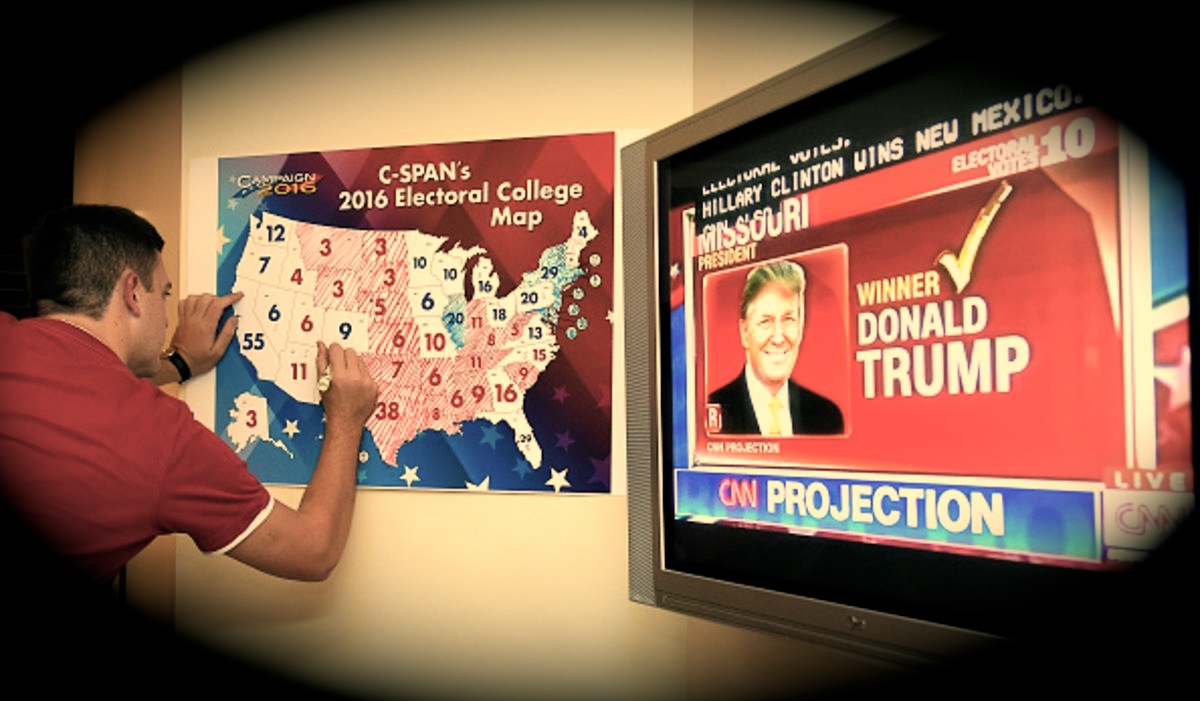
Science isn’t about predicting one-off events like election results, but that doesn’t mean the way to make election forecasts scientific (which they should be) is to build “theories of voting.” A number of people have sent me articles on statistical aspects of the recent U.S. election, but I don’t have much to say and I like to keep my blog non-political. I won’t violate this rule in making a couple of comments on Faye Flam’s Nov. 11 article: “Why Science Couldn’t Predict a Trump Presidency”[i].

For many people, Donald Trump’s surprise election victory was a jolt to very idea that humans are rational creatures. It tore away the comfort of believing that science has rendered our world predictable. The upset led two New York Times reporters to question whether data science could be trusted in medicine and business. A Guardian columnist declared that big data works for physics but breaks down in the realm of human behavior. Continue reading

Categories: Bayesian/frequentist, evidence-based policy | 15 Comments

Gigerenzer at the PSA: “How Fisher, Neyman-Pearson, & Bayes Were Transformed into the Null Ritual”: Comments and Queries (ii)

screen-shot-2016-10-26-at-10-23-07-pm

.

Gerd Gigerenzer, Andrew Gelman, Clark Glymour and I took part in a very interesting symposium on Philosophy of Statistics at the Philosophy of Science Association last Friday. I jotted down lots of notes, but I’ll limit myself to brief reflections and queries on a small portion of each presentation in turn, starting with Gigerenzer’s “Surrogate Science: How Fisher, Neyman-Pearson, & Bayes Were Transformed into the Null Ritual.” His complete slides are below my comments. I may write this in stages, this being (i).

SLIDE #19

gigerenzer-slide-19

  1. Good scientific practice–bold theories, double-blind experiments, minimizing measurement error, replication, etc.–became reduced in the social science to a surrogate: statistical significance.

I agree that “good scientific practice” isn’t some great big mystery, and that “bold theories, double-blind experiments, minimizing measurement error, replication, etc.” are central and interconnected keys to finding things out in error prone inquiry. Do the social sciences really teach that inquiry can be reduced to cookbook statistics? Or is it simply that, in some fields, carrying out surrogate science suffices to be a “success”? Continue reading

Categories: Fisher, frequentist/Bayesian, Gigerenzer, Gigerenzer, P-values, spurious p values, Statistics | 11 Comments

I’ll be speaking to a biomedical group at Emory University, Nov 3


d-g-mayo-emory-flyer
Link to Seminar Flyer pdf.

Categories: Announcement | 1 Comment

Philosophy of Science Association 2016 Symposium

screen-shot-2016-10-26-at-10-23-07-pmPSA 2016 Symposium:
Philosophy of Statistics in the Age of Big Data and Replication Crises
Friday November 4th  9-11:45 am
(includes coffee  break 10-10:15)
Location: Piedmont 4 (12th Floor) Westin Peachtree Plaza
Speakers:

  • Deborah Mayo (Professor of Philosophy, Virginia Tech, Blacksburg, Virginia) “Controversy Over the Significance Test Controversy” (Abstract)
  • Gerd Gigerenzer (Director of Max Planck Institute for Human Development, Berlin, Germany) “Surrogate Science: How Fisher, Neyman-Pearson, and Bayes Were Transformed into the Null Ritual” (Abstract)
  • Andrew Gelman (Professor of Statistics & Political Science, Columbia University, New York) “Confirmationist and Falsificationist Paradigms in Statistical Practice” (Abstract)
  • Clark Glymour (Alumni University Professor in Philosophy, Carnegie Mellon University, Pittsburgh, Pennsylvania) “Exploratory Research is More Reliable Than Confirmatory Research” (Abstract)

Key Words: big data, frequentist and Bayesian philosophies, history and philosophy of statistics, meta-research, p-values, replication, significance tests.

Summary:

Science is undergoing a crisis over reliability and reproducibility. High-powered methods are prone to cherry-picking correlations, significance-seeking, and assorted modes of extraordinary rendition of data. The Big Data revolution may encourage a reliance on statistical methods without sufficient scrutiny of whether they are teaching us about causal processes of interest. Mounting failures of replication in the social and biological sciences have resulted in new institutes for meta-research, replication research, and widespread efforts to restore scientific integrity and transparency. Statistical significance test controversies, long raging in the social sciences, have spread to all fields using statistics. At the same time, foundational debates over frequentist and Bayesian methods have shifted in important ways that are often overlooked in the debates. The problems introduce philosophical and methodological questions about probabilistic tools, and science and pseudoscience—intertwined with technical statistics and the philosophy and history of statistics. Our symposium goal is to address foundational issues around which the current crisis in science revolves. We combine the insights of philosophers, psychologists, and statisticians whose work interrelates philosophy and history of statistics, data analysis and modeling. Continue reading

Categories: Announcement | 1 Comment

Formal Epistemology Workshop 2017: call for papers

images-33

.

Formal Epistemology Workshop (FEW) 2017


Home Call For Papers Schedule Venue Travel and Accommodations

Call for papers

Submission Deadline: December 1st, 2016
Authors Notified: February 8th, 2017

We invite papers in formal epistemology, broadly construed. FEW is an interdisciplinary conference, and so we welcome submissions from researchers in philosophy, statistics, economics, computer science, psychology, and mathematics.

Submissions should be prepared for blind review. Contributors ought to upload a full paper of no more than 6000 words and an abstract of up to 300 words to the Easychair website. Please submit your full paper in .pdf format. The deadline for submissions is December 1st, 2016. Authors will be notified on February 1st, 2017.

The final selection of the program will be made with an eye towards diversity. We especially encourage submissions from PhD candidates, early career researchers and members of groups that are underrepresented in philosophy. Continue reading

Categories: Announcement | Leave a comment

International Prize in Statistics Awarded to Sir David Cox

00-statprize

Unknown-1

.

International Prize in Statistics Awarded to Sir David Cox for
Survival Analysis Model Applied in Medicine, Science, and Engineering

EMBARGOED until October 19, 2016, at 9 p.m. ET

ALEXANDRIA, VA (October 18, 2016) – Prominent British statistician Sir David Cox has been named the inaugural recipient of the International Prize in Statistics. Like the acclaimed Fields Medal, Abel Prize, Turing Award and Nobel Prize, the International Prize in Statistics is considered the highest honor in its field. It will be bestowed every other year to an individual or team for major achievements using statistics to advance science, technology and human welfare.

Cox is a giant in the field of statistics, but the International Prize in Statistics Foundation is recognizing him specifically for his 1972 paper in which he developed the proportional hazards model that today bears his name. The Cox Model is widely used in the analysis of survival data and enables researchers to more easily identify the risks of specific factors for mortality or other survival outcomes among groups of patients with disparate characteristics. From disease risk assessment and treatment evaluation to product liability, school dropout, reincarceration and AIDS surveillance systems, the Cox Model has been applied essentially in all fields of science, as well as in engineering. Continue reading

Categories: Announcement | 1 Comment

Blog at WordPress.com.