Manipulative parasites induce phenotypic changes in their hosts that neuroscientists cannot recreate in the lab. These parasites can be thought of as evolutionary neuroscientists, and understanding the mechanisms through which they manipulate host phenotype may reveal previously unexplored links between the immune system, brain, and behavior.
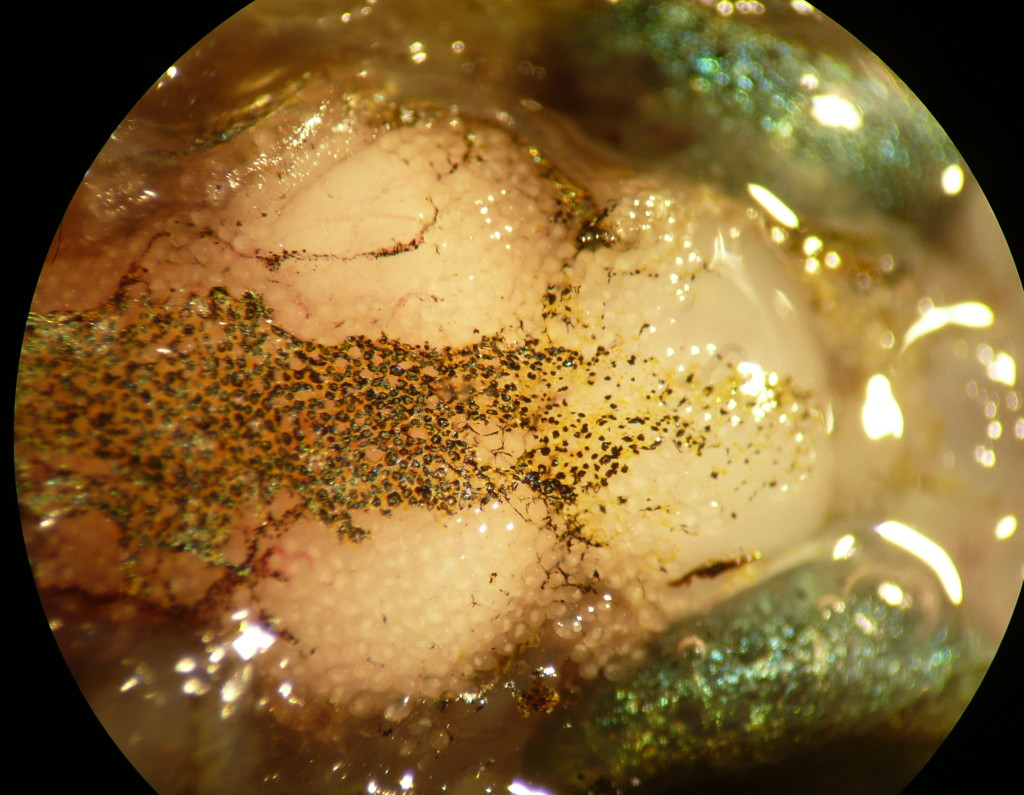
EUHA infection is associated with baseline changes in neurotransmitter activity and a suppression of the serotonergic stress response in California killifish. To explore how EUHA induces these changes in neurotransmission, Dr. Øyvind Øverli (Norwegian University of Life Sciences) and I conducted a pilot study quantifying the metabolome of various brain regions. We discovered brain-region specific differences in the metabolome of infected and uninfected fish, and are working to identify these compounds and determine their relevance for changes in neurotransmitter activity.
Changes in neurotransmitter activity could result from parasite manipulation of hormones or vice versa, or both. I thus predicted that infection would be associated with changes in cortisol (a stress hormone). In collaboration with Dr. Ryan Earley (University of Alabama), I validated a non-invasive hormone collection technique that extracts hormones from the water in which a fish has been held for an hour. Water-borne release rates of cortisol mirrored concentrations of these hormones in the plasma, revealing that water-borne hormone release rates are biologically relevant. I discovered that an interaction between EUHA density and handling stress is an important predictor of cortisol release rates (Weinersmith et al., in prep). We thus observed stress-associated, but not baseline differences in steroid hormone release rates.
To confirm that observed changes in hormone release rates were induced by EUHA and to explore their impact on killifish behavior, I measured baseline and stress-associated cortisol release rates and conspicuous behaviors before infection, and again at 1, 2, 4, and 6 weeks post-infection. Once behavioral video analysis and hormone assays are complete, this experiment will distinguish between killifish-induced and parasite-induced changes in cortisol release rates.