Thursday, December 10, 2015

Why are "new economy" moguls mostly optimists?

Are people in the New Economy – especially tech billionaires – different from their Old Economy peers? I have long maintained that the Silicon Valley types retain a sense of loyalty to the “diamond shaped” society that engendered them, and to the middle class engineers and others whose skill made them rich. This is in sharp contrast to those who got wealthy from resource extraction, finance-parasitism and inheritance, who tend toward colluding together in hope of restoring society to its more accustomed shape – a feudal pyramid of owner-privilege.  As evidence for this difference, many tech moguls have signed the Gates-Buffett pledge to donate half their wealth to good causes. Another? Most of them are (or sympathize with) democrats.  

But in fact, the situation is complex.  As this article -- Silicon Valley Represents an Entirely New Political Category -- shows, these men and women of the New Economy – including those who are less than zillionaires – retain some strong libertarian leanings.  They want capitalism to be open and competitive and fair… but they want capitalism. They tend to be “collectivist” in the sense that they stroingly believe in a commons where all children get fed, and educated, with free health care… but they expect the resulting, confident adults to need and want to strive. Government has a major, desireable role in all of this. But its preferred function is to level the starting blocks, not the finish line.

Gregory Ferenstein writes, “I found that the philosophy of Silicon Valley is radical idealism. Founders describe themselves as optimists, first and foremost.”  And… “This idealism is not rhetorical fluff; it’s founded on two deep-seated assumptions about the world: change is inherently progressive and there are no conflicts between major groups in society.”

The author then cites Elon Musk: “If we’re all in a ship together and the ship has some holes in it, and we’re sort of bailing water out of it, and we have a great design for a bucket, then even if we’re bailing out way better than everyone else, we should probably still share the bucket design.”

This view is refreshing… and jibes well with the underlying notions of science fiction.  That change is inevitable, but exploring it together, openly – mixing competition that is fair with cooperation that is real and far-seeing – can take us forward to better days. 

Of course there are optimists and then hyper optimists, as Peter Diamandis shows in his book Abundance.   If he's right (and many indications are there) then we are on our way to Tomorrowland.  Then Star Trek. But only after finishing our passage through this adolescent purgatory, solving problems ambitiously and scientifically and with good will.

== Global Trends  ==

New projections from the UN suggest that, in a few decades, we could secure a stable global population. “To be clear, the forecasts do not show an imminent end to population growth – far from it. The global population has the momentum of an elephant on an ice rink. The U.N.’s medium-variant projection shows a rise to 9.7 billion people in 2050 and 11.2 billion by 2100.”

The plunge in childbearing is startling. Eighty-three countries containing 46 per cent of the world’s population – including every single country in Europe – now have fertility below replacement rate of about 2.1 births per woman. Another 46 per cent live in countries where the birth rate has fallen sharply. In 48 countries the population will decline between now and 2050. That leaves just 9 per cent of the world’s population, almost all in Africa, living in nations with pre-industrial fertility rates of five or six children per woman. But even in Africa fertility is starting to dip.

200 Years that Changed the World: A classic animation showing how life expectancy and wealth have varied in a wide sampling of nations, across the last 200 years.  See China “bounce” during the 1840s T’ai Ping Rebellion and points scatter during the two world wars, then a more recent acceleration as much of the world catches up – at last – with the West.  

== and more ==

Kiosks!  I think the trend is seriously under-rated. The company that runs Redbox and Coin-Star is now putting out ECO-ATM which will pay cash for your old cell phone, while ensuring it is either refurbished or recycled.  Does it seem archaic? After all, who will be renting DVD disks in ten years?  Oh, the business will have to be agile. But picture a 3D printing kiosk that’s much more capable than the little unit in your garage.  Look up the piece you need and zap an order to the nearest kiosk, retrieving it far faster than any drone will bring it to you…. 

Developing skills to manage the future: A new game in development attempts to utilize all the fun world-building tools and capabilities that kids find so attractive in Minecraft, but with an added layer of natural beauty and much better eco-economics.  In ECO, players choose whether to run their civilization democratically or feudally and so on and get to compare results. Players use ever-changing data about the ecosystem to make wise economic and social choices. Develop too fast or in a wastrel way and you will rapidly deplete your resources. 

Foiling threats: The raging wildfires out west have led to a trend… wrapping cabins in aluminum foil. 

Changing attitudes... An interesting article shows that thousands of locales in the U.S. still have place-names that are racist or otherwise offensive by modern and evolving standards.  Most must have been offensive - deliberately so - in their own time and context… though some may have been genuine homages. No matter.  Standards do evolve and we should use names to suit our needs and times. And our time needs to to care. 

And yet divides remain: John Oliver does a terrifically incisive – and hilarious – job exploring the vast disparity in Sex Education across the U.S.

One of the world's great animators makes the transition from paper to virtual reality...

Yogi Berra died at age 90: Yogi was far, far wiser than that awful, nasty little oven mitt, Yoda!
  

Tuesday, December 08, 2015

Paranoia, Conspiracies and Surveillance

== Another summons to resigned despair ==

Conspiracy theories abound.  They erupt out of human nature, it seems, and your ethnicity or caste or political leanings only affect which direction you credit with devilish cleverness, secret power and satanic values. For sure, as a science fiction author I can concoct plausible schemes and plots with the best of them!  Indeed, let me add that some real life cabals are so blatant and proudly obvious that you just have to admit – sometimes “they” are completely real and up to awful mischief.

(Anyone who does not trace the ownership of Fox News, for example, and draw obvious conclusions, must already have succumbed to that particular mind control plot.)

And yet, I have a completely different take on this kind of paranoia. It helps to step back and realize that almost certainly the vast majority of wild-eyed conspiracy theories out there are hogwash. 

Moreover, underlying it all is the fact that most are all about flattery!  Each one caters to the believer’s inflated sense of importance: 

“Me and my pals are in the know, and the rest of you are sheep!”

Never once have I seen any conspiracy fetishist stop and admit the obvious, that every Hollywood film preaches not just suspicion of authority (SoA), but also the bovine nature of our neighbors.  (Neighbors who assume they are the knowing ones, while you are the braying, easily-fooled ungulate.)  

But okay, let’s put aside the fact that cabal-believers suckled their SoA milk from the most relentless propaganda campaign in human history. That irony is too rich for them (or even most of you) to fully contemplate. Nevertheless, is it possible that some of the “black helicopter” type scenarios contain a grain of truth?

More than a grain, I’ll avow.  Oh, not “government camps” and martial law or any of that crap.  If you ever met an actual civil servant, in one of those cryptic agencies, you’d know how hard such things would be to keep secret.  Edward Snowden blew the whistle on… what was at the time marginally legal meta-data mining, with not a single citizen being even slightly (physically or financially) inconvenienced.  There’d be 10,000 Snowdens if any of the Blofeld-style scenarios about real heinous stuff had even a glimmer of truth.

(That is my own take on Snowden, that he served as a canary demonstrating the threshold of “heinousness” at which civil servants can be expected to step-up.  And we can take some solace that the threshold is way, way, way lower than “black helicopters.”)

But no… the grain of truth has to do with surveillance. Watching us. Collating data from our phones and online searches and fitbits and phone calls.  The stuff that Snowden and his fellow “T Cells” are complaining about, and that serve as grist for this leap by Walter Kirn into gonzo paranoid-journalism in the Atlantic, entitled: “If You’re Not Paranoid, You’re Crazy.” 

Mr. Kirn begins with a very leading question: 

“As government agencies and tech companies develop more and more intrusive means of watching and influencing people, how can we live free lives?” 

Tabulating a series of worst-case scenarios and semi-warranted extrapolations, he weaves a pretty darn entertaining-scary tapestry of “we might as well give up now, because Big Brother is already here.” (My (accurate) paraphrasing.)  

Oh-kaaay.  But then, Mr. Kirn, even if you are right in every respect, what’s your prescription, sir? And why do you never once even try to answer the question posed in the title of your screed? 

Of course there’s no solution offered. As we saw above, jeremiads are easy.  Cynical, snarled rants flow, by pure momentum, no different than the ones you wrote as a college sophomore. 

 Oh, don’t get me wrong. We need shouted warnings that we are about to lose our freedom to tech empowered hierarchs – whether the elites in question are new-lord aristocrats, faceless corporations or faceless government bureaucracies.  The real reason that our myths nearly all preach Suspicion of Authority is because the danger is very real!  

We are revolutionaries.  And outside of the last couple of centuries in the west, no other experiment in freedom or in flattened social orders ever lasted more than a generation. I utterly share a deep, grinding worry that some privileged few will regain the kind of obligate power over our lives that kings and priests exerted, nearly everywhere for 6000 years.  

Only, I'm not satisfied to smugly point and shout denunciations. As said in part 1 (above), I want to look at how we got the (imperfect/threatened) window of relative freedom we currently have. Only by understanding this will we be able to prescribe solutions and pass the imperfect gift on to future generations.

And this Atlantic article only makes me sigh. Mr. Kirn, like almost every other privacy pundit, is so ensorceled by dudgeon that he cannot – even briefly – glance at what has worked so far. Nor at the possibility that these new technologies might empower us and our will-to-freedom… 

...as they have already done, recently, in the Black Lives Matter Movement. A perfect case of technology making more of a difference than anyone wants to admit.  Making the difference, in fact.  And that difference was technology empowering the People, and not the Man.

By dismissing that - even as a passing thought - Mr. Kirn and other Jeremiahs show that their interest does not lie in solutions, or even revolution. It revolves around the number two lesson suckled from Hollywood flicks – right after suspicion of authority.  That all my neighbors are sheep.

== From the battlefront for freedom, transparency and privacy  ==

Which is a pity, because the Big Brother trends are, in fact, very real!  For example, Singapore has established Social Credit Scoring and China plans to follow suit.  From a western perspective it seems spectacularly chilling, that civil servants at a monolithic government agency should track every aspect of your life and tabulate in a single number how fine a person you are being? How much “credit” you have to be trusted with things like passports and visas and even childbearing?  

It is the ultimate manifestation of top down methods of governance.  Whether implemented in order to smoothly deliver services in an all-swaddling nanny state or else to create the ultimate Orwellian enforcement machine, most of us over here, across the political “spectrum” would deem the whole approach to be utterly loathsome and doomed to devolve into stifling tyranny.

And yet, the author of this piece suggests that even the US cannot help but evolve, at least somewhat, in this direction.  Elements of this judgment-and-reward system already exist in the U.S. private-sector credit scoring infrastructure, in our college scores, and in the United States TSA’s airline passenger “whitelist” system. Indeed, many futurists (including yours truly) have talked about Reputation systems replacing currency.

The visceral reaction is basically correct. Take an interesting experiment in militant transparency:  The Open Source Party is a political movement that derives both inspiration and methods from Open Source software principles. The crux: political processes are seen as a body of code. That code, and any changes to the code, must be visible and understandable and modifiable by a free and agile user-citizen population.  And I am there… in principle.  Let’s discuss the principle… while pushing ahead with the practical.  

== Biometrics… Schmetrics… ==

The sad thing is how many of our brave and righteous paladins of Freedom - for example at ACLU and EFF are right and righteous in their overall dedication to prevent Big Brother, yet wind up recommending the same wrongheaded prescription that cannot possibly work:

"Everybody hide!"

Over the years, I've given an insane number of examples. Here's another: in September, the Office of Personnel Management admitted that the number of federal employees’ fingerprints compromised in the massive breach of its servers revealed over the summer has grown from 1.1 million to 5.6 million.  OPM adds that it’s mailing letters to all affected victims, and notes that it’s also offering them free credit monitoring.  And it goes much farther. 

In The Transparent Society I talk about the difference between a unique identifier and a verifier.  Your Social Security number is an example of the former.  It correlates with a unique person and say, "this conversation or transaction is about this particular John Smith and no other."  It does not prove that the person using the SSN actually IS that John Smith!

A password is the very opposite of an identifier. It can be changed! It can be replaced with a more secure one!  Fingerprints are like SSNs.  They establish who is being discussed.  It used to be, when only the FBI had a database of them and they were hard to copy, a fingerprint might be used also as a verifier.  That is no longer true.

In future, almost any single biometric that is unique to you might be sniffed or snooped or recorded. So we will adapt.  You'll visit your local bank branch monthly or weekly and there the whole suite of biometrics will confirm who you are and you and your banker will then clean up and establish that month's (or week's) passcodes.  Again we will adapt!  I didn't claim it would be easy or problem-free.

But we must start by looking at fundamentals.  And understanding the difference between an identifier and a verifier.  One of dozens of things explained carefully in The Transparent Society.

 == A philosophical aside: Principles vs Outcomes ==

We should hold in suspicion any and all proclamations of pure and enraged principle, unless those stances can also point to:

1. correlation with positive real-world outcomes over long time spans, and 

2. an inherent ability to keep re-evaluating, adjusting and backing out of errors.

Purist declarations have been used so often to justify self-serving oppression of others and/or cheating or simple insanity, that we must deem this kind of rationalization to be one of humanity's greatest sicknesses.  

That is not to say that all declarations of principle are wrong! But let's take one example -- Freedom of Speech.  A core principle that most of us deem quasi-sacred, without ever pausing to ponder how the vast majority of our ancestors would have called it crazy.  

FoS seems "good" to us.  But that appearance is backed-up by a solid correlation with our civilization's spectacularly better rates of innovation, wealth-generation, problem-solving and fun, all of which are direct outcomes of FoS.   Which must be defended with zeal AS IF it were holy, though the deepest reasons are pragmatic.  

Especially the end to 6000 years of societies wasting most of their available human talent.

Likewise, Freedom of Speech is the best way to detect errors and flaws, even in our own principles -- even in our most-sacred principles, like Freedom of Speech!  Allowing us to make guarded, minimal but practical compromises that make sense to each generation.  But above all, allowing later generations to fluidly argue, re-assess and back out of mistakes. That ability to keep up a diversity of viewpoints that are not repressed by either hierarchy or conformity is a palpable and inarguable strength that FoS fosters.

Am I saying we should never passionately propound principles?  Not so!  FoS must be shouted zealously, even religiously, or we'll not have the fervor it will take, to overcome the world's cheaters and would be oppressors (including those on our "side.") But over the long run, there must be a grounding in objective reality, or all our subjective screaming will not suffice to make a false "principle" true.

== And finally ==

A fascinating article on Cold War intelligence shows how a KGB official was able to glean patterns  from the simplest details in order to uncover CIA operatives, so effectively that the CIA went crazy for years, searching for nonexistent moles.  This sort of thing, by the way, is why I roll my eyes over “crypto” fans who declare that encryption of online data is all they need in order to be free forever from meddling by the oppressive State.  

I have yet to meet one cypherpunk who has ever studied the 4000 year history of cat and mouse games by spies and resistance  cells and secret police, dating back to Hammurabi.  Of the dozen or so general types of methods used by czarist and Nazi and Communist and imperial and modern agencies to pierce underground movements, crypto can only – even theoretically – inconvenience maybe three. 

Such blithe, willfully trusting fantasy and ignorance would be charming, except that these techno-romantics style themselves as our best defense against Big Brother. Fortunately… there are others. 
  

Saturday, December 05, 2015

Sci Fi Flicks - getting better and better? (Plus some coolness from space.)

My next science fiction posting will have plenty of news... about my new book...

...and about the twenty or so new film and TV projects that appear to be in the works, based on actual, first-rank novels by real, thoughtful authors like Clarke, Asimov, Scalzi, Stephenson, Leckie and more. But first...

Note that SyFy will premiere both Childhood's End and The Expanse on December 14. One of them at 8 pm and the other at 10 pm. Make it a viewing party with friends! (We mean to!) and from 9 to 10? You could either socialize during the break... or make it a science fiction marathon by inserting a viewing (on Amazon Prime) of The Man in the High Castle!

So until that next big SF posting...shall we make do with lesser but still cool news?

A new film 51 Degrees North confronts the main character with news that the world will end in less than three weeks when a series of asteroids will strike the Earth. However, a glimmer of hope remains in the form of a secret space station orbiting the Earth that can house up to 2,000 people. Hm. While apocalypse is getting really hackneyed, this one seems interesting… and a clear prequel to Neal Stephenson’s new novel Seveneves.

We got glimpses of the future of Artificial Intelligence in both Ex Machina and Chappiewritten and directed by Neill Blomkamp, who also did District 9 and Elysium)The audience identifies with the child-robot -- an overall concept which is possibly correct.  To be honest, I found Ex Machina to be truly I'm inferior in about a dozen ways. Alas.

Jennifer Phang's indie science fiction film Advantageous, a darling of 2015’s Sundance, came to Netflix Instant Streaming (and Amazon)….  As Arthur Chu put it: "We live in a renaissance of science fiction film and TV and "geek" culture in general -- the accelerating pace of technological change thanks to Moore's Law makes it hard to deny we're living in "the future," we're all part-machine-part-human for practical purposes now, no one can guess what element of science fiction is next to become science fact..." Actually about technological obsolescence...

By all means rent the film Predestination. It's a wonderful expansion upon Robert Heinlein's uber-classic story "All You Zombies."  The entire story is there, every single scene... though of course there are added layers and layers, to make it a movie.  None of those layers detract.  The compounded ironies are preserved and enhanced. The writing is solid. Ethan Hawke and Sarah Snook are terrific. It is simply criminal that she was not nominated for Best Actress in the Academy Awards. Criminal. 

I deeply disliked the pretentious and misleading Alan Turing flick Imitation Game, though Benedict Cumberbatch was good as usual.  Breaking the Code was much better, and I saw it in London with Derek Jakoby!

Brin in espanol!  El Pais, the prestigious Spanish Language journal and site has posted a 4-minute interview with David Brin about our fantastic future.

Talk about sci fi. I describe this from many angles in stories...people who hope for resurrection via AI-tech, by recording as much as possible for the rest of their lives.

Running a little short, this time.  So let's tack on...

== ... some news from Space! ==


What does it look like when a black hole eats a star?  This embedded NASA video animation is way-cool! 

Some exoplanets have a bulk density higher than iron's. The authors assume that these worlds are the naked cores of jovian planets that have lost their outer layers, and that the extreme density results from the presence of degenerate matter. Under some circumstances the degenerate matter can survive for geological time scales; in others, decay of the degenerate matter will actually cause the planet to explode.

This video by Deep Space Industries describes plans for asteroid mining.  And here is one from Planetary Resources. And yes there are still those who believe in the Moon, as in this TED talk, though I am definitely in the asteroid camp... as are most scientists and folks serious about getting the riches we need, to make space sustainable.    

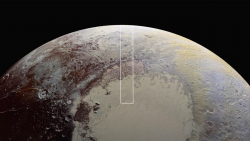
And finally, did I mention that 2015 was the best year for humanity’s exploration of space ever? So far?  Here’s a final taste of a great year in which we should have been proud, instead of boorishly angry ingrates all the time.  A video released by the New Horizons team shows the best closeups yet of Pluto’s bizarre and spectacularly varied surface. 


Thursday, December 03, 2015

Smart tech! - and how to allocate your well-targeted philanthropy

Tis the season for giving, right? We are all getting emails from philanthropic entities… and I am all in favor! But can some basic principle guide your choice? How about a strategic approach?  Start with a list of things you care about in the world. I’ll bet every one of your concerns has some NGO dedicated to making it happen. So why not, once a year, pay dues to a dozen or so? That way, through the magic of “proxy activism,” you can know you’re doing the basic minimum… hiring others to make the world better for you!  

For example combine the Sierra Club and Greenpeace with the Electronic Frontier Foundation and ACLU, plus The Planetary Society and Oxfam— six modest checks and voila! You’re a participant in eco, liberties and hunger shifts for the better and helping us move forward exploring the cosmos. Sure, it’s good to do more than that! By all means pick a political party and a candidate. A local library and food bank. A local high school robotics team. But here’s the deal; if you are doing less than a dozen such memberships - chosen by your own standards - then it’s pretty clear what kind of person you aren’t. 

Proxy activism says: “I know I’m cheap and lazy and distracted by other things.  But at least I can give my support to a dozen NGOS who will hire dedicated people to be active, saving the world in ways that I — in my lazy-distracted way — think it needs saving!” Learn more about this approach, which I have been promoting for two decades.  

A final note to those of you who believe in singularities or life extension.  Okay so you've got your cryonics contract and all that. What makes you think future people will want to revive you, just to spend money you squirreled away in investments?  Bah.  They will be choosy who they want to revive and share their world!  And they'll take into account whether any of the frozen folks truly did try to make it a better world.

Come to think of it, that's a reasonable-better standard for getting into classic Heaven.

== Interesting! ==


The new season of Xploration Earth2050 started last week. It's good to be back. You can watch both seasons on Hulu or Amazon. And yes, I give good blather.


And  now a holiday season run-down of cool items.

How can we fight back against the War on Science?  Billionaire Yuri Milner, who established the Breakthrough Institute’s new endeavor to re-invigorate SETI, now leads a group of his peers in establishing a set of big-time, Hollywood-style awards for top scientists, hopefully leading to some of the burnished prestige that comes from red-carpet treatment.  With his friends Facebook CEO Mark Zuckerberg, Google cofounder Sergey Brin, 23andMe founder Ann Wojcicki and Alibaba CEO Jack Ma, Milner wants the world to celebrate the great research being done in fundamental physics, life sciences and math.  Each of the seven winners gets $3 million and a chance to stand onstage before a crowd of Silicon Valley’s leading lights, in a ceremony broadcast live on the National Geographic channel.

An interesting rumination on “algocracy”… our incipient trend toward leaving some kinds of decisions – even policy – to be decided by algorithms. John Danaher writes, “Public decision-making processes ought to be legitimate. Most people take this to mean that the processes should satisfy a number of proceduralist and instrumentalist conditions. In other words, the processes should be fair and transparent whilst at the same time achieving good outcomes. The problem with algocratic systems is that they tend to favour good outcomes over transparency and fairness.” Someone watch the source material and report back here? 

U.S. shale oil producers shocked everyone by innovating to remain efficient and profitable when prices fell below $50 a barrel, despite Saudi efforts to flood the market and drive them out of business.  Now though, at $40 or so, U.S. producers are finally pulling back... which should not be taken as bad news!  Let our oil sit in the ground when it’s this cheap, if the Saudis are willing to sell at a loss.  Now is the time to invest in re-filling the U.S. Strategic Petroleum Reserve.. exactly opposite to the Republican strategy of always selling our national resources low (to pals) and buying high. (You should see the travesty that traitors did with our Helium Reserve.)  

Merrill-Lynch projects investment opportunities in artificial intelligence, in general robotics, drones… and – well – killer robots.  Ironic, given how Wall Street is busy funding the biggest chunks of AI research, all of it aimed at developing “skynet” intelligences that will be designed from go to be predatory, parasitical, amoral and insatiable. 

== Tech Advances ==

Moore’s Law ain’t done yet?  Shrinking transistors even further… probably sometime after the beginning of the next decade, reducing the contact point between the two materials to just 40 atoms in width, the researchers said.  By simply swapping carbon nanotube transistors for conventional ones in a simulated IBM microprocessor, they were able to increase speeds by as much as seven orders of magnitude or, alternatively, achieve almost as significant power savings.

Smart LEDs will help us save the planet.  They will also communicate with the house, with each other and you phone.  Introducing “Li-Fi” — 100x as fast and capable as Wi-fi and just in time for the Internet of Things.  The good news is obvious. More info!  Faster!  Can we get all that without the bad? Smart bulbs spying on us for hackers or The Man?  

Li-Fi presents one more example of the utter impossibility of the “solution” suggested by most well-meaning civil libertarians… endless legislation to reduce info-flows. That will not protect freedom or even privacy.  Not at all.  Not even a little bit.  It never has and never, ever will. But if we can catch the voyeurs, we might prevent them from actually using the info to harm us.  Why, oh why is that so counter-intuitive?

== The point is driven home ==


They will be able to see through walls.... A team from MIT has invented "RF-Capture" – which can discern and identify persons by analyzing the reflections from ambient WiFi signals, even through walls as they reflect off the moving human body, parsing heart rate and breathing patterns. Creeped out yet? But this is only one more out of a near infinite number of examples of how futile is the routine and reflex prescription offered by modern activists recommending that we all "hide!" 

That reflex is becoming pathetic, distracting folks from the only thing that can can possibly, even conceivably, defend freedom and (some) privacy. Forget the cowardly and hopeless goal of hiding. Be militant, insisting that average citizens share the elite's unstoppably rising power to see. Our hope lies in demanding and developing the power to supervise those in power. If they are going to be able to peer at us through walls, then we must seize our right to look back.

== Future Tech Miscellany ==


How will we enhance bio-security? The National Bio and Agro-Defense Facility (NBAF) in Manhattan, Kansas. This state-of-the-art maximum biocontainment facility will offer leading-edge capabilities to help protect our food supply and the nation’s public health. They are beginning with a $100,000 prize/challenge for unique ideas how to do this.  

Huh. The X-Prize methodology has been really taking off.  Its advantages are huge and manifold. (1) it stimulates imaginative thinking from a wide variety of outside competitors who feel incentivized to think outside the box. (2) In most such contests, the teams each spend much more than the prize purse, in (very realistic) hope of followup patents and contracts and publicity for outside customers, even for second or third placers. (3) the prize-givers do not have to spend much till they get results dropped into their laps. (4) It is a creativity-stimulating methodology that is inherently difficult for closed or despotic societies to emulate.

Perhaps overly optimistic... Super-fast hyperloop transportation could arrive in about five years! 

Researchers have developed a method to produce the highly-sought after graphene that is 100 times cheaper than the traditional method.

Heard of “Gorilla Glass?” Get ready for "Godzilla Glass." 

People call bright flashlights "tactical" ... this one might be subject to arms treaties.  1000-Watt LED Flashlight: 90,000 Lumens

== Preparing for change ==

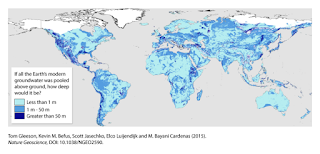
The first map showing the world's hidden groundwater brings us closer to estimating how much there is, and when it will run out if we over-use the resource. 

Science is offering paleontological perspective on climate change.  At one extreme is the “Green Sky” catastrophe that (we now think) drove the worst extinction of them all, at the end of the Permian, which a methane-flooded atmosphere, joined by sea-bottom hydrogen-sulfide - became acidic, killing most of life on Earth.  Let’s try not to set off a methane-release calamity of our own, as ever more of that powerful greenhouse gas fizzes out of hydrate ices long buried under the now-warming seas.

Milder but important-to-understand swings happened when earlier greenhouse eras suddenly swung negative, leading to ice ages.  In the Journal of Geology there is a new paper that describes how dust in Paleozoic times resulted in plankton blooms and reduction of CO2 levels in the air that were many times present day levels to such low levels as ice ages were initiated. 

Only note that this particular article originates from a controversial figure who was involved in the “rogue experiment” a few years ago – sponsored by a native American tribe – to dump iron dust into currents off the Pacific Northwest.  While I share a belief that experiments in ocean fertilization have been improperly blocked and should proceed, I cannot actually condone rogue and unvetted and rather unscientific “experiments” of this kind. 

The dust thing is of course related to why -- in my novel Earth -- I portray tide powered bottom-stirrers that send up plumes of ocean bottom muck into fast currents, thus fertilizing vast stretches that are now almost lifeless deserts.  This would be better than the iron-dumping experiments, since stirring simply emulates what nature already does in rich fishery zones like Chile and the Grand Banks.

== Biotechnology advances ==

The latest Great Life Hope for those who want to live forever?  An experimental drug targeting Alzheimer’s disease shows anti-aging effects in animal tests. “We did not predict we’d see this sort of anti-aging effect, but J147 made old mice look like they were young, based upon a number of physiological parameters.” Oh, but there are many ways to get such effects in mice. And any such drug… that our ancestors could have evolved to synthesize themselves … classifies as “low hanging fruit.” The effects on ameliorating specific syndromes of aging may be fine.  But it will not (I predict) affect even slightly the "wall" of 100 to 120 years.

A new test detects virtually any virus that infects people and animals. Subtypes can be identified easily. To develop the test, the researchers targeted unique stretches of DNA or RNA from every known group of viruses that infects humans and animals.  “It also may be possible to modify the test so that it could be used to detect pathogens other than viruses, including bacteria, fungi and other microbes, as well as genes that would indicate the pathogen is resistant to treatment with antibiotics or other drugs.”  

An artificial retina can be implanted and restore some sight to certain kinds of blindness. And cataracts, known to be the leading cause of blindness in humans, may soon be cured via a simple eye drop.

Scientists would like to understand what the genetic basis is for humans' apparently special capacity for logic, abstract thought, complex emotions and language. Humans and chimpanzees have DNA that's remarkably similar — researchers say our genetic code is about 95 percent identical. “Scientists would like to be able to make a genetic change and show that it really makes a difference. "But we're talking about humans and chimpanzees here, and you cannot experiment on either of those," she notes. "And so it's very challenging to prove causation."  

I guess the future is (almost) here. Take this title of a talk at USC: “Engineering Memories:  A Neural Prosthesis for Cognitive Function.”  Yes a microchip implant in the hippocampus to get around damaged areas that destroyed memory function. They aim at creating: “a biomimetic model of hippocampal nonlinear dynamics that can perform the same function as part of the hippocampus.  Through bi-directional communication with other neural tissue that normally provides the inputs and outputs to/from a damaged hippocampal area, the biomimetic model can serve as a neural prosthesis.”  Woof.

The PCS - paracingulate sulcus - is one of the last structural folds to develop in the brain before birth, and varies in size between individuals. It is linked to the ability to distinguish real from imagined information, a process known as ‘reality monitoring.’ In people diagnosed with schizophrenia, a 1 cm reduction in the fold’s length increased the likelihood of hallucinations by nearly 20%.

In an example of rapid evolution in action, three new species of wasps are turning into three new species, in real-short time.  Let's hope they don't become as terrifying as in Joe Wallace's creepy novel Invasive Species.

And finally...

"Cli Fi" Maven Dan Bloom offers the following observation: "In Isaac Asimov’s 1941 short story “Nightfall,” a journalist in the distant future on a far away imaginary planet named Lagash strikingly resembles the cynical columnists on the planet Earth. Asimov’s story deals with a kind of climate denialists. A Lagash scientist lashes out at a newspaper editor who could be someone like Marc Morano or Anthony Watts of today:
         “You have led a vast newspaper campaign against the efforts of myself and my colleagues to organize the world against the menace which it is now too late to avert.”
        That quote from a 1941 sci fi story offers a chilling forecast of a modern journalism that gives equal time to climate change deniers. Scary."