While in my physics classes, I've always heard that the simple harmonic motion formulas are inaccurate e.g. In a pendulum, we should use them only when the angles are small; in springs, only when the change of space is small. As far as I know, SHM came from the differential equations of Hooke's law - so, using calculus, it should be really accurate. But why it isn't?
|
|
|||||||||||||||||||||
|


|
The actual restoring force in a simple pendulum is not proportional to the angle, but to the sine of the angle (i.e. angular acceleration is equal to $-\frac{g\sin(\theta)}{l}$, not $-\frac{g~\theta}{l}$ ). The actual solution to the differential equation for the pendulum is $$\theta (t)= 2\ \mathrm{am}\left(\frac{\sqrt{2 g+l c_1} \left(t+c_2\right)}{2 \sqrt{l}}\bigg|\frac{4g}{2 g+l c_1}\right)$$ Where $c_1$ is the initial angular velocity and $c_2$ is the initial angle. The term following the vertical line is the parameter of the Jacobi amplitude function, which is a kind of elliptic integral. This is quite different from the customary simplified solution $$\theta(t)=c_1\cos\left(\sqrt{\frac{g}{l}}t+\delta\right)$$ The small angle approximation is only valid to a first order approximation (by Taylor expansion $\sin(\theta)=\theta-\frac{\theta^3}{3!} + O(\theta^5)$). And Hooke's Law itself is inaccurate for large displacements of a spring, which can cause the spring to break or bend. |
|||||||||||||||||||||
|

|
The problem here isn't so much calculus as the assumptions that are made about the system. The solution can only be as accurate as the assumptions made, no matter how accurate the solutions of the equations are. For a pendulum where the distance between the centre of gravity and the anchor point is $l$ and the mass is $m$, the equation of motion is: $$\frac{d^2\theta}{dt^2}+\frac{g}{l}\sin \theta=0$$ Where $\theta$ is the angle between the pendulum and the vertical. But this is mathematically difficult to solve, so we invoke the small angle approximation: $$\sin \theta \approx \theta$$ This makes the equation easy to solve but its solutions only approximate. Similarly for spring mass systems we usually assume the spring to be Hookean but for many real world systems that's only an approximation. Often other assumptions about an oscillating system, such as no friction/no drag will also introduce further inaccuracy of the model vis-a-vis reality. |
||||
|
|

|
For a pendulum, you use the approximation $\sin(\theta)\approx\theta$ in the derivation of the simple harmonic equation of motion, which is only valid for small angles. For a spring, it is Hooke's law itself that is only valid for reasonably small streching of the spring - a spring to which you apply hundred times the force needed to strech it by 10% usually will not be ten times its length, if it is still in one piece at all. |
||||
|
|

|
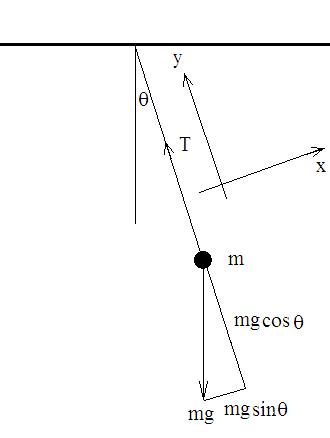
The differential equation for the harmonic oscillator $$ \frac{d^2x}{dt^2} - kx = 0 $$ is an approximation to the general pendulum. Going back to the elementary pendulum we have the basic sum of forces for the y coordinate oriented along the string and the x axis perpendicular to it. The forces are labelled in the diagram here
We do our sum of forces along the y direction, which is zero so the tension $T = mgcos\theta$, and the acceleration in the $x$ direction is $$ ma = mgsin\theta. $$ We usually make the following assumption. This angle is assumed to be small so we have $sin\theta \simeq \theta$. The arc length of the swing is $r = \ell\theta$. for $\ell$ the length of the massless string. This differential equation, where $a = d^2x/dt^2$, is then written as $$ \frac{d^2\theta}{dt^2} - \frac{g}{\ell}\theta = 0, $$ which gives us the elementary solutions $\theta(t) = exp\left(\sqrt{g/\ell}~t\right)$. We return though to the general case with $$ \frac{d^2\theta}{dt^2} - \frac{g}{\ell}sin\theta = 0, $$ This is the Jacobi equation, and its solutions are $$ \theta(t) = 2J_{am}\left(\frac{1}{2}\sqrt{(k - 2g/\ell)(t + t_0)}\Big|\frac{4g/\ell}{2g/\ell - k}\right) $$ wnere $J_{am}(x|y)$ is the Jacobi amplitude, or elliptic function. I am not going to go into that in any greater detail, but leave that to the reader. The harmonic oscillator is a linearization of a more general problem. There are related subjects such as the Mathieu equation and Floquet solutions, and in a relativistic framework a related sin-equation is the sine-Gordon equation for a soliton. |
|||
|
|

|
One has to keep clear the difference between the mathematical model proposed, and the physical system that it will describe.
The mathematical equation is accurate, because that is the function of mathematics. The question is "can it model a specific physical setup?"
The statement "is only valid for small angles" defines the bounds where the harmonic oscillator mathematical model can be used to describe the pendulum. By the way, the mathematical harmonic oscillator in the quantization regime is very important because most symmetric physics potentials expanded in a taylor series have as a first dominant term the x^2 . That is why it is a useful potential for a lot of approximations of complicated potentials. |
||||
|
|

|
Addendum to ACM's answer:
This is actually false: SHM formulas are very accurate (most of the times). They are just not exact, that is, they are usually approximations to real life phenomena. But in the end, all of the formulas we use in physics are approximations to real life phenomena, so no big deal.
The approximations comes from the fact that, to get those differential equations, we may have neglected some terms in the equations of motion. Or put it another way: the solution to the ODE's are exact, but the ODE's themselves are an approximate description of reality. |
|||
|
|

protected by Qmechanic♦ yesterday
Thank you for your interest in this question.
Because it has attracted low-quality or spam answers that had to be removed, posting an answer now requires 10 reputation on this site.
Would you like to answer one of these unanswered questions instead?
