With BJTs, we can control base current using Vin (from diagram). Why do textbooks state that BJTs are current controlled when it's obvious that changing the voltage controls the current through the collector? 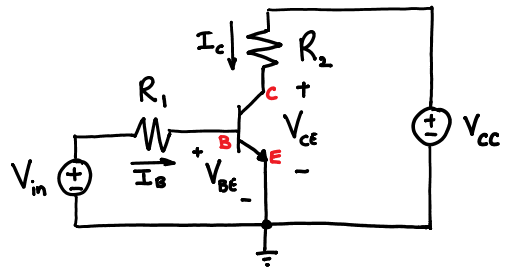
Electrical Engineering Stack Exchange is a question and answer site for electronics and electrical engineering professionals, students, and enthusiasts. Join them; it only takes a minute:
Sign up
Sign up
Here's how it works:
- Anybody can ask a question
- Anybody can answer
- The best answers are voted up and rise to the top
|
|
|||||||||||||||||||||
|


|
In the above circuit Vin is controlling the current going to the base, not the voltage drop across the base and emitter of the transistor itself. The voltage drop across Vbe will always be around 0.7V for Vin > 0.7; the excess voltage will be dropped across the R1. By changing Vin, you are actually controlling the current going to the base based on the equation: $$I_B = (Vin-0.7V)/R1$$ |
|||||||||||||||||
|

|
A BJT isn't current-controlled, but, to a useful approximation, it behaves that way. Under more accurate models of the BJT, like Ebers-Moll, the collector current isn't a function of the base current but of the base voltage (\$V_{BE}\$). |
|||||||||||||||||||||
|

|
I think you got it backwards. \$V_{in}\$ is controlling \$I_{B}\$ via Ohm's law (assuming the voltage drop on the base is small): \$I_{B} = V_{in}/ R_1\$. The BJT is in turn controlled by this current: \$I_C = \beta \cdot I_B\$. In the end there is a linear relationship between \$V_{in}\$ and \$I_C\$, but this is only true for as long as \$R_1\$ remains constant. Since \$R_1\$ is not part of the BJT, you cannot assume anything about it when discussing BJT characteristics, and you cannot say the BJT is controlled by \$V_{in}\$. Perhaps an example would explain it better. Imagine I drive a car, and its speed depends on how hard I push the gas and for how long. But I don't want to get any fines, so I always respect speed limits. Now you come along and say:
So what you say is true in this particular case, but that doesn't change the fact that cars don't care in the slightest about flat metal objects in their surroundings. |
|||||||||||||||||||||
|

|
Let's start with a little digression: what makes a generator a current generator instead of a voltage generator? Look at the V-I characteristics: the one with mostly constant voltage (almost horizontal in the I-V plane) will be called a voltage generator, the one with mostly constant current (almost horizontal in the V-I plane) will be called current generator. This is because the 'accent' is on the constant quantity (the voltage or current supplied - the other variable depends on the load and the compliance of the generator). In a controlled device, the accent is on the variable quantity. Given the exponential input characteristic, that leaves Vbe almost constant, it is current you like to see as the controlling variable. You should also ask yourself why you need a base resistor. Try to control the BJT by removing that resistor and by supplying a pure voltage (that is voltage from an ideal generator) between base and emitter. Not so easy, uh? (Conversely, with a MOSFET you'll have trouble in trying to use a current generator...) The bottom line is that it's easier to distinguish between 10 e 40 uA than it is to separate 0.65386 and 0.65389 V. Note: The dependence on Vbe shown in the Ebers-Moll model is not implying a cause-effect relationship. It's just simpler to write the equations in that way. Nobody forbids you from using inverse functions. |
||||
|
|

|
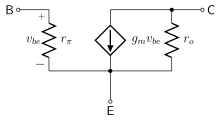
In general you could imagine the BJT to be a current-controlled current source when finding the bias point in a linear application (large signal). \$I_C=\beta I_B\$ It's more useful to think of it as a voltage-controlled current source when you are doing small-signal analysis, such as for an amplifier- using the hybrid pi model.
Neither is particularly useful when you are evaluating switching applications since the base current will be high enough that the collector current is determined by the external circuit and not by the transistor characteristics (the first helps somewhat in ensuring that condition exists). |
|||||||||||||||||||||
|

|
If you made Vin a constant and R1 a variable would you say BJT's are resistance controlled devices? In your setup you appear to have control of a voltage and observe it is able to effect the collector current. It's reasonable to use this as proof this circuit's current is voltage controlled, but it's not reasonable to say this means that all BJT's are voltage controlled. You have to make a distinction between the whole system and a component in the system, even when it's the most interesting component or even the only interesting looking one. |
|||||
|

|
I think it makes sense to call a BJT current controlled when you compare it to the MOSFET. The MOSFET has a gate, and the higher the voltage on the gate (which draws essentially no current), the higher the conductance from drain->source. So, this is a voltage controlled device. Alternatively, A BJT has a base. If you pump current into the base, the there is conductance from collector to emitter. Sure, this current is generated from a voltage somewhere, but you cannot power a BJT without current. |
|||||||||||||||||||||
|

|
Other answers have expressed opinions on whether the BJT is voltage controlled or current controlled or both. In my answer, I wish to address instead this:
Consider the following alternative circuit:
simulate this circuit – Schematic created using CircuitLab Is it not obvious that $$I_C = \beta_{DC}I_B$$ and $$i_c = \beta_{ac}i_b$$ and thus that the base current controls the current through the collector? Yes, you might object that changing \$I_B\$ necessarily changes \$V_{BE}\$ etc. but that is a two-edged sword since the objection works both ways, i.e., a change in \$V_{BE}\$ necessarily changes \$I_B\$. So no, it's not obvious, by your example, that the BJT is voltage controlled. |
|||
|
|


|
The collector current is, by definition / physics, a function of the base current (and implicitly the load current demand). The governing formula of a BJT is \$I_C = \beta \cdot I_C\$. Where \$\beta\$ is the gain, \$I_B\$ is the current through the base-emitter junction, and \$I_C\$ is the (maximum) current through the collector-emitter junction. The base voltage (i.e. the voltage measured at the base terminal with respect to GND) is actually more or less a constant (at least in saturation), as characteristic of a diode forward voltage drop. |
|||||||||||||||||||||
|


|
Up to now, I count 10 answers and a lot of comments. And again I have learned that the question if the BJT is voltage- or current controlled seems to be a question of religion. I am afraid, the questioner („Why do textbooks state that BJTs are current controlled“) will be confused because of so many different answers. Some are correct and some are totally wrong. Therefore, in the interest of the questioner I like to summarize and clarify the situation. 1) What I never will understand is the following phenomenon: There is not a single proof that the collector current Ic of a BJT would be controlled/determined by the base current Ib. Nevertheless, there are still some guys (even engineers!) which again and again repeat that the BJT - in their view - would be current-controlled. But they only repeat this assertion without any proof - no surprise, because there is no proof and no verification. The only „justification“ is always the simple relation Ic=beta x Ib. But such an equation can never tell us anything about cause and effect. More than that, they forget/ignore how this equation was originally derived: Ic=alpha x Ie and Ie=Ic+Ib. Hence, Ib is just a (small) part of Ie - nothing else. 2) In contrast, there are many observable effects and ciruit properties which clearly show and proof that the BJT is voltage-controlled. I think, everybody who knows how a simple pn diode works should also recognize what a diffusion voltage is and how an external VOLTAGE can reduce the barrier effect of this fundamental property of the pn junction. We must apply a proper VOLTAGE across the corresponding terminals to allow a current through the depletion zone. This voltage (resp. the corresponding electrical field) is the only quantity which delivers the force for the charged carrier movement, which we call current! Is there any reason that the base-emitter pn junction should behave completely different (and does NOT react upon the voltage) ? Upon request I can list at least 10 effects and circuit properties which can be explained solely with voltage control. Why are these observations so often ignored? 3) The questioner has presented a circuit which deserves an additional comment. We know that an opamp (undoubtly voltage driven) can be wired as a current-in-voltage-out amplifier (transresistance amplifier). That means: We always have to distinguish between the properties of the „naked“ amplifier unit and a complete circuit with additional parts. For the present case, that means: The BJT as a stand-alone part is voltage-driven - however, viewing the whole circuit (with a resistor R1) we can treat the complete arrangement as current driven circuit if R1 is much larger than the input resistance of the B-E path. In this case, we have a voltage divider driven by the voltage Vin. |
|||||||||
|

protected by W5VO♦ 2 hours ago
Thank you for your interest in this question.
Because it has attracted low-quality or spam answers that had to be removed, posting an answer now requires 10 reputation on this site (the association bonus does not count).
Would you like to answer one of these unanswered questions instead?

