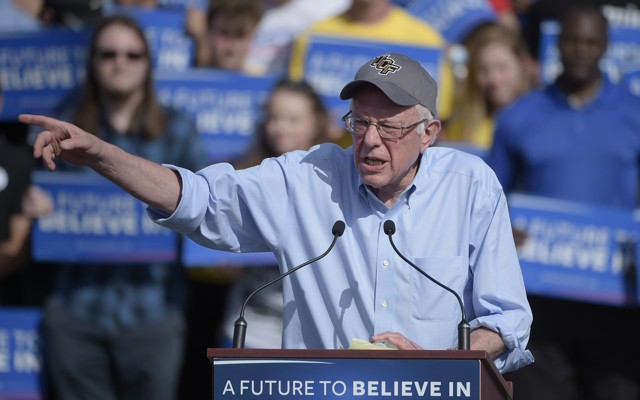
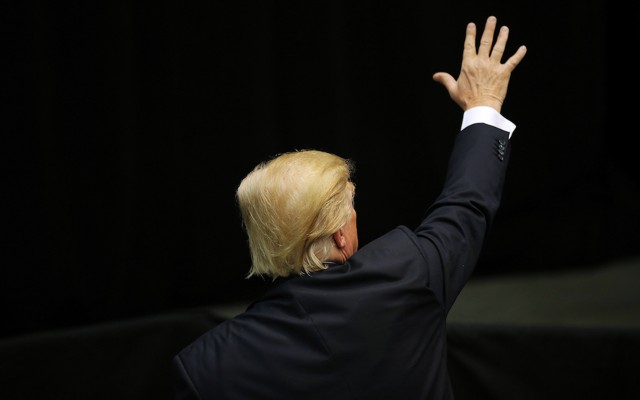
Three states and a territory voted on Tuesday night, but by the time the votes were tallied in the first, the results were already clear—Hillary Clinton and Donald Trump would add to their leads in the delegate count by claiming the night’s big prize, Arizona. The Grand Canyon State delivered strong support for both front-runners, and there weren’t enough delegates still on the table for Bernie Sanders or Ted Cruz to close the gap. As my college Russell Berman wrote, the voting punctuated the day’s news, with terror pushing the campaign out of the headlines:
The primaries played out as the candidates responded to the deadly terrorist attacks in Brussels, and Clinton quickly pivoted to national security during her election-night remarks in Seattle. “The last thing we need, my friends, are leaders who incite more fear,” she said after calling our Trump and Cruz by name. “This is a time for America to lead, not cower.”
You can read the rest of Russell’s analysis, and the full liveblog of the results, here.
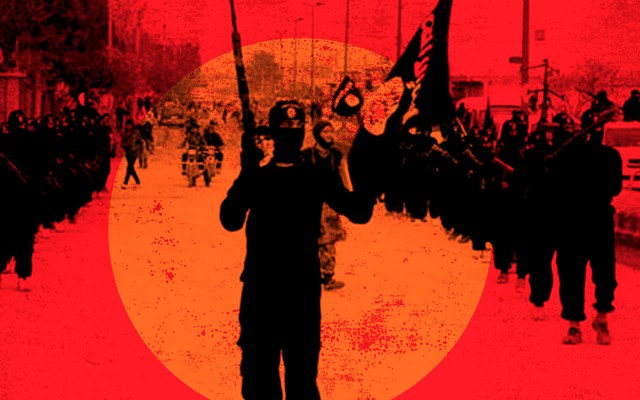
Deadly explosions in Brussels, cont’d: Belgian officials updated the death toll to 34 on Tuesday evening, with more than 200 others wounded. ISIS has claimed responsibility. You can read our coverage here and here.
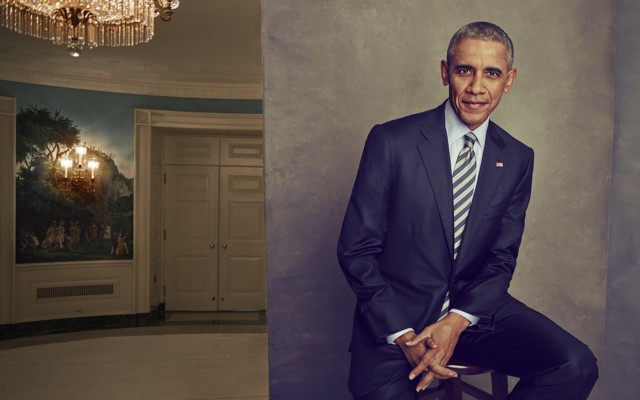
Obama in Cuba, cont’d: The president capped his historic visit to the island by taking in an exhibition game between the Cuban national baseball team and the Tampa Bay Rays at Havana’s famed Estadio Latinoamerico. Earlier in the day, he addressed human-rights issues and the two countries' histories at El Gran Teatro.
Western Tuesday: Voters in Arizona, Idaho, Utah, and American Samoa head to the polls as Trump and Clinton hope to fend off their challengers in the delegate race. You can follow our live coverage of results tonight here.
“Jesus was a freedom fighter. The cops came to arrest Jesus, and dragged him off and executed him. I don’t know how much more in tune with today’s time we can get,” —Heber Brown III, a pastor and political activist.
“I just wanted an adult show, a show that a smart adult would feel comfortable watching,” —Jerrod Carmichael, a comedian and sitcom creator.
“If every planet has clouds to the level that one does, it might kill all our dreams,” —Sara Seager, a planetary science professor who hopes to find evidence of alien life.
Fifty-three years ago today—on March 22, 1963—the Beatles released their first album, Please Please Me. The last of the 14 tracks? A rambunctious cover of “Twist and Shout”(the original version was recorded by Top Notes in 1961, followed by a chart-hitting version by The Isley Brothers in 1962):
In the June 2013 issue of The Atlantic, Colin Fleming argued that 1963 was “the year the Beatles found their voice”—in part through a series of covers (how appropriate):
In 1963, the Beatles were exploding in England. Their debut LP, Please Please Me, came out in March, followed by their megahit single “She Loves You” in August. Their second album, With the Beatles, and another hit single, “I Want to Hold Your Hand,” followed in the fall. Screaming girls, throngs of fans, bushels of albums being sold—this was when it all started.
But the Beatles were also a veritable human jukebox that year. One of their many commitments was to turn up semi-regularly at the BBC, horse around on air, read requests, make fun of each other, make fun of the presenter, and play live versions of whatever people wanted to hear, whether that was their own material or a vast range of covers: Elvis Presley numbers; obscure rhythm-and-blues songs by lost-to-time bands like the Jodimars; Broadway show tunes; Americana; vamps on Buddy Holly, Carl Perkins, Chuck Berry; rearrangements of girl-group cuts; torch songs. If you wanted to hear what made the Beatles the Beatles, here is where you would want to start.
My wife and I saw The Who on four of their first seven farewell tours, 1982 to sometime in the 1990s. At least twice, their encore was “Twist and Shout.” Pete Townshend called it “the best song we know,” or words to that effect.
I love the Goldberg Variations [posted Sunday]—especially the Rosalyn Tureck version. She repeats the returns, as written, which makes the recording longer—over 70 minutes, I believe. I know of no better music in which to get lost in contemplation.
Enjoying this series.
(Track of the Day archive here. Access it through Spotify here. Submit via hello@)
The gaffe: The Texas Republican recently named Frank Gaffney as a foreign-policy adviser. Gaffney is outspoken on Islam, and often makes inflammatory and inaccurate statements; the Southern Poverty Law Center named him to its hate list. In 2009, Gaffney called Obama “the first Muslim president,” laying out reasons to suspect he was a crypto-Muslim. Asked about that statement on Monday, Cruz refused to disclaim it, telling Wolf Blitzer, “I'm not interested in playing the media 'gotcha game' of 'Here's every quote everyone who's supporting you has ever said at any point, do you agree with every statement?' That's silliness.”
The defense: In general, it’s hard to hold a candidate to account for every statement any adviser has made.
Why it matters (or doesn’t): That general defense doesn’t really hold up here. Is there any context in which Gaffney’s comments might not be over the line? Besides, presumably Cruz chose Gaffney because of the signal it sends that he is willing to be tough on Islam. It’s possible (though hardly flattering) that Cruz isn’t aware of this specific Gaffney remark, but to be unaware of this aspect of his record is to be unaware of Gaffney’s entire MO. This is a guy who has also claimed that everyone from Hillary Clinton adviser Huma Abedin to famed GOP anti-tax crusader Grover Norquist are agents for Islamism.
The lesson: With friends like this, you’re bound to attract enemies.
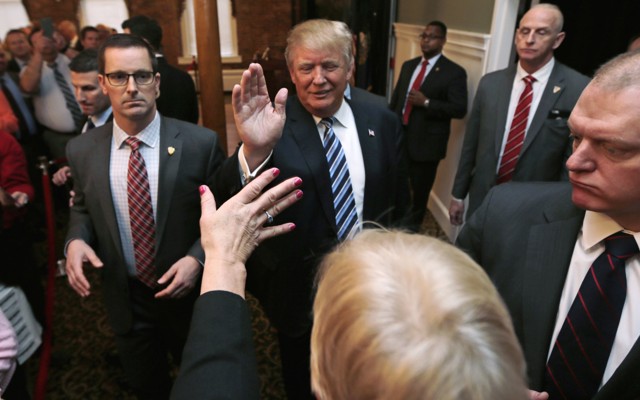
The gaffe: There were many strange moments in the GOP front-runner’s interview with the editorial board of The Washington Post: when he hit on an editor. When he called for looser libel laws. When he discussed his glove size. But some attention has fallen on his answer to Post Publisher Fred Ryan, who asked him whether he’d use a tactical nuclear weapon against ISIS. In simple terms, that’s a smaller bomb, aimed not at destroying a whole city, but for battlefield use. “I don’t want to use, I don’t want to start the process of nuclear,” Trump replied, then veered into electoral politics. “Remember the one thing that everybody has said, I’m a counterpuncher. Rubio hit me. Bush hit me. When I said low energy, he’s a low-energy individual, he hit me first. I spent, by the way he spent 18 million dollars’ worth of negative ads on me.” Ryan gently reminded him the question was about ISIS, not Marco or Jeb. Trump bailed: “I’ll tell you one thing, this is a very good looking group of people here. Could I just go around so I know who the hell I’m talking to?”
The defense: You can’t prove definitively that he doesn’t know what a tactical nuclear weapon is or that he hasn’t through through the issue. You can only strongly infer it.
Why it matters (or doesn’t): Oh come on, this is Trump: All that matters is that he sounds “tough.” He’s been talking about nukes for more than 30 years and yet he seems to have learned nothing about them. But it’s reasonable to expect a prospective president to have a more fully developed answer on nuclear weapons than mentioning his vanquished electoral opponents—especially when that candidate has demonstrated his ignorance about nuclear weapons in the past.
The lesson: A man who bombs an interview might be a risky bet to control the bombs.
A photo posted by The Jefferson Grid (@the.jefferson.grid) on
Okay, they’re a lot bigger than your average puddle: These spring-colored plots are actually ponds of potash, a potassium-containing salt used in farm fertilizers. Suzy Strutner has more in the Huffington Post:
Workers pump the potash from way below the Earth’s surface into the ground-level ponds, where sun evaporates the pond water and leaves potash behind. The water is dyed an eye-catching blue so that it’ll absorb heat and evaporate more quickly, a process that typically takes about 300 days. Some passersby have found it jarring when, seemingly out of nowhere, the mine pools make a surreal stark contrast to the mostly unspoiled landscape.
Deadly explosions in Brussels, cont’d: At least 32 people have been killed in the blasts at the city’s airport and a main train station. ISIS has claimed responsibility. You can read our coverage here and here.
Obama in Cuba, cont’d: President Obama urged the Cuban people to “leave the past behind” in a historic address in Havana. As Russell reports: “The speech was a lengthy balancing act for the president: He offered praise both for Cuban artists and innovators and the Cuban government, and he wrapped criticism of America’s own flaws into a broad defense of its open society and democratic values.”
RIP, Rob Ford: The colorful, larger-than-life former mayor of Toronto died Tuesday, his family said in a statement. He was 46. The cause was a rare form of cancer. Our story here.
Our video team created a short piece on the work of psychologist Paul Bloom:
A reader weighs in:
Interesting proposition. I only agree partially. Empathy has great value in enabling us to connect to and understand other people. Understanding is a good thing (the alternative is insensitivity, even intolerance). I suggest to the author that the problem does not rest with empathy, but rather with the critical analysis, intent, and decisions made by the empath. To lose sight of optimal outcomes, in order to attain selfish, short-sighted gratification, is always a bad idea. Empathy can be very good; poor choices and decisions are bad.
The New York Times’s John Tierney reported yesterday on Dr. Bloom’s research, asking, “Is empathy an essential virtue for a presidential candidate?”
In his current research, Dr. Bloom and a colleague are finding that the more empathic people feel toward victims of terrorism in the Middle East, the more they favor taking military action.
“If I want to do terrible things to a group, one tried-and-true way is to arouse empathy for victims of that group,” Dr. Bloom said in an interview. “Often the argument for war is rooted in empathy for victims of the enemy.” Dr. Bloom concludes that empathy is overrated as a guide for personal morality or public leadership. “Sob stories are not a good way to make public policy,” he said. “The best leaders have a certain enlightened aloofness.”
Human history is replete with examples of principle-based atrocities. The reasoning underlying genocide and “ethnic cleansing” seems perfectly logical to people who subscribe to a twisted belief system—bring about a “greater good” by “cleansing” the world of “bad” people—but it’s empathetically bankrupt. What drives and sustains the suicide bomber? The belief in the purity of his principles, principles that require one to blind oneself to the suffering and carnage of the innocents at his mercy.
It was the cold light of reason—based of course on false beliefs—that gave us laws permitting slavery, burning human beings at the stake, and bear baiting as a form of entertainment. It was empathy for the victim that ended these practices. It is empathy that prevents a man from beating his wife when the law in some countries fully permits (or even requires) him to do so. It is empathy for the victim that brought us the Red Cross, Amnesty International, and the scores of other humanitarian organizations that grace our world. It is empathy that makes us want to rescue victims, and it is empathy that prevents us from killing their tormenters—despite our rage and lust for retributive justice.
Your thoughts on empathy and politics? Let us know.
This reader makes the most important distinction, I think, in the debate over crying at work:
I really appreciate these curated conversations, thank you. To the woman who said:
I really despise seeing [crying] at work. Unless something just absolutely devastating happened personally (then go home and take care of it), then NO.
I say, you are without understanding and I will restrain myself from using stronger language to describe your unkind attitude. Crying for some is a completely involuntary reaction to stress. Whenever it happened to me, I HATED that I was crying and was FURIOUS with myself for the tears welling out of my eyes. My rational mind was completely divorced from the physical reaction and trying to hide it and re-gain control of my tear ducts as fast as possible, all the while trying to assure anyone around that I really am not as upset as I appear and simply cannot help it for the moment.
One of the few benefits of aging and menopause is that I no longer tear up as readily as in the past, so I presume hormones have something to do with it. But it should NOT be automatically assumed that it is always a measure of distress or a ploy for sympathy.
However, there’s surely a distinction between welling up and sobbing; the former is involuntary and the latter is much less so—except, perhaps, when it comes to Smiley the Blind Therapy Dog or Lil’ Brudder:
A reader takes the bait from this one, who said that “single people are basically freeloaders”:
Your reader’s comment and your call for responses made me actually laugh out loud, so nice work there. As to his point: I’m 32 and have never been married. I’ve been engaged, but I walked away after realizing marriage and children with my partner at the time would have been a terrible decision for both of us.
In my experience, two groups of people generally get married young or at all (this is more than a binary comparison, but for the sake of this email, two choices makes the point): 1. People who have met the right partner and should get married, and 2. People who need to get married because other people are doing it. Those in group 1 don’t have the insecurities of those in group 2, and rarely if ever make such freeloader comments.
To this reader, on behalf of the single people who financed his wedding, baby shower, housewarming, and—pick an event for married people that has no single people equivalent—you’re welcome. (And yes, this idea came from Sex & the City.)
That linked video is unembeddable, but here’s the money quote:
I did a little mental addition, and over the years I have bought Kiera an engagement gift, a wedding gift, the trip to Maine for the wedding, three baby gifts—in toto, I have spent over $2300 celebrating her choices. […] And if I don’t ever get married, or have a baby, what—I get bupkis?
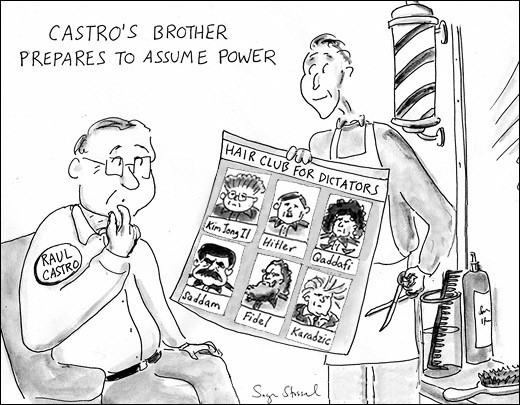
As Obama meets with Cuba’s President Raul Castro, here’s a look back at a cartoon from 2006, on Castro’s imagined preparations for assuming power from his brother Fidel. (Of course, in 2016, it’s here in America that a dramatically coiffed figure with authoritarian leanings is angling to assume power … )
Deadly explosions in Brussels: Fatalities have been reported in the blasts at the city’s airport and metro stations. The BBC, citing local media, reported at least 13 people were killed. Other reports said at least one person had been killed. Brussels has been the focus of recent anti-terrorist operations in connection with last November’s Paris attacks. This is a developing story and the details are preliminary and likely to change. I’ll update it as more is known. Update: More here
Double fault, cont’d: Raymond Moore, the CEO Indian Wells Tennis Garden, has resigned amid the backlash following his comments about the Women’s Tennis Association and “lady” players. In a statement, Larry Ellison, who owns the tournament, said: “Ray let me know that he has decided to step down from his roles as CEO and Tournament Director effective immediately. I fully understand his decision.”
Obama’s Cuba trip, cont’d: The president will address the Cuban people and this evening will attend a baseball game between the Tampa Bay Rays and the Cuban national team. He then flies to Argentina.
“I don’t know what to expect with a white president or a woman president. He’s the only president we remember,” —Josh Frost, a 13-year-old, on Barack Obama.
“I realized I had to change my focus from hurting two 80-year-old guys to helping 11 million people,” —Mike Fernandez, a Cuban American who supports ending the Cuban embargo.
“It would be fan-fucking-tastic,” —a Cuban entrepreneur on the idea of a Times Square in Havana.
An attack in Bamako: Gunmen stormed a hotel in the Mali capital that had been converted into the headquarters for a European Union mission of about 600 military personnel who are training the country’s security forces. No personnel were injured, the training mission said. One attacker was killed.
The Obamas in Cuba: They’ve crossed off a few things on the itinerary for their three-day visit in Havana. President Obama and Cuban President Raul Castro delivered remarks to the press and took a couple of questions this afternoon, ending the event like this:
Obama then met with several hundred members of the Cuban business community, and First Lady Michelle spoke with a small group of Cuban teenage girls. “When women and girls get an education, their country, your family prospers,” she told them, according to press pool reports. Next up: a state dinner with Castro.
Hulk Hogan v. Gawker: The Florida jury in the legal battle between the former professional wrestler and the news outlet has awarded Hogan $25 million in punitive damages, on top of the $115 million Gawker must pay for posting a sex tape of him four years ago. Matt has the backstory on the case here.
A floating bar is bound for Cuba: Cuba has granted permission for the cruise company Carnival to operate travel to the country (the U.S. gave approval last summer). Carnivals’s future journey will mark the first time in over 50 years that a cruise ship sailed from the U.S. to Cuba.
Love this series so far and thought I’d throw in one of mine. This shot was taken along the central California coast in the Big Sur area after taking off from Monterey en route to Montgomery Field in San Diego in a Diamond DA-40. In contrast to all of the great shots so far on (mostly) clear days, this photo was captured under instrument flight rules. [CB note: That’s defined as “rules and regulations established by the FAA to govern flight under conditions in which flight by outside visual reference is not safe”—in contrast to visual flight rules.]
The right side of the picture shows an interesting pattern that tends to show up in cell phone pictures taken from propeller aircraft. The best explanation I have found is here.
Over the weekend, a reader sparked a new series for TotD: songs to have to sex to. Submit here. But another reader points to a key challenge with the genre:
The problem with most songs is that they don’t last long enough. The extended version of Donna Summer’s “Love to Love You Baby” made progress towards solving that problem by running over 16 minutes long, all the while maintaining a steady, uninterrupted rhythm. I suspect that it may have helped many a couple in the 1970s discover the patience necessary to achieve mutual satisfaction (a fairly new concept to some, back in the day).
According to the BBC, the song contained 23 “orgasms”. By that point, the song was renamed “Love to Love You Baby” [the original version didn’t have “Baby”]. It took up the entire first side of the album of the same name, and was also released as a 12" single. Edited versions were also found on 7" vinyl.
(Track of the Day archive here. Access it through Spotify here.)
Sophie’s new piece on Daredevil, the Marvel series on Netflix, is getting some good reader feedback, so I compiled a representative sample below, followed by Sophie’s response. Our first reader concurs with her main contention:
I wholeheartedly agree; the level of violence on Daredevil is so astonishing as to be distracting. [CB note: One of the less gory scenes is embedded above.] I’m no prude, and I can stomach depictions of blood/gore if in service to a story. But on Daredevil (and even on Jessica Jones, to some extent), the directors seem to go out of their way to include as many cheap gross-out shots as possible, as if to signal to viewers that the show is supposed to have dramatic “weight.” You know, it is possible to tell a good story without resorting to cheap shock tactics, but god forbid a superhero story every attempt that.
This reader dissents:
This article really missed the mark. I agree that the amount of violence in our entertainment is disturbing, but adding graphic sex to that isn’t going to help. To be honest, I think it’s refreshing that a show isn’t using women’s bodies as a way of attracting viewers. Just because it doesn’t feature massive amounts of T&A doesn’t mean that sex is “taboo” ... it’s just not the show’s focus.
One of the main themes of this season is that Daredevil is taking over Matt Murdoch. If he doesn’t have time to have friends or a job, it would follow that he doesn’t have much of a dating life. The “painfully chaste” scene makes sense when you’re dealing with a person who a) has heightened senses and b) is reluctant to get involved with a coworker/friend. There’s a lot of variety in the world and not everything has to be porn in order to be realistic.
I think it’s strange that a female writer is complaining because one show in the world doesn't feature hyper-sexualized, objectified women. Jessica Jones was good, too, but this isn’t a competition. Both shows have their own points of focus.
Another reader looks beyond both shows:
I really don’t see why we need to insult one of these shows to state our case for the other. Both Daredevil and Jessica Jones have been excellent so far, both at least 15 times better than any other superhero TV show ever made (apart from perhaps Agent Carter, which just about barely matches them in terms of entertainment and production values if not in artistic ones). And in fact I find them both to be better, more profound and less pulpy than 90 percent of the endless procession of recycled superhero *movies* out there at the moment, Marvel or otherwise.
One more reader zooms out even further:
This article is pretty over the top about its gender issues, but it alludes to the general dumbness of Daredevil pretty well. Comic books are simplistic stories aimed at pre-adolescents and geeks. Movies/TV shows based on comic books are even worse. A good comic book movie is still well below the standards of an actual good movie, but thanks to all the fanboys/girls it still ends up being considered similarly.
The worst part is the so-called mythology of these series, which is shockingly amateurish. Immortal ancient evil ninjas who fight with bows and knives? Wtf? Mythology of fantasy books and shows like the Thrones series, Malazan books, or the Cosmere series are nuanced and brilliant so it can be done right, with a palpable sense of mystery and discovery. But those are aimed at adults while comic books aren’t. Even Nolan’s supposedly amazing Batman series has one decent movie (The Dark Knight), one dumb movie (Begins) and one horrid movie (Returns). But the standards are so low that even marginally not-terrible productions end up being considered Great (like Daredevil).
Jessica Jones, even though long and dragged out and possessing myriad flaws, ends up showing a rare amount of self-awareness and nuance. It’s probably the best comic book production ever. But it covers NO new ground that Buffy didn’t already manage to cover 10-something years ago. Pause on that a little. It is said that there is child hiding among all of us, which is honestly the only reason for the absurd popularity of this entire preposterously inane genre. Maybe it is time to grow up a little.
Here’s Sophie’s response, first addressing the dissenting reader:
To be clear, I don’t think I was advocating anywhere in the article for more “graphic sex,” or “hyper-sexualized, objectified women.” I’m as tired as anyone of shows that gratuitously use naked bodies to draw in viewers without any narrative reason to do so. But I think the disparity between the standards for sex and violence in Daredevil is extraordinarily telling. As I wrote in my piece, it’s fascinating that Marvel bans nudity and the word “fuck” in its shows but has no qualms about showing a man’s organs spilling out of his body, or a character being tortured with an electric drill, or another character tortured by having metal rods pushed into his fingers.
The violence in Daredevil almost always has a sexual subtext. It’s all about weapons being inserted into people in various ways—the aforementioned drills and metal rods, as well as swords, bullets, ninja arrows, knives. At one point the Punisher sews a razor blade inside his own wrist. It’s an incredibly gory show: one that I as an adult viewer found really hard to watch on multiple occasions. Violence like this, rendered in comic books, feels necessarily cartoonish thanks to the medium, but portrayed on television it’s something else entirely. My question is why the producers of Daredevil think it’s necessary, and whether they think it’s responsible to inform their legions of young viewers that nudity is much more alarming and unconscionable than graphic torture scenes.
In regards to the third comment, I’d argue it’s my job to compare Marvel’s Netflix offerings when writing about them. If I’d written about Daredevil without mentioning Jessica Jones, I’m sure people would have complained that I was ignoring a huge part of the Marvel Cinematic Universe. Jessica Jones had graphic violence, too, but I thought it was rendered in a psychological rather than needlessly gory way that made it much more effective, and I think it’s a much more sophisticated show that proves what Daredevil has the potential to be.
As for why I sometimes consider gender issues when writing about culture, it’s because, frankly, this is a crucial failing of the entertainment industry. When TV shows or movies or comic-book series consist only of male voices, they limit themselves. They run the risk of alienating 50 percent of viewers, for one thing, but they also miss out on developing intriguing characters who can make stories richer. I’d argue that Daredevil would be a much better, more compelling, more insightful show if there were more women in the writer’s room. For many reasons, but one is that they might point out that female characters can be more than subservient helpmeets or (spoiler) the most powerful killing machines in human history.
If you have any additional thoughts about Daredevil, Jessica Jones, or Marvel adaptations more generally, drop us an email. Update from a reader:
I’ve been seeing the “it’s so violent but so sexless” complaint levied at Daredevil in the wake of Jessica Jones, but I think there’s something a little strange about it. Not everyone is terribly interested in sex, and it’s exceedingly rare that a fictional examination of sex and romance reflects what I’ve experienced personally. I’ve met plenty of people who would rather dedicate themselves to any number of activities, and sexuality is far down on their list of priorities. Matt Murdock doesn't seem any more immature than, say, my father, except that he’s replaced “working on various projects with every second of free time” with “punching criminals in the face.”
And that’s the real immaturity of comic books: they don’t deal with problems in realistic ways. Daredevil wouldn’t work in real life for reasons that go far beyond the fact that he’d likely be shot and killed shortly into his career. And a real-life rape victim is unlikely to be literally mind-controlled by her assailant or able to literally break his neck as in Jessica Jones. At best, comic book properties provide entertaining metaphors for real issues.
Perhaps the issue with Daredevil is that it doesn’t work as a metaphor for our times. Jessica Jones is about the all-too-real problems women face, particularly from sexually predatory men. If Daredevil is trying to similarly offer a masculine perspective, what is the modern masculine perspective? If simply punching bad guys isn’t enough to justify the grim and serious tone of the series, what would elevate the subject matter? If everything else was well-executed, would the show still be lesser if it ignored the sexual side of its title character?
Of course, the series could also be a letdown on the sexual side of things simply because so much fictional sexuality is rote. Attractive man meets attractive woman, they fall in love because they are the designated love interests in the obligatory love story, audience falls asleep because this is the tenth time today they’ve seen a story with this subplot. Perhaps the writers of Daredevil just wanted to make a show about a guy punching crooks and they’re as disinterested in TV romance as I am by this point but obligated to put it in because, hey, that's what you do in fiction, and Frank Miller kind of tied their hands with Elektra, and Marvel properties aren’t going to spin-off by themselves.
A great milestone for one of the best things on Instagram:
Today we’re doing a PRINT GIVEAWAY because we just passed 250K followers! To enter the contest, simply TAG FOUR (4) FRIENDS in the comments of this post and we’ll randomly select a winner on Friday who will win a 16x16” print with this stunning Overview of Venice. To see more details of this print or to check out what else is available in our Printshop, just click [here]. Good luck and once again, our sincerest thanks to everyone for making Daily Overview what it is today!
And thanks to its creator and curator, Benjamin Grant, for providing so many amazing views for this feature.
Now that it’s here, readers are reminding me that the Trump and Sanders phenomena are not the end result of voter unrest. They represent merely the beginning of a great unraveling. Many Americans have not just lost faith in the political system; they’re losing faith in the idea that they can ever trust again. This email is from a Michigan attorney who works for the federal government:
I have long believed in our governmental institutions. In an era where some people want to destroy government agencies with a hatchet, I've quietly defended these institutions as necessary and worthy of support and reform. But now? How can anyone have any modicum of faith in these institutions? In democracy?
I grew up in Grand Blanc, Michigan, where the population is affluent enough, and white enough, to avoid being poisoned. It's shameful for me to think about how the golf course my parents live on gets cleaner water than the children a few miles up I-75. Periodically, I'll read something in the news about the Flint water crisis that will sicken me so much, that I feel I must make a large financial donation to the cause. I've done that three times so far, and will probably be compelled to do so again soon.
Today, I sat in the waiting room of an auto repair shop, waiting for a mechanic to fix the damage done by the Michigan legislature’s unwillingness to fund road repairs. To pass the time, I listened to the most recent congressional testimony. The thing that stood out to me the most was the “circular-Nuremberg-defense” between [Gov. Rick] Snyder and [EPA director Gina] McCarthy. Apparently, leadership comes full circle. The other thing I noticed was that, even if a person was originally oblivious to which political party each congressman belonged to, they could figure it out by the first question that they asked. I guess it's true that the two parties are living in alternate universes.
I've always been a cautions optimist. But now …
I replied to his email: “Any thoughts on our way out of this? Is there hope in the next generation? Are there bold policy fixes?” I included a link to this column suggesting that, beyond recrimination, political leaders could find in Flint the seeds of broader government reforms that allow for crowd sourcing of crises and solutions. He replied:
A couple years ago, I legitimately thought Flint could have had a Detroit-style revival. Young professionals, loft apartments, gluten-free artisan everything. I really doubt that’ll ever happen. Call me a cynic, but Flint’s best case scenario is now just getting back to its pre-lead-poisoning past. If Flint is able to maintain anything close to its current population (even if it’s mostly people who are too poor or too stubborn to leave), that’ll be a huge victory. Pretty depressing aspirations, right?
As far as larger policy fixes, it would be nice if both parties developed a legitimate interest in actually improving government. What we have now is Republicans wanting to kill government with a chainsaw, and Democrats just trying to stop them, but not seeking reform. It would be nice if Republicans made their peace with the existence of government regulations, and Democrats worked with them to maintain a constant sense of vigilance and oversight. That would be how government should ideally work. But it’s hard to focus on clearing out the rats when someone else is trying to burn down the entire building.
I couldn’t agree more with this reader. Note the lack of equivalence in his critique; he clearly sympathizes more with Democrats than Republicans. And yet, unlike most professional liberals and conservatives in both politics and the media, he’s holding his party to the highest standard.
Where does this all lead? The reader isn’t hopeful:
Best case scenario: The funding comes in and Flint slowly crawls its way back to being one of Michigan's struggling medium-sized cities. Government learns a bit of a lesson.
Worst case scenario: Once the political fervor subsides, Flint gets forgotten and rapidly crumbles. Then, sometime in a couple years, you get to write an article about Flint that has to include a lengthy introduction reminding readers of where Flint is and what happened there.
Will Flint get its money? Will the duopoly reform government? Or is the United States circling the drain? Let me know what you think. More importantly, let me know what you’re doing to force disruption upon the status quo. I’m on email and Twitter.
Once I “had” someone cry at work. We had an ant problem in the office and I asked her to call the pest control company. The next day I got into the office late morning and immediately started gagging from the overpowering smell of pesticide. I asked her to call the company back to confirm if we needed to vacate the office from the powerful chemicals. To my embarrassment the company hadn’t been there yet and the smell was her perfume.
I felt terrible. So did she, because she cried.
This is an example where I inadvertently insulted her new perfume, thereby insulting her. So crying was okay. And you are darn right I felt uncomfortable. Have you ever tried to apologize to someone while she is washing her wrists with a lemon scented wet wipe? Awkward.
I gave her a plant the next day. We laugh about it now.
This reader is less sympathetic:
As a woman, I really despise seeing this at work. Unless something just absolutely devastating happened personally (then go home and take care of it), then NO. It’s unprofessional no matter what. I’ve worked in some dire environments (read end-of-life atmosphere, and sometimes under tragic circumstances), but you should still be able to show compassion or care without crying.
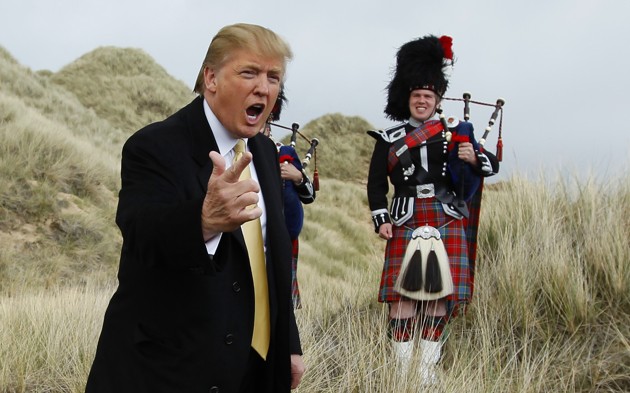
Until recently, the most famous Scottish-American could well have been Scrooge McDuck. Now there’s a new title holder. The millions of Americans who share this heritage, including me, reflect somberly upon the shift to the Trump brand. Here is Mr. Trump back in the motherland a few years ago, at some golf course ceremony. (David Moir / Reuters)
A reader who is a mental-health professional in Australia responds to speculation in some previous posts (notably here) that Donald Trump’s public persona meets many of the criteria of actual mental disorders: (Emphasis added in his note.)
I am responding to the comment made by a clinical psychology doctoral student… I think that your reader made a very compelling case in their first paragraph as to why we can’t “safely say that Donald Trump has a narcissistic personality disorder”; namely that this requires extensive quantitative and qualitative assessment over a period of time with the individual’s personal engagement. Also, it's hard enough for those with NPD to seek help, without thinking they're going to be compared to this whole mess!
However, they missed one incredibly important reason why he probably doesn’t have a personality disorder: Trump’s narcissism is part of the product he’s selling.
Trump is one of the world’s most successful salespeople of a personal brand, a reality TV star and an American politician. Self assured attention seeking is the key to success in all these arenas. Trump’s had a long history of seeing how much people like him when he shows no doubt.
I think people are struggling to determine how much of what Trump does is a performance. But, the difference between performance and self-perception is vital. The lack of empathy is a performance of his non-PC persona. His disinterest in listening to experts is part of his ‘Übermensch of the people’ act. His desire to be seen as exceptional and to be admired by others is ultimately no different from that of any other presidential campaign pitch.
I would argue, however, that Trump’s inner world, how he really perceives himself and relates to others remains very much a mystery. That aspect, the self-perception, is crucial to diagnosing personality disorders. You would know better than I, but I imagine there is much about a politician’s inner world that we don’t see from the public performance.
Trump should not be subjected to armchair diagnoses. Not just because it’s a cheap shot, not just because it’s a profound misunderstanding of clinical psychology and an injustice to those who do suffer from personality disorders, but because the claim that Trump is mentally ill is too easy and too comforting.
The ‘disordered’ Trump character is the twisted reflection the ‘hopelessly aloof’ Obama caricature that some hold in their head. We struggle to empathise with those who seem to be pitching their message to someone else. It’s part of the same inability to even attempt to understand the other that drives political animosity in your country and mine (look up Clive Palmer if you want the low-rent Australia version of Trump). Writing people off as mentally ill absolves us from needing to engage with a point of view that needs to be engaged with, regardless of how toxic it is.
Trump is Trump. You can’t diagnose him; the disease is in the political system. In the partisan politics of the current era there’s never been a happier warrior, because he’s completely at home there.
Good luck with that one.
***
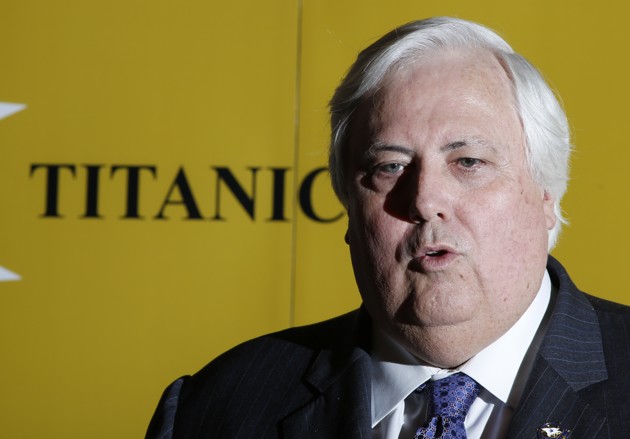
And who is this Clive Palmer, referred to above? He’s the person you see pictured below, with a follow-up explanation from the Australian reader about why the comparison with Trump is illuminating.
Clive Palmer, announcing a plan to build a replica of the Titantic (Olivia Harris / Reuters)
From the Australian mental-health practitioner:
The more I see of what's happening in America right now, the more convinced I am that we really dodged a bullet over here with Australia's very own Trump, Clive Frederick Palmer.
Up to a point, the stories seem remarkably similar. Take one eccentric/absurd business man (greatest hits: announcing that he was building his own replica of the Titanic, getting his football team kicked out of the country's premier league for bad business practices, opening a dinosaur park where the dinosaur burnt down) with delusions of grandeur.
Add in a bid for leadership of the country, funded by his personal wealth, with a populist campaign that promises the moon. Stir through a climate of animosity towards 'politics as usual' that's tainted both major parties Finish up with a scattershot of policies drawn from the left and right side of politics, with no unifying philosophy beyond "things will be better!" and "let's make more money!".
What saved us is the parliamentary system. Palmer had been chased out of party politics years ago, and there is no way in our political system that anyone can ride a populist wave all the way to the top because the party hacks can trip you up a hundred times along the way. Palmer had to start his own party and scurry to find legitimate candidates for both houses of parliament in time for the election….
Minor parties here need to build themselves over successive elections by demonstrating that they're actually legitimate about their values and about being a serious part of the political system. How's the Palmer United Party doing in it's first term? Well two of the three Senators have left the party citing cronyism and abuse. Palmer was taken to court by Chinese investors for misusing their funds. His old nickel refinery has gone into voluntary administration and sacked its workforce, after having donated heavily to his campaign. His bizarre behavior in office and the ever-present whiff of corruption have pretty much ended any hope of re-election. And the Titanic II still hasn't been built.
The American system has a lot of advantages, but I'm not sure how well it holds up to snake-oil salesmen at times like this.
***
To round out today’s internationally themed dispatches, a reader in Canada says that the Trump era has already arrived there:
We in Toronto have already elected Donald Trump, in the person of Rob Ford, a populist, wealthy son of a demanding father who made a political point of not owing anyone anything.
If our experience offers any guide, the election of Donald Trump would lead to disaster for the United States, and a worse disaster for Donald Trump. By the end of his first term, even his worst enemies would pity him. The United States might well simply lose four years, in the sense that Rob Ford's term as mayor stopped some important initiatives cold and brought no new ones to the table.
Rob Ford enjoying a moment of levity during a Toronto city council meeting in 2013. (Mark Blinch / Reuters)
Of course, losing direction in a city government, even an alpha world city, has many fewer potential consequences than dysfunctional or even malignant government in the planet's leading economic and military power. Unlike Donald Trump. Rob Ford had and has expertise in responsive government; he got elected partly on his well earned reputation as the quickest councillor to return phone calls. Unfortunately, even a major city mayor cannot handle the whole business of a city by returning phone calls, and most analysis I have seen suggests that Rob Ford quickly found himself well out of his depth as mayor. The mismatch between Donald Trump and the skill set required of an American president appears much greater.
Ahead of his meeting with the Cuban leader, President Obama told ABC News: “Change is going to happen [in Cuba] and I think that [President] Raul Castro understands that.”
A guilt verdict at the ICC: Jean-Pierre Bemba, a former rebel leader and once a vice president of the Democratic Republic of Congo, was found guilty today of two counts of crimes against humanity (murder and rape) and three counts of war crimes (murder, rape, and pillaging) committed in 2002 and 2003. Bemba is expected to appeal the decision, which the BBC reported was the first time the International Criminal Court focused on sexual violence as a weapon of war.
Hillary Clinton addresses pro-Israel group: The Democratic front-runner, in comments to AIPAC, called Israel’s security “nonnegotiable.” She also faulted Donald Trump, who leads the the Republican field, as an unreliable ally of the Jewish state. Trump will address AIPAC this evening.
A reader addresses that question through the lens of the military:
I have always wondered why a marriage saves you money but never really cared about it until I joined the Army. Then I got angry.
By age 26, I had been through college and was responsible for calling in airstrikes. However, as a SINGLE soldier, I had to live in a barracks with 18- and 19-year-old kids. A barracks is equivalent to a college dorm except you are stuck on a military post. If you are a married soldier, you receive a tax-free housing allowance, a tax-free food allowance, and extra pay when deployed. You can move off post and rent or buy a house.
So, as a 26-year-old sergeant, I was technically making less than a married 18-year-old private. Even more frustrating is to hear married folk complain about their finances or having to fix their house that they just bought since their housing allowance can cover a mortgage.
To further add salt to my wound, a married soldier with the same rank as me STILL makes more. If married, your housing and food allowance is slightly increased over a single soldier’s pay. Not to mention a break on your taxes.
While in the military, marriage is placed on a pedestal.
Pre deployment you have to attend meetings that inform wives on the upcoming deployment … even if you’re single. Oh and the military considers you “single” so long as you’re not married. Dating or engaged isn’t recognized, nor is cohabitating with a girlfriend or boyfriend. Additionally you also get the smart-ass comment from married soldiers on how easy single life is compared to theirs (although I’m sure that happens at civilian jobs as well)
However, there is a silver lining to this, in my opinion. I am generally more financially secure and happier than my married colleagues. Now that I’m a staff sergeant, I can live off post and receive a housing allowance but I don’t pay rent while deployed. I actually only have a phone bill and a car payment to worry about. I don’t have children and I don’t have a spouse who, since he or she is married to a soldier, statistically makes less than someone married to a civilian.
I also don’t have to deal with the strain a deployment puts on marriages and families. I only have to worry about my situation, not my wife’s or my children’s. I don’t have to worry about a Dear John letter or find out that my wife is leaving me for someone else while I’m on the other side of the world.
I’ve come to realize that being single is financially unfair but emotionally better for me as a solider. I’m way more happy with the single life in the military than I would be married. I do wish that I was financially equal to my married counterparts, but I’ve come to see that what society views as the benefit to marriage isn’t a benefit to me.
I do have a girlfriend at the moment, and we’ve already talked about why marriage doesn’t need to happen for us to be happy. We don’t need a piece of paper and a tax break to reinforce our relationship as valid and enduring.
Thanks for the rant.
Another reader is likely to solicit more rants with this rhetorical bomb:
Society puts a premium on being married because society and civilizations future depends entirely on raising stable healthy kids, and marriage (same sex included) is the best social institution in which to raise kids. Single people are basically freeloaders, since they will inevitably depend on the support of younger generations that they didn’t provide for or help raise.
Freeloaders can respond via [email protected]. Update from one of many readers already responding:
I had to deal with this as well, since others are being compensated for a life choice that is outside of their job duties. As for your reader who said they are freeloaders, I paid SS tax just like everyone else, and the idea that having a job but no kids when you are 22 means you won’t ever have kids and thus deserve less pay for equal work is insane. I’m 34, and I’m having kids in a year. This does not mean my quality of life as a soldier when I was 25 should be negativity impacted.
An unrelated issue which also concerns me is your lack of a comment section in Notes. This disturbing trend came about as a way to not require comment moderation, but when sites like The Atlantic do it, you provide cover for less scrupulous sites to do the same—and the result is that the Internet becomes like what it replaced: TV. It becomes one way and non interactive; it becomes a radio tower blaring out propaganda with no ability for citizens to challenge the information being put forth, and this is a very bad thing for humanity. Half the planet hasn’t even gotten online yet, and before they do, the version of it that they become familiar with will be a lesser version than the original one. I shouldn’t have to mother-may-I just to make a comment.
Update from another reader, who gives the other side of the “comments or no comments” debate (something we perennially debated for years at The Dish, and our readers repeatedly voted down the idea of a comments section):
For the person who thinks Notes needs a comments section: All I have to do is turn to The Atlantic’s articles that have comments sections and say no, no, no. The idea in Notes of inviting and moderating comments on particular issues is about promoting intelligent discussion while the open comments sections inevitably devolve into shout-fests.
I want to read intelligent discussion. I do not want to wade through pages of nonsense to find a few reasonable thoughts on a topic. I believe strongly that there are plenty of people out there who can enliven a discussion and bring new thoughts to the table.
I’m one of those people who loved Coates’s comments sections. I also know that moderating a discussion section is hard, hard work and, when much of the discussion deals with race, it’s got to be terribly depressing. Unfortunately, unmoderated or barely moderated comments sections are places where people vent, not places where people can read and discuss and learn.
I love the way the Notes section brings in discussion to the old pre-internet, read-and-learn model. Keep it up.
The front-runners grabbed Tuesday’s biggest prize, even as their rivals showed strength in other contests.
Hillary Clinton and Donald Trump were the early winners on Tuesday night as voters in a trio of Western states cast their ballots in primaries and caucuses. Both presidential front-runners easily carried Arizona, padding their delegate leads by claiming the biggest prize of the night.
Ted Cruz and Bernie Sanders were expected to fare better in the Utah caucuses, yet victories there (and potentially in Idaho for Sanders) are unlikely to change the trajectory of a race that now heavily favors both Trump and Clinton. On the Republican side, Trump benefitted from a strong turnout of supporters who in the nearly four-week early voting period. When the first returns came in, he had 46 percent of the vote, more than twice the total of Cruz, who appeared to be hurt by the fact that Marco Rubio picked up more than 50,000 votes before he withdrew from the race a week ago. Trump appeared poised to take all of Arizona’s 58 delegates.
The Islamic State is no mere collection of psychopaths. It is a religious group with carefully considered beliefs, among them that it is a key agent of the coming apocalypse. Here’s what that means for its strategy—and for how to stop it.
What is the Islamic State?
Where did it come from, and what are its intentions? The simplicity of these questions can be deceiving, and few Western leaders seem to know the answers. In December, The New York Times published confidential comments by Major General Michael K. Nagata, the Special Operations commander for the United States in the Middle East, admitting that he had hardly begun figuring out the Islamic State’s appeal. “We have not defeated the idea,” he said. “We do not even understand the idea.” In the past year, President Obama has referred to the Islamic State, variously, as “not Islamic” and as al-Qaeda’s “jayvee team,” statements that reflected confusion about the group, and may have contributed to significant strategic errors.
The U.S. president talks through his hardest decisions about America’s role in the world.
Friday, August 30, 2013, the day the feckless Barack Obama brought to a premature end America’s reign as the world’s sole indispensable superpower—or, alternatively, the day the sagacious Barack Obama peered into the Middle Eastern abyss and stepped back from the consuming void—began with a thundering speech given on Obama’s behalf by his secretary of state, John Kerry, in Washington, D.C. The subject of Kerry’s uncharacteristically Churchillian remarks, delivered in the Treaty Room at the State Department, was the gassing of civilians by the president of Syria, Bashar al-Assad.
The GOP front-runner's rhetoric may cost him support in Tuesday’s Utah caucuses, and spell trouble for the party in November.
Utah voters head to caucus sites across the state on Tuesday, where polls show the overwhelmingly Mormon electorate is expected to hand Republican front-runner Donald Trump a resounding defeat. Given Trump’s surprising success at courting evangelicals, some may be puzzled as to why Mormon voters—long thought to be a key component of the Religious Right—would reject Trump's charms. But for many Utahans, the businessman’s attacks on other religious groups, while popular with some, hedge uncomfortably close to the Mormon faith’s own troubled past.
Mormons—like modern-day Muslims—have a long history of being rejected by their fellow Americans because of their beliefs. Throughout the 19th century, followers of Joseph Smith were repeatedly expelled from lands by people who saw them as strange, foreign invaders, with some opponents even declaring them non-white. Angry, anti-Mormon mobs eventually murdered Smith during his short-lived campaign for president, and longstanding tensions between his flock and the U.S. government led to violent clashes and short-lived wars in pockets of the American West. So intense was the American rejection of Mormonism that the U.S. secretary of state once recommended that President Rutherford B. Hayes act to limit Mormon immigration into the country, a moment Utah Governor Gary Herbert saw as eerily reminiscent of Trump’s call to ban all Muslims from entering the United States last December.
In a recent interview with The Washington Post’s editorial board, the GOP front-runner struggled with the truth—and his insecurities.
Donald Trump deserves credit for sitting for an interview on Monday with the Washington Post editorial board, “people who have mercilessly attacked him,” according to one of its members, columnist Ruth Marcus. It takes a big man. (More on his size to follow.)
What struck me about the transcript was no single piece of news, because there wasn’t a major breakthrough, but rather what emerged from the whole: a vexing personality and policy profile. (Read the full transcript here.)
Trump has a Clinton-sized victim’s complex
“I’ve been treated very, very badly by The Washington Post,” he whined. “I’ve had stories written about me—by your newspaper and by others—that are so false, that are written with such hatred—I’m not a bad person.” When you read the transcript, you’ll notice that Trump conflates criticism with inaccuracy. Surrounded by yes-men and yes-woman his entire professional life, born into great wealth and ego, Trump doesn’t seem to accept the criticism that comes with public life. If a journalist reports something negative about him, it must be wrong.
Since November’s carnage in Paris, Belgian authorities have rushed to grapple with Islamist violence, but were stymied by institutional failures, short staffing, and communication struggles.
“What we feared has happened. We were hit by blind attacks.”
That’s how Belgian Prime Minster Charles Michel described Tuesday’s attacks in Brussels. They point to the paradox at play in the tiny, divided Low Country nation: Ever since the Paris attacks in November 2015, Belgian counterterrorism officials have been on high alert, and yet they correctly worried that deadly violence was inevitable. While the details of the attacks remain to be discovered and reconstructed, there are still some hints of why it was so hard to prevent an attack. Belgium has long been a center for Islamist terrorism, but certain aspects of the state’s structure and relationship with Europe also made it difficult for the government to fight back.
New research suggests being in charge is appealing because it offers freedom—not because it allows people to control others.
Power is a force that needs an object: To have power, a person has to have it over something, or someone.
One would think that this would be the appeal of power—to be able to control things, to change them to fit your vision of reality. (This can obviously be good or bad, depending on who’s in power and what their vision is.) But a new study suggests that people who desire power are mostly looking to control one thing—themselves.
The study authors, from the University of Cologne, the University of Groningen, and Columbia University, present two different conceptions of power—power as influence and power as autonomy. “Power as influence is expressed in having control over others, which could involve responsibility for others,” they write. “In contrast, power as autonomy is a form of power that allows one person to ignore and resist the influence of others and thus to shape one’s own destiny.” Their question: Which of those things, influence or autonomy, would satisfy people’s desire for power?
When U.S. politicians talk about Scandinavian-style social welfare, they fail to explain the most important aspect of such policies: selfishness.
Bernie Sanders is hanging on, still pushing his vision of a Nordic-like socialist utopia for America, and his supporters love him for it. Hillary Clinton, meanwhile, is chalking up victories by sounding more sensible. “We are not Denmark,” she said in the first Democratic debate, pointing instead to America’s strengths as a land of freedom for entrepreneurs and businesses. Commentators repeat endlessly the mantra that Sanders’s Nordic-style policies might sound nice, but they’d never work in the U.S. The upshot is that Sanders, and his supporters, are being treated a bit like children—good-hearted, but hopelessly naive. That’s probably how Nordic people seem to many Americans, too.
A Nordic person myself, I left my native Finland seven years ago and moved to the U.S. Although I’m now a U.S. citizen, I hear these kinds of comments from Americans all the time—at cocktail parties and at panel discussions, in town hall meetings and on the opinion pages. Nordic countries are the way they are, I’m told, because they are small, homogeneous “nanny states” where everyone looks alike, thinks alike, and belongs to a big extended family. This, in turn, makes Nordic citizens willing to sacrifice their own interests to help their neighbors. Americans don’t feel a similar kinship with other Americans, I’m told, and thus will never sacrifice their own interests for the common good. What this is mostly taken to mean is that Americans will never, ever agree to pay higher taxes to provide universal social services, as the Nordics do. Thus Bernie Sanders, and anyone else in the U.S. who brings up Nordic countries as an example for America, is living in la-la land.
The Republican front-runner claims he “had no choice” but to publicly discuss his anatomical endowments.
To Donald Trump supporters, I pose this question: When you think back on your high school, your platoon during basic training, your frat brothers, men you've dated, or the regulars at your local bar, did the loud guy who boasted about his anatomical endowments strike you as a confident winner, or deeply insecure?
Was he comfortable in his skin and ready to lead others, guided by the needs of the task at hand, or was he desperate to fill a void in his psyche with attention-seeking?
These are not idle questions.
Once again, the Republican frontrunner for the presidential nomination is talking at length about his penis to the national press. His comments came in an interview with the Washington Post’s editorial board. Its editor, Fred Hiatt, harkened back to a GOP debate where Trump went out of his way to assure Americans that “there's no problem” when it comes to his genitals. “You are smart and you went to a good school. Yet you are up there talking about your hands and the size of your private parts,” Hiatt said. “Do you regret having engaged in that?”