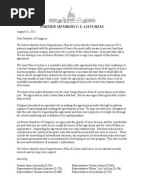
Letter to Congressional Leadership from Former Under Secretaries of State and former American Ambassadors to Israel on the Joint Comprehensive Plan of Action July 27, 2015
Dear Speaker Boehner and Minority Leader Pelosi: As former United States ambassadors to Israel and former Under Secretaries of State, we have worked throughout our careers to strengthen and deepen the bonds between the United States and Israel. Our firm instructions in every administration we served, reflecting American national interests and values, were to help assure Israel’s well-being and safety. It is our commitment to this enduring objective of American policy that motivates us now to write in support of the Joint Comprehensive Plan of Action (JCPOA) reached by the five permanent United Nations Security Council members plus Germany (P5+1). We are persuaded that this agreement will put in place a set of constraints and monitoring measures that will arrest Iran’s nuclear program for at least fifteen years and assure that this agreement will leave Iran no legitimate avenue to produce a nuclear weapon during the next ten to fifteen years. This landmark agreement removes the threat that a nuclear-armed Iran would pose to the region and to Israel specifically. We acknowledge that the JCPOA does not achieve all of the goals its current detractors have set for it. But it does meet all of the key goals required for high confidence that, should Iran violate it and move toward building a nuclear weapon, the international intelligence community and the IAEA will discover Iran’s actions early and in sufficient time for strong countermeasures to be taken to stop Iran’s activities. No agreement between multiple parties can be perfect or without risks. We believe that without this agreement, however, the risks will be much higher for the United States and Israel. We see no fatal flaws that should call for the rejection of this agreement and have not heard any viable alternatives from those who oppose the implementation of the JCPOA
.
Those who advocate rejection of the JCPOA should assess carefully the value and feasibility of any alternative strategy to meet the goal of better protecting the security of the U.S. and Israel and more effectively prevent Iran from acquiring a nuclear weapon. The consequences of rejection are grave: U.S. responsibility for the collapse of the agreement; the inability to hold the P5+1 together for the essential international sanctions regime and such other action that may be required against Iran; and the real possibility that Iran will decide to build a nuclear weapon under significantly reduced or no inspections. The rejection of this agreement could lead to the U.S. having to use military force without the support of other allies and without the understanding of the international community.